Showing posts with label War with Iran. Show all posts

Thursday, July 10, 2008


THE PRICE OF TEA IN CHINA, THE PRICE OF GAS IN IOWA

.
WHAT'S THAT GOT TO DO WITH MCBUSH POLICY ON ISRAEL, IRAN, IRAQ, AFGHANISTAN, PAKISTAN?

DUBYA DETERMINED TO HIT $200/BBL, $6/GAL BEFORE HE GOES

It's A Family Thing: He Promised His Daddy & His Friends

What rational reason could the United States have for attacking Iran, at this point?

Or Iraq, in the first place?

Let's look at the results: Much higher oil prices. Much less security in America, the Middle East, and around the world. A rising police State. A cowering, compliant, corporatist Congress. Much higher military budgets. Much larger deficits. A large permanent American military presence in the oil fields. Strategic positioning between Israel and her enemies. A more and more belligerent Israel. Greater tensions in the Middle East. A general shift toward anti-Islamic and anti-Arab sentiments and policies in the U.S. A loss of respect for and belief in American world leadership. A shift away from the U.S. Dollar in international business and in financial markets. More and more public debt required to support the war effort and the sinking dollar. A still further sinking dollar. Multiple crises in business and finance in the U.S. and abroad. Consumer confidence shattered. Unemployment and inflation rising dramatically. Much higher gasoline prices. The rich are up and the rest are down. Public outcry. Weak-kneed politicians. More oil drilling. More corporate control.

Mission accomplished.

And it only cost a few thousand American lives, and an unknown number of "Other" lives, but they don't patronize our gas stations, so, no great loss.

So, if we have to threaten, provoke or start another war in the oil fields to reach Bushco's price point, it's just business as usual. Nothing personal. And if the Iranians cooperate by rattling their own sabers, or scimitars, they get more money for their oil too. The question is, between the bloodthirsty ayatollahs and the money-hungry oil sheiks, or whatever they call them in Iran, are there any sane people in charge over there? Because it doesn't seem like there are any back in Texas, home of Big Oil and really Bad Presidents.

[Cross-posted on blog me no blogs.]
.

MORE WAR TODAY? HIGHER OIL TOMORROW!

.
BUSHCO, ISRAELI'S, AYATOLLAH'S BUMP-UP PRICE OF OIL ON A BLUFF(?)

LET'S HOPE THEY'RE BLUFFING!

United States Allows Israeli Warplanes Onto U.S. Iraq Airbases "Five Minutes From Iran"

Everybody keeps saying they're all bluffing. Reports say the Iranians are years from producing nuclear weapons. Their recent missile-tests were a failure. Israel is in no danger. The U.S. has guaranteed her security, repeatedly and belligerently. Iran says they don't want trouble, but they will stop all Gulf oil from flowing if they are attacked. Oil prices jumped on this news, after falling earlier.

Americans are suffering at the gas pump, and in the grocery stores as the price of everything skyrockets due to energy costs. The U.S. economy is tanking and taking the world economy with it. U.S. unemployment and inflation are up, exports and the dollar are down. It's all about oil, but there is no actual shortage of supply. Prices are being pumped up by fear and speculation that supplies might be cut off. But that is all coming out of the White House, which is engineering this crisis. Why?

It doesn't make sense for a sitting President to be whacking his own economy in the middle of a tough election campaign. It does make sense for an international oil exec, though. Conclusion: We have an international oil exec as Commander-In-Chief. Bush & Co are Oilco moles who have taken over the U.S. government for the benefit of Big Oil. Bush is a traitor, an agent for foreign economic interests. Does the Iraq War, and the possible Iran War begin to make any sense, now? Still think it's not about oil? No blood for oil? What's that stuff coming out of our troops wounds, then?

HERE'S HOW IT PLAYS OUT:


INTERNATIONAL MIDDLE-EAST MEDIA CENTER
"Massive Israeli military exercise seen as provocation to Iran"

' US officials dismissed the exercise as “sabre-rattling”, and said Israel is not likely to bomb Iran without US permission. "If the Israelis were serious about it, no one would know about it until after it has happened," said the official, adding that the Pentagon knew that Israeli forces "have been conducting some large-scale exercises - they live in a tough neighborhood".
'

AFP
"US plays down fears of war with Iran"
' But Under Secretary of State Williams played down any imminent dangers from Iran's uranium enrichment despite fears among world powers fear the sensitive nuclear program could be used to make a nuclear weapon.
"While Iran seeks to create the perception of advancement of its nuclear program, real progress has been more modest," he told Congressional hearings on the "strategic challenge posed by Iran." '

CNN
"Reports: Iran test-fires more missiles"
' The Shahab-3 has a range of about 2,000 km, putting all of Israel, Turkey, Pakistan and the Arabian peninsula within striking distance. From Iran the missile's reach extends from southern Russia to the Horn of Africa, from south-eastern Europe to Nepal. '

THE GUARDIAN
"US will not hesitate to defend Israel, Rice warns Tehran"
' Oil prices resumed climbing yesterday as Opec said it would not be able to replace any shortfalls if Iran were attacked and took its crude supplies off the market. '

CHINA VIEW
"News Analysis: Tensions mount in Mideast as Iran test-fires missiles"
' Iran's missile tests also lend U.S. an excuse of persuading other countries such as Russia the necessity of expanding its missile defense system in Europe. '

AGI NEWS
"IRAN'S BLUFF: PHOTOS OF MISSILE TESTS RE-TOUCHED"
' The trick was spotted by Mark Fitzpatrick, analyst at London's Institute of Strategic Studies (IISS), according to whom Teheran wanted to "disguise the malfunction of one of the missiles" Bearing in mind that the objective of Teheran's missile test "is to send a signal of strength (to the international community) Iran exaggerated its capacities by fiddling the photo", Fitzpatrick explained. '

THE INDEPENDENT
"Israel hints at pre-emptive attack on Iran"
' Most analysts believe that for all bellicose talk, a pre-emptive attack, by the US at least, is most unlikely. "Everyone recognises what the consequences of a conflict would be," the Defence Secretary Robert Gates warned, among them possible closure of the oil lifeline through the Strait of Hormuz, the risk of generalised war in the Middle East and immense new strains on the fragile global economy. '

THE TIMES OF LONDON
"Iran and Israel build up their bluffing game"
' In short this would be in effect a joint US-Israeli mission. The catch is that Washington has no intention of joining in any attack any time soon. '

ISRAEL TODAY
"Israeli warplanes taking up position in Iraq?"
' If Israel ultimately decides to launch a aerial strike against Iran's main uranium enrichment facility, taking off from Hadita would cut the flight time to the target down to about five minutes. '

BLOOMBERG
"Crude Oil Rises to Record on Speculation Israel May Attack Iran"
' ``We are now in uncharted territory here with the Iranian situation,'' Tom James, head of commodities trading at Liquid Capital Markets Ltd., said in a phone interview ``People are just too scared to sell.'' '

GLOBAL RESEARCH
"Is There an Oil Shortage?"
' Contrary to the claims of the champions of war and militarism, of the Wall Street speculators in energy markets, and of the proponents of Peak Oil, the current oil price shocks are caused largely by the destabilizing wars and political turbulences in the Middle East. These include not only the raging wars in Iraq and Afghanistan, but also the danger of a looming war against Iran that would threaten the flow of oil out of Persian Gulf through the Strait of Hormuz. '
.


[Cross-posted on blog me no blogs.]

.


There's more: "THE PRICE OF TEA IN CHINA, THE PRICE OF GAS IN IOWA" >>

Saturday, April 12, 2008


Politics: The Drumbeat For War in Iran

Persian Gulf regional map

Attention, people! The Bush/Cheney Misadministration is starting the drums beating for a war with Iran. Seymour Hersh warned us about this two years ago. Now that the elections are only six months away, what better present could the crooks and thugs in power deliver to John McInsane's presidential ambitions than to start yet another war?

Here's the evidence: Yesterday (April 11th, 2008), the Times told us that "new satellite photographs" have uncovered a secret launch site in Iran for long-range missiles. Iran has always claimed that this site and the launches therefrom are part of their civilian space program, by the way.

Yesterday (April 11th, 2008), AP informed us that a U.S. Navy ship, the USS Typhoon, trespassing in Iranian waters in the Persian Gulf (in order to access which body of water, vessels must first pass through the Straits of Hormuz, Iranian waters) "encountered"

... a small Iranian high-speed boat in the central Persian Gulf and warned it away by firing a flare, the Pentagon said Friday.

Two other similar Iranian boats in the area did not come as close.

The USS Typhoon tried unsuccessfully to establish radio contact with the Iranian boat after it came within an estimated 200 yards of the Typhoon on Thursday, outside Iranian territorial waters. A Navy official said the ship then fired the flare and continued on its way without incident.

The official, who spoke on condition of anonymity because of the sensitivity of the matter, said there were no signs any boat was armed.
Question: How exactly did the USS Typhoon "try unsuccessfully" to establish radio contact? Do they have Farsi speakers on board? Or was it the old tourist stratagem of "If they don't speak English just shout louder and slower"?

The Iranian authorities are claiming that there was no incident.

Today (April 12th, 2008), in the WahPoo, Staff Writer Karen deYoung tells us that Robert Gates, General Betrayus, and Ambassador Ryan Crockoshit have determined that Iran is the biggest threat to Iraq.

Consider this: Iraq is majority Shi'a. Iran is majority Shi'a. They are two of the very few majority Shi'a nations in the Islamic world.

The Sunni tribes of Iraq form the backbone of the "insurgency," about which not word one has been said of late. Saudi Arabia, home of Gee Dumbya's good friends, is Sunni. The Saudis follow the fundamentalist Wahhabiya flavour of Islam. Most of the hijackers who destroyed the twin towers were Saudi nationals.

Which of these players poses a greater threat to the U.S.?

We're fairly confident that, if asked, the Shi'a majority in Iraq would gladly embrace Iran as good friends and allies. It wasn't that long ago that Iranian President Ahmedi Nejad was greeted with flowers on an official visit to his good friend Nouri al-Maliki.

Don't let Gee Dumbya and his gang of thugs lie us into another war.

Crossposted over at ThePoliticalCat


There's more: "Politics: The Drumbeat For War in Iran" >>

Sunday, January 13, 2008


Bush's Last Defiant Act As President: Fomenting Another War

Crossposted from BFD Blog!

In an article headlined "Bush Urges Arab Allies to Confront Iran" in the New York Times Steven Lee Myers reports:


In an address to government and business leaders here, Mr. Bush focused not only on what the United States suspects are Iran’s nuclear ambitions but also its suspected support for Islamic groups and militants in Afghanistan, Iraq, Lebanon and the Palestinian territories. He called Iran’s government “the world’s leading sponsor of terrorism” and accused it of imposing repression and economic hardship at home.


“Iran’s actions threaten the security of nations everywhere,” Mr. Bush said. “So the United States is strengthening our longstanding security commitments with our friends in the gulf and rallying friends around the world to confront this danger before it is too late.”


"Confront this danger before it is too late" sounds like code for "provide me the cover to invade another sovereign nation to further the agenda of my true masters, the disaster capitalism corporate complex."


Don't let this "train leave the station", folks, contact your representatives in Congress and tell them to exercise some character and stop writing Bushiliburton blank checks. Tell them to stand up to everything that is evil, greedy, rapacious and mercenary about Bushliburton and the disaster capitalism corporate complex and to stop dragging our country in to Fascism.


Illustration: The Worried Shrimp


There's more: "Bush's Last Defiant Act As President: Fomenting Another War" >>

General David Petraeus To Iran: “Have you stopped beating your wife yet?” Notes on a personable administration military mouthpiece

Cross-posted @ My Buffalo River Home, and McClatchy

From McClatchy:


"Army Gen. David Petraeus, the top U.S. general in Iraq, who briefed the president on Iraq along with U.S. Ambassador to Iraq Ryan Crocker, also spoke out against Iranian intervention.

BushPet 225"Iran's senior-most leaders promised Iraq's that they would stop funding, arming, training and directing of militia extremists and other elements in Iraq that were creating security challenges," Petraeus said. "We are waiting, frankly, to see that carried out."


The Iranians said that they would attempt to prevent the aforementioned behavior. They NEVER admitted to arming ANY Iraqi insurgents with ANY weaponry, EFPs, or anything else!

You know the old saying: "Have the Iranians stopped beating their wives yet?"

David Petraeus is quite simply a personable administration military mouthpiece with a limited logical/rhetorical repertoire.

How
DO you disprove something you aren't doing?

Do they have to start arming Iraqi militants (patriots) to stop and say they did, but they aren't anymore?

Anyone with a living brain can see that this is utter B.S.

The U.S. has not produced a single speck of physical evidence to back their claim, and there is NO DOUBT it would be just as fabricated as the "Iranian speedboat tape."

Perhaps using those 1/4 million missing AK47s lost by the Pentagon's favorite air carrier, Victor Bout... Former KGB, now Russian mobster with connections to AQ & the Taliban...

Mr. Petraeus had the temerity to say it was just "..a bookkeeping error"

His time is up. He lies too much, just like his boss, George W. Bush.

Da' Buffalo

Related @ Technorati: , , , , , , , , , , , , , , , , , , , , , , , , , , , , , , , , , , , , , , , , , , , , , , , , , , , , , , , , , , , , , , , , , , , , , , , , , , , , , , , , , , , , , , , , , , , , , , , , , , , , , , , , , , , , , , , , , , , , , , , ,


There's more: "General David Petraeus To Iran: “Have you stopped beating your wife yet?” Notes on a personable administration military mouthpiece" >>

Tuesday, January 8, 2008


Provocation in the Strait of Hormuz

Cross Posted at Edgeing, at Docudharma and SanchoPress


If the Iranians attack a US ship in the gulf, or shut down the strait, it will be, in historical context, retribution and retaliation for US Foreign Policy and imperialism over the past century, and we will be as much or more to blame than they.

We get what we give. As we sow, so we reap.

Imperialism is coming home to bite us on the ass, bigtime. It has been coming for a long time...

In about a year, when there will probably be a Democratic President sitting in The White House, we're going to have the same "Foreign Policy" we've had for the past nearly a century.

Nothing more, nothing less, and nothing changing.

"Ancient History": U.S. Conduct in the Middle East Since World War II and the Folly Of Intervention
If the chief natural resource of the Middle East were bananas, the region would not have attracted the attention of U.S. policymakers as it has for decades. Americans became interested in the oil riches of the region in the 1920s, and two U.S. companies, Standard Oil of California and Texaco, won the first concession to explore for oil in Saudi Arabia in the 1930s. They discovered oil there in 1938, just after Standard Oil of California found it in Bahrain. The same year Gulf Oil (along with its British partner Anglo-Persian Oil) found oil in Kuwait. During and after World War II, the region became a primary object of U.S. foreign policy. It was then that policymakers realized that the Middle East was "a stupendous source of strategic power, and one of the greatest material prizes in world history."

Subsequently, as a result of cooperation between the U.S. government and several American oil companies, the United States replaced Great Britain as the chief Western power in the region.(5) In Iran and Saudi Arabia, American gains were British (and French) losses.(6) Originally, the dominant American oil interests had had limited access to Iraqi oil only (through the Iraq Petroleum Company, under the 1928 Red Line Agreement). In 1946, however, Standard Oil of New Jersey and Mobil Oil Corp., seeing the irresistible opportunities in Saudi Arabia, had the agreement voided.(7) When the awakening countries of the Middle East asserted control over their oil resources, the United States found ways to protect its access to the oil. Nearly everything the United States has done in the Middle East can be understood as contributing to the protection of its long-term access to Middle Eastern oil and, through that control, Washington's claim to world leadership. The U.S. build-up of Israel and Iran as powerful gendarmeries beholden to the United States, and U.S. aid given to "moderate," pro-Western Arab regimes, such as those in Saudi Arabia, Kuwait, and Jordan, were intended to keep the region in friendly hands. That was always the meaning of the term "regional stability."
Provocation in the Strait of Hormuz
By Marc Ash, t r u t h o u t | Perspective, Tuesday 08 January 2008


Two separate news reports relying mostly on information provided by the Pentagon were picked up and disseminated by US mainstream media outlets Monday. The reports point to two separate instances involving US armed forces operating in the Persian Gulf and the Strait of Hormuz.

The first, typified by The New York Times, "US Describes Confrontation With Iranian Boats", and the second, tucked away from the features sections, "Navy Fighter Jets Crash in Persian Gulf", reported by the Associated Press, are not connected directly in the reports, but bear consideration side-by-side nonetheless.

The report in The Times, in fact, tells you everything you need to know, albeit in a conclusionless form. US Warships are in the Persian Gulf. The Strait of Hormuz, through which all warships must pass to enter the Gulf, is the same passage through which all oil-bearing ships must pass bringing oil to the US. And "Oil prices on world markets spiked briefly on the news, which was first reported by CNN." That pretty much says it all.

US Navy warships are parked a few miles off the coast of Iran. They are there, apparently, to protect oil shipping lanes into and out of the Persian Gulf. Tensions are mounting. If provocation is at issue, those facts must remain front and center. If Iranian warships ever made it as close to the American coastline as US warships now lie to Iranian shores, our military would in all likelihood attack them. Iran is not attacking our warships - parked on their doorstep.

The US State Department last year warned Iran, "not to interfere with US interests in the region." What the State Department did not explain to the American people is what interests average Americans have in the region. The answer to that question is, likely none. That leads to the next question: whose interests is the American Navy protecting in the Persian Gulf? The owners of the oil tankers, apparently. The American people are the end consumers; we pay what's marked on the pump. Bluntly stated, the United States Navy appears to be in the Persian Gulf to protect the interests of US-based oil businesses, not the interests of the American people. Incidentally, the second-largest deposits of oil in the world lie beneath the soil of Iraq, so the same formula applies there as well.

Could Iranian forces sink an American ship a few miles off the Iranian coast? Yes, although it is highly unlikely that they would say beforehand, "I am coming at you, and you will explode in a few minutes." Would such a sinking take the lives of many good American sailors? Yes, it would. Such a sinking and the attendant loss of life would affect the best interests of the American people. The American armed forces are the true interest of the American people. For too long, the American people have turned a blind eye to their interest: their service members. It's time to bring our soldiers home and let the gas station mind its own business.
*emphasis added

This cannot be taken out of historical context. To do so is the "neocon" way.

If anyone is doing any "provocatin'" in the Persian Gulf and the Strait of Hormuz, it has been successive US and British administrations, and oil companies, for nearly a century...


There's more: "Provocation in the Strait of Hormuz" >>

Thursday, December 6, 2007


Bush-Cheney may still start World War III

Just when you thought Bush and Cheney might have to rethink starting World War III, Matt Rotshschild has to spoil your mood. Rothschild, editor of The Progressive, writes:

Hold on a second here.

The risk of Bush attacking Iran is not yet over.

When the National Intelligence Estimate on Iran came out earlier this week, a lot of people jumped to the conclusion that Cheney and the hardliners have lost, and so we can all breathe a sigh of relief.

Well, I’m not exhaling at the moment.

Because I still believe Bush and Cheney are going to do the deed.


And he may well be on to something.

If there's one thing our own, DC-based Axis of Evil learned in the runup to the Iraq war, it's that if one argument doesn't work you should just keep making others, until you wear down the resistance and something finally sticks.

And if it turns out later that you were wrong or lying about it, so what?

Will bombing be enough? Sending ground troops might be problematic, since most of those available are bogged down in another quagmire at the moment. And World War III will be a bit of an overstatement when it turns out Iran has no nukes and little ability to fight back. So maybe, despite Bush's hype, it's just another dirty little war.

Rothschild posits that Bush will simply switch gears and find another reason to attack:

“Iran was dangerous, Iran is dangerous, and Iran will be dangerous if they have the knowledge necessary to make a nuclear weapon,” [Bush said.]

Note well that he didn’t say Iran will be dangerous when it acquires such a weapon, but prior to that, when it acquires the knowledge to make one. That’s a big difference, and it shortens the timetable laid out in the NIE, which doubted Iran would have such a weapon until 2015.

Who knows when Iran will have the “knowledge to make” one? Maybe it has that knowledge already and lacks only the technical sophistication...

He reiterated that “Iran needs to be taken seriously as a threat to peace,” adding: “My opinion hasn’t changed.” And he remained as macho as ever in boasting that he wouldn’t allow Iran to acquire such a weapon while he’s around.


There's more. And it doesn't read like paranoia.


There's more: "Bush-Cheney may still start World War III" >>

Thursday, November 22, 2007


MeK Cons Media At Third Attempt

Crossposted from The Newshoggers

Hardline U.S. rightwing blogs are beginning this evening to pick up a story about a petition in Iraq, organised by a hitherto unknown group called either the Independent National Democratic Tribes' Gathering or the Independent National Tribal Organization depending on which report you read, which condemns Iran for fomenting violence in Iraq.

The Washington Post writes:

"The Iranians, in fact, have taken over all of south Iraq," said a senior tribal leader from the south who spoke on condition of anonymity because he feared for his life. "Their influence is everywhere."

The unusually organized Iraqi rebuke illustrates the divisions that Iran has provoked among Iraq's majority Shiites. The prime minister and major political blocs are closely tied to Iran, but the petition organizers said many citizens are fiercely opposed to Iranian meddling in Iraqi affairs.

Several sheiks leading the campaign traveled to the capital from the southern province of Diwaniyah and showed The Washington Post and other news organizations an electronic file filled with images of signatures they said endorsed the petition. Their effort is being supported by the People's Mujaheddin Organization of Iran, or Mujaheddin-e Khalq, an Iranian opposition group that is listed by the U.S. government as a terrorist organization but that nonetheless enjoys U.S. military protection in Iraq.


The petition, which the organizers said was signed by 600 sheiks, calls on the United Nations to send a delegation to investigate what it termed crimes committed by Iran and its proxies in southern Iraq.

"The most painful stab in the back of the Shiites in Iraq by the Iranian regime has been its shameful abuse of Shiite religion to achieve its ominous end," the sheiks said a statement. "The only solution and hopeful prospect for Iraq, and in particular the southern provinces, is the eviction of the Iranian regime from our homeland."
Hang on, I'm sure you're thinking, why is the Sheik so unwilling to be named if, presumably, his signature is already on this very public petition? And are so many Iraqis really willing to agree with the MeK, an organisation hated throughout Iraq for being Saddam's bully-boy henchmen?

Wait, there's more.

Reuters adds some more details. They saw "two thick bundles of notes which contained original signatures", not an electronic file, which was shown to them by the sheiks. At least, they say they are sheiks and that there are 600 of them.
The statement said that besides 600 Shi'ite tribal leaders, the petition was signed by a number of lawyers, engineers, doctors and university professors.

The group of sheikhs is the same one that told Reuters last month that Shi'ite Islamist political parties were imposing strict Islamic rules in southern Iraq and using their armed wings to create a state of fear.
And CNN adds even more:
The petition has the support of 14 members of the clergy and 600 sheiks. It also was signed by 25,000 women, the release stated.

"The most painful stab on the back of the Shiites in Iraq by the Iranian regime has been its shameful abuse of Shiite religion to achieve its ominous ends," the petition states.

The petition also is backed by the People's Mujahedeen Organization of Iran -- or Mujahedeen-e Khalq (MEK) -- which seeks to overthrow the Islamic regime in Iran.

MEK has been labeled a terrorist group by the United States, Iraq and Iran -- all for different reasons -- but it continues to operate in southern Iraq under the protection of the U.S. military despite Iraqi pressure to leave the country.

The United States considers the group a source of valuable intelligence on Iran.
And yet, of over 50 MeK claims about Iran's nuclear program over the past three years since the group first exposed that program, not one has proven true upon investigation by the IAEA. Maybe not so valuable intelligence after all. As to the "different reasons" for the groups description as being terrorists - the Iraqis labelled them for complicity in Saddam's crimes and are trying to have their protected status revoked, the Iranians accuse them of attacks inside Iran which have killed both soldiers and civilians, while the U.S. State Dept calls them terrorists because they killed US citizens and supported the taking of hostages at the US embassy in Teheran in 1979. All pretty good reasons, you might think, despite such a throwaway dismissal by CNN.

Finally, the Chinese newspaper People's Daily has even more, including more numbers:
"It is widely known that the Iranians have taken over all Iraq's southern provinces," said the Independent National Democratic Tribes' Gathering in a statement obtained by Xinhua on Thursday.

The statement said that more than 300,000 Iraqi Shiite Muslims in the Iraqi southern provinces have signed a petition accusing the neighboring Iran of fomenting violence and chaos in southern the war-torn country.

Among the signatories of the petition of the Shiites in southern Iraq are 14 clergies, 600 Sheikhs, 1250 jurists, 2,200 doctors, engineers, university professors and 25,000 women, the statement added.
That's a lot, isn't it?

But...

It isn't as many as when this story was last hawked around, back in June. Then, according to the MeK's own website, it was 450,000 members of the Iraqi tribes of Diyala who were condemning Iran's presence as part and parcel of expressing "full solidarity with the Mujahideen Khalq (MEK)"

But...

Even that is nothing compared to the attempt before that to hawk the self-same story. Back in June 2006, the MeK's political wing - the National Council of Resistance of Iran, which FOX News expert on Iran Alireza Jafarzadeh used to be spokesman for - announced that:
Solidarity Congress of Iraqi People announced the support of 5.2 million Iraqi's to a declaration condemning Iranian regime's meddling in their country. The declaration also lends support to People's Mojahedin Organization of Iran [The MeK's other alias - C] whose presence in Iraq has acted as a major obstacle to mullahs' fundamentalist ambitions in Iraq. The announcement was made before a huge crowd of Iraqis in Ashraf City on June 17.
Ashraf City, by the by, is the MeK's own name for "Camp Ashraf" - the rather salubrious location, situated conveniently close to iraq's biggest munitions dump - where thousands of MeK members are "guarded" by a handful of US and Bulgarian troops.

Back then, the breakdown of the notable signatories to the petition was even more admirable:
121 political parties and social groups, 700,000 women, 14,000 lawyers and jurists, 19,000 physicians, 35,000 engineers, 320 clerics, 540 professors, 2,000 tribal sheikhs and 300 local officials among 5.2 million signitaries of the declaration.
Maybe it was the claim that fully a third of Iraq's population had signed something supporting such an odious terror group that lead to general disbelief and the story sinking without a trace.

So either the folk supporting the MeK against an alleged infiltration of the Iraqi government from top to bottom are changing their minds - by the millions - or the latest version is just the MeK scaling down their entirely fictitious nonsense to a more believable level.

Were it not for the fact that anti-Iranian rhetoric is currently fashionable, and is being stirred at every opportunity by U.S. neoconservatives both in and out of the White House, this latest story would have sunk without a trace too.


There's more: "MeK Cons Media At Third Attempt" >>

Thursday, November 1, 2007


Apparently NOT "Made In Iran" - Whose EFPs (IEDs)? Iraqi EFPs - Rightweb

To paraphrase the old Mickey Mouse Club refrain:

"Because they LIKE US!"

The next time someone announces (F’rinstance the State Department, George Bush, ‘Big Dick’ Cheney, Robert Gates, or a co-worker) that Iran is complicit in the killing of U.S. soldiers in Iraq… Show them this:

(Click the pic for the original illustration and article @ Weed Garden)

EFP

The copy on top reads:

These hunks of copper found in a workshop in Iraq are the "high-tech" components of deadly "explosively formed penetrators" (EFPs) that administration flacks say come from Iran.

Because, clearly, Iraqis are too stupid to make these copper disks on their own.

Never mind that these explosives have been used by many groups, including the Irish Republican Army. Never mind that the U.S. has their own brand of EFP.

Here's what the official Iranian version of this weapon actually looks like:


RightWeb On EFPs:

"The earliest EFPs appearing in Iraq in 2004 were so professionally made that they were probably constructed by Hezbollah specialists, according to a detailed account by British expert Michael Knights in Jane's Intelligence Review last year.

By late 2005, however, the British command had already found clear evidence that the Iraqi Shiites were manufacturing their own EFPs. British Army Maj. Gen. J. B. Dutton told reporters in November 2005 that the bombs were of varying degrees of sophistication.

Some of the EFPs required a "reasonably sophisticated factory," he said, while others required only a simple workshop, which he observed, could only mean that some of them were being made inside Iraq.

After British convoys in Maysan province were attacked by a series of EFP bombings in late May 2006, Knights recounts, British forces discovered a factory making them in Majar al-Kabir north of Basra in June.

In addition, the U.S. military also had its own forensic evidence by fall 2006 that EFPs used against its vehicles had been manufactured in Iraq, according to Knights. He cites photographic evidence of EFP strikes on U.S. armored vehicles that "typically shows a mixture of clean penetrations from fully-formed EFP and spattering." That pattern reflected the fact that the locally made EFPs were imperfect.

Then U.S. troops began finding EFP factories. Journalist Andrew Cockburn reported in the Los Angeles Times in mid-February that U.S. troops had raided a Baghdad machine shop in November 2006 and discovered "a pile of copper discs, 5 inches in diameter, stamped out as part of what was clearly an ongoing order."

In a report on February 23, NBC Baghdad correspondent Jane Arraf quoted "senior military officials" as saying that U.S. forces "have been finding an increasing number of the advanced roadside bombs being not just assembled but manufactured in machine shops here."

In full @ RightWeb


Leighm, 'The Buffalo in da' midst"


There's more: "Apparently NOT "Made In Iran" - Whose EFPs (IEDs)? Iraqi EFPs - Rightweb" >>

Wednesday, October 31, 2007


WWIII; who will stop it?

(Originally posted at The Motley Patriot)

Larry Johnson at NoQuarter has an article up titled, `Diego Garcia Secretly Readied for Bunker Busters`. This should scare the living daylights out of everyone no matter where they live in the world.

Diego Garcia is a small island in the Indian ocean. It is owned by the British and was leased to the United States. It currently houses a joint United States/United Kingdom air and naval refueling station and support facilities. Currently, the base is used to house and refuel stealth bombers that were used during the invasion of Afghanistan and Iraq.

The Bush administration has asked for $88 million dollars, tucked into a war funding supplemental, to upgrade stealth bombers so they are capable carrying the bunker buster bombs. The request was based on an "urgent operational need". The bunker buster bomb was originally conceived as a conventional weapon, however, there is another "bunker buster" bomb; one that carries a nuclear warhead.

The Bush administration has repeatedly denied that it is readying to attack Iran. It claims that they are trying every diplomatic option to work out our differences with Iran. This is laughable. The "diplomacy" that President Bush used with Saddam Hussein was to force Iraq to prove a negative; disarm the WMD's you don't have or face invasion. The diplomacy that President Bush is using with Iran? Dismantle the nuclear weapon program you don't have or we attack you.

I say "don't have" in reference to Iran for two reasons; 1) as a signatory to the Non-Proliferation Treaty, Iran has every right to develop peaceable nuclear energy, and 2) even with the Additional Protocol forced upon Iran, the IAEA has no evidence of a weapons program. Still, the Bush administration clings to the rhetoric that Iran is trying to develop a nuclear weapon and we have to stop them at all cost. This leads us to the latest statement made by President Bush; "if you are interested in averting WWIII, you don't want to see a nuclear armed Iran".

So, understand this entire process that President Bush is using:

- We force an Additional Protocol on Iran for IAEA inspections that produces no evidence of a weapon, but, the rhetoric increases.
- Our "diplomacy" with Iran consists of sharpening the rhetoric that Iran is trying to build a nuclear weapon and if they don't stop we will attack them.
- Since Iran doesn't stop what we have no evidence they are doing, we instill sanctions on their country.
- We are now readying the stealth bombers to carry the bunker busters, which will include carrying the nuclear bunker busters.

Why is this path leading to WWIII? Russia and China.

Russia and China have already held two joint military exercises since our invasion of Iraq. The "missile defense" system President Bush is trying to put on Russia's doorstep isn't to stop Iran, it is to stop Russia from being able to back Iran if we do attack. Russia knows this and is taking steps to block it. China holds most of our debt for the Iraq war and can easily plunge our country into economic ruin if it dumps that debt onto the world market all at once.

The war in Iraq, and by default, the entire Middle East, is about oil and getting U.S. military bases into the Middle East to protect/control that oil. That has been American foreign policy since the 1950's. That is why in 1953 the CIA pulled the coup in Iran to instill the pro-western Shah. That is why we supported Saddam Hussein as he was gassing the Kurds in the 1980's. That is why we are supporting General Mousharraf in Pakistan; another dictator. That is why President Bush is clamoring for regime change in Iran and Syria today. It is all about getting friendly puppet governments into power so we can build military bases and shut out Russia and China from having access to the oil.

President Bush's entire gambit at this time is to bet that even if he attacks Iran, even if he drops a nuclear bunker buster or two, countries like Russia and China will not put the entire world at risk by retaliating with a nuclear strike against the United States. But, this premise also hinges on the fact that Russia and China will be willing to sit back and watch the United States take over the Middle East one country at a time, even by nuclear means, until they are shut out totally. This is a mistake of catastrophic proportions; Russia has formally backed Iran.

President Bush is taking a page out of history. In 1940 and 1941, President Truman put so many sanctions on Japan that eventually Japan attacked Pearl Harbor thereby drawing the United States into WWII. Then, President Truman, to stop the war, used nuclear weapons to bomb Japan into submission. Today, President Bush is using sanctions to try and goad Iran into attacking the United States to give him the justification to start a war with Iran. Unfortunately, as we saw with Iraq, even without provocation President Bush will merely lie his way into the war. This time, America may start with nuclear ordnance instead of end with it.

The stealth bombers are already being fitted to use them. The rhetoric is getting worse, not better. The lies are told repeatedly that Iran has a nuclear weapon program despite the fact no evidence has yet been discovered. The sanctions are already being put into effect and military forces gathered.

Who will stop WWIII?


There's more: "WWIII; who will stop it?" >>

Thursday, October 25, 2007


The Real Iran, Six Lies About Iran, And Some Consequences Of An Attack On Iran

This is the country that George W. Bush and Dick Cheney want to expand their Iraq Debacle into by attacking.

This is the country that Nancy Pelosi and the Democratic Leadership, through their complicity and their refusal to do what they were elected in November 2006 to do - stop funding and end the Iraq Occupation - are helping George W. Bush and Dick Cheney to expand their Iraq Debacle into by attacking.

Fortunately, there are clearer heads in the world than Bush's, Cheney's, or Pelosi's, and if the Democrats will not put a stop to Bush's insanity, it appears that our old "enemies" the Russians, will.

The barely reported highlight of Russian President Vladimir Putin's visit to Tehran for the Caspian Sea summit last week was a key face-to-face meeting with Supreme Leader Ayatollah Ali Khamenei.

A high-level diplomatic source in Tehran tells Asia Times Online that essentially Putin and the Supreme Leader have agreed on a plan to nullify the George W Bush administration's relentless drive towards launching a preemptive attack, perhaps a tactical nuclear strike, against Iran. An American attack on Iran will be viewed by Moscow as an attack on Russia.
...
Iranian hawks close to Ahmadinejad are spinning that Putin's proposal involves Iran temporarily suspending uranium enrichment in exchange for no more United Nations sanctions. That's essentially what International Atomic Energy Agency chief Mohammad ElBaradei has been working on all along. The key issue is what - in practical terms - will Iran get in return. Obviously it's not the EU's Solana who will have the answer. But as far as Russia is concerned, strategically nothing will appease it except a political/diplomatic solution for the Iranian nuclear dossier.

US Vice President Dick Cheney - who even Senator Hillary Clinton now refers to as Darth Vader - must be foaming at the mouth; but the fact is that after the Caspian summit, Iran and Russia are officially entangled in a strategic partnership. World War III, for them, is definitely not on the cards.


A photo essay of Iran.


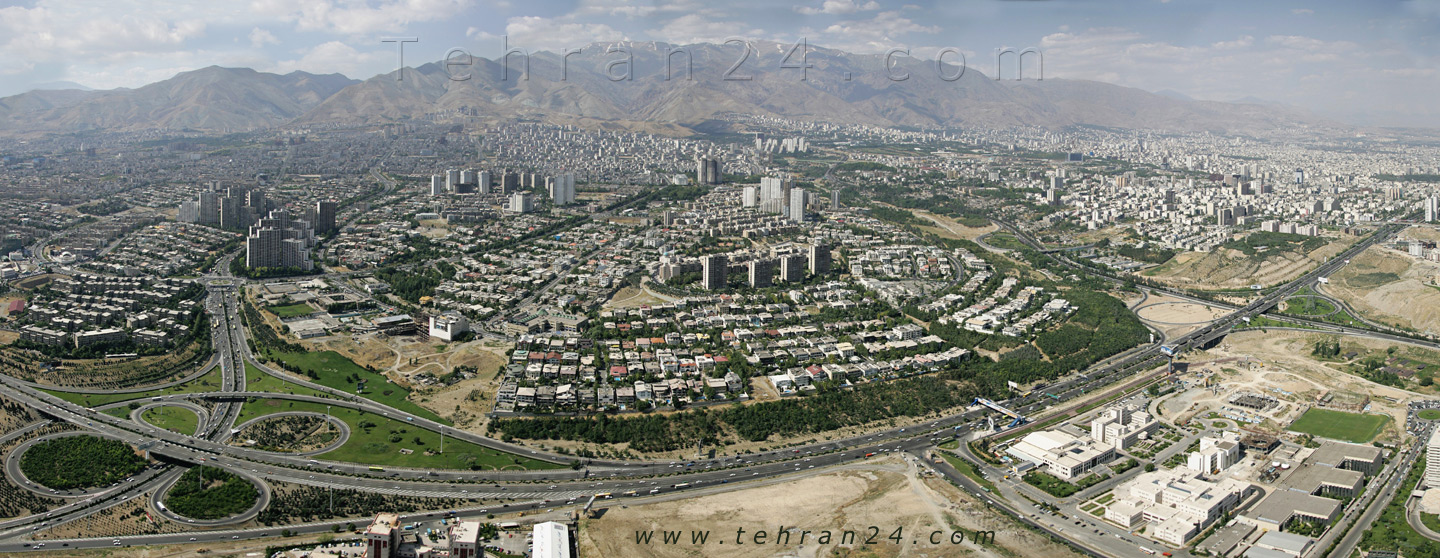
Iran's Capital, Tehran.


Six Lies You Shouldn't Believe About Iran, Especially Since, Hey, There's People Down Here.
by Rosa Schmidt Azadi
February 3, 2007, OpEdNews.com

It feels so different watching an aircraft carrier group coming toward you than watching it sailing away from you toward another part of the world.

I'm an American who used to live in New York City. All my life, when I heard about warships, it was US warships going places far away. I never even imagined hostile warships sailing toward New York. Now I'm in Tehran, and aircraft carrier USS John C. Stennis is heading our way. And as it sails, people are discussing Israel and/or the US bombing Iran as if my family and 69 million other people weren't even here. I'm getting scared.

Most Iranians that I know don't worry about this as much as I do, though they're wondering how the sanctions will affect the economy. Khomeini had a famous saying that we actually saw on a sign yesterday in another town: "America can't do anything to us." Some friends here speculate that Bush just needs an enemy so that he can continue his programs in the US, and that Iran is the enemy du jour. I wish I could believe that.

The way I see it, somebody has to stop the US president right now, and it's very upsetting that the Congress isn't doing it. My frustration is greater because I'm in a country where the Internet is not completely available. For example, I tried to send a donation to Dennis Kucinich, but PayPal wouldn't take it because of the embargo. I tried to write to my Congressperson, but the Islamic Republic blocked the communication, presumably because it was with the US government. (Sometimes news stories that I want to read are blocked, too, but there are ways around that.)

If the US and/or Israel attack Iran, it will be a war based on lies, just like the Iraq war. Iraq didn't have WMD, but Iraqis died in the hundreds of thousands. The lies about Iran seem intended to, first, make Iran look like the new Nazi state that must be bombed so as to avoid a new Holocaust, and second, make Americans fear that Iran will hurt our soldiers in Iraq or give nuclear weapons to terrorists who will hurt us in "the homeland."

History shows that Americans are very susceptible to demonization of particular leaders of countries that the US wants to attack. Remember Castro? Noriega? Saddam? Now it's Ahmadinejad. Whatever people think of views attributed to Ahmadinejad, it remains the case that it's not morally acceptable to kill people because of their president, whether that president be Saddam Hussein, Mahmoud Ahmadinejad, or George Bush.

I want to discuss six big lies we are hearing to justify expanding the war to Iran.

LIE NUMBER 1: President Ahmadinejad "has repeatedly threatened to wipe Israel off the map."

Even Al Jazeera English version based in Qatar keeps saying that. Why hasn't this mistranslation been corrected after it's been thoroughly exposed? (in the Guardian and prisonplanet.com)

Juan Cole, in Informed Comment, explained how "wiped off the map" was a mistranslation; Ahmadinejad was restating the official Iranian policy that the government system based on Zionism must end. And why the heck can't newscasters learn to pronounce the man's name? Anyone who knows Farsi could teach them in a minute. Why should we think they know what he said, in Farsi, if they can't even say his name?

LIE NUMBER 2: The Iranian government is run by 1930s-style anti-Semites.

Last Spring, a story was planted that the Iranian parliament had passed a law forcing Iranian Jews to wear yellow badges. "Fourth Reich," screamed a banner headline on one of the New York City tabloids. In a few days, the neocon source was disclosed and the story was completely retracted by the Canadian paper in which it was first published. The New York paper never apologized. When I mention the "yellow badges" to people here in Iran, they look incredulous. "But ... that didn't happen." I know. But I'll bet there are some Americans, and Israelis, who actually believe Jewish Iranians are walking around wearing yellow badges.

LIE NUMBER 3: Iran is bent on wiping out the Jews.

Maybe Americans should have a little humility and remember how recalcitrant the US was about accepting Jewish refugees fleeing Hitler during WWII. Iran has a very good history, under Cyrus the Great, of protecting the Jews. The long history of Jews in Persia is indicated by a monument to the Jewish prophet Daniel in the south of Iran. As for the European Holocaust deniers who were among the speakers at the Holocaust conference in Tehran, I just can't figure it out, unless Ahmadinejad is trying to win popularity points with pro-Palestinian regional populations by appearing to be unafraid of Israel and the US. Or he could be a fool and/or a religious fundamentalist (like some other presidents who shall go unnamed).

LIE NUMBER 4: Iran is causing trouble in Iraq and threatening Arab states.

Everyone should be very clear: Who's meddling in Iraq, who's flying thousands of missions shooting at Iraqi citizens, who attacked whose diplomatic mission, who is detaining whose citizens, and who has announced that it is supporting subversive operations inside whose country and across whose border (from Iraqi Kurdistan)? Most likely some of the undemocratic and unpopular rulers in the Middle East are afraid that their own citizens may be attracted to the Iranian model. That may concern the US oil men and financiers who have business and military ties with them, but it's not a reason for Americans to back destruction of Iran.

LIE NUMBER 5: Iran is dangerous to humanity because it's trying to get nuclear weapons.

Other people who know more than I are writing about the nuclear issues. But regarding threats by Israel and the US to bomb Iranian nuclear research sites, that's a violation of international law, not to mention a danger to innocent civilians. Regulating nuclear activities is the responsibility of the IAEA. So far, the IAEA has declared that Iran does not have nuclear weapons and is in compliance with the nuclear non-proliferation treaty. That's more than we can say about the USA, which is supposed to be actively disarming its 10,000 warheads, not refurbishing them and developing new kinds of nuclear weapons. Though there are good reasons to think Iran does not want nuclear weapons, let's imagine, just for the sake of argument, that Iran would someday acquire them. Humanity has managed to live with other countries having nukes. The only reason Iran's having nukes would be of greater concern would be if the lies spelled out above were true. But they're lies.

LIE NUMBER 6: Iranians are looking to the USA to bring them democracy, just like the USA has brought democracy to Afghanistan and Iraq.

I'm living here in Tehran, Iran, now, with my family, as are many other Americans, Europeans, Asians, and other foreigners. We are inviting friends and relatives to come and visit. The skiing's fine. More democracy and more civil liberties would be better, but there are elections and there are laws and there are non-governmental organizations and you can approach public officials. Whatever's not right with this country is the business of the people here to work on. Some Iranians living in other countries want the US to "save" Iran. I don't know, but I suspect people like that would like the US to magically bring back the good old days when the US-allied Shah sat on his throne and the well-off classes had a fine life. If anyone finds any overseas Iranians who actually are willing to see Iran bombed, I hope the reporters ask them if they have any relatives currently living in Iran. I hope Americans don't take these has-beens too seriously.

----------
Rosa Schmidt Azadi is a long-time peace activist, an anthropologist, and a retired civil servant who's also a wife, daughter, sister, aunt, great-aunt, godmother, and the mother of two college students. After walking out of the smoke of the 9-11 attacks in New York City and returning to participate in the recovery effort, Rosa began working to prevent further death and destruction in other countries at the hands of the U.S. government. Participating in a peace vigil at the World Trade Center site for more than three years gave her the privilege of talking with thousands of people from all over the world about things that matter most. Dr. Azadi has earned two advanced degrees and is still learning. Currently, she's splitting her time between Tehran, Iran, and upstate New York.


James Martin Center for Nonproliferation Studies
Monterey Institute of International Studies, Monterey, CA
Consequences of an Attack on Iran's Nuclear Facilities
Contrary to popular belief, it appears that Israel's attack on Osirak [Iraq's nuclear reactor] in June of 1981 did nothing to hinder Iraq's nuclear aspirations. Although it temporarily set back its capabilities, it served rather to reinforce and increase Saddam's desire for a nuclear arsenal.
...
With regard to Iran, there is no reason to believe that an attack on the facilities in Bushehr, Arak, or Natanz would have any different consequence than the Osirak example. Such an attack would likely embolden and enhance Iran's nuclear prospects in the long term. In the absence of an Iranian nuclear weapon program, which IAEA inspectors have yet to find, a preemptive attack by the United States or Israel would provide Iran with the impetus and justification to pursue a full blown covert nuclear deterrent program, without the inconvenience of IAEA inspections. Such an attack would likely be seen as an act of aggression not only by Iran but most of the international community, and only serve to weaken any diplomatic coalition currently available against Iran.

The most troubling aspect of such a scenario is that, unlike Iraq in 1981, Iran is not dependent on foreign imports for nuclear technology and already has available the raw materials, and most of the designs and techniques, required to pursue a nuclear weapons program. Iran has the necessary know-how and has already produced every stage of the nuclear fuel cycle.[31] Furthermore, Iran has uranium mines in Yazd and is in the process of constructing milling plants to manufacture yellow cake uranium and conversion plants that convert it to UF6 gas.[32] Iran has also begun manufacturing its own gas centrifuges used to enrich uranium. Even if Natanz, Arak, and Bushehr were destroyed in a preemptive strike, Iran probably has duplicate equipment that can be activated and has the know-how to produce more, to pursue a more vigorous and unabated nuclear weapons program in the long term.

Effect on Iran's Relationship Vis-a-Vis the IAEA and International Coalition

In the event of an unprovoked preemptive attack on its nuclear facilities, Iran could justifiably argue that it requires nuclear weapons to guard against aggression and protect its sovereignty, effectively announcing its intention to withdraw from the NPT and altering the current international dynamic. Especially given the recent lack of substantiation in the Iraqi WMD case, such a strike would undoubtedly result in U.S. or Israeli diplomatic isolation.

The practical diplomatic consequences of a preemptive attack in Iran are worth considering. In the aftermath of such a strike, it is highly unlikely that the United States would be able to convince members of the UN Security Council to impose sanctions on Iran. Without international sanctions, Iran will be able to allocate greater financial and human resources to its nuclear program. If the Iraqi Osirak example is any indication, the size of Iran's nuclear program would probably increase dramatically, as the Iranian government touts an expanded nuclear program as the key to deterring Iran's enemies.

As the target of an unprovoked attack, Iran gains by pointing to justifications for escaping the constraints of the NPT, therefore becoming a much greater proliferation threat. Unrestrained, the Iranians will have the means and technology to eventually manufacture gas centrifuges and mine, mill, convert, and enrich uranium. Even under IAEA intrusive inspections, Iran has assembled more than 920 gas centrifuges, 120 of which were assembled in just two and a half months, between November 2003 and mid-January 2004.[33] To enrich enough HEU to make one nuclear bomb requires running 750 gas centrifuges for one year.[34] If Iran seceded from the NPT, and increased the size of its nuclear program, it would be able to manufacture and assemble many more gas centrifuges, and therefore rapidly enrich uranium. Once sufficient fissile material is obtained, designing a basic nuclear warhead can be easily accomplished. In the absence of intrusive inspections or threat of UN Security Council (UNSC) sanctions, the only way to prevent Iran from obtaining a nuclear weapons capability would be to occupy Iran, a very unlikely occurrence given the serious challenges already faced by the United States in a smaller, weaker Iraq.

Effect on U.S.-Russian Relations

Attacking Iranian nuclear facilities also has the potential of igniting a diplomatic crisis between the United States and Russia. The Russian Federation is not only Iran's foremost supplier of nuclear technology and training, it is reported that hundreds of Russian scientists and technicians currently work in Bushehr. A preemptive attack on Bushehr may kill a large number of Iranian and Russian personnel; the ensuing diplomatic crisis could seriously affect not only Russian-U.S. trade but also cooperation on international matters, including the war on terrorism.
A pre-emptive attack on George Bush's and Dick Cheney's psychotic fantasies would result in much better consequences.


There's more: "The Real Iran, Six Lies About Iran, And Some Consequences Of An Attack On Iran" >>

Saturday, August 25, 2007


Iraq Isn't Working Out So Well


And of course the fact that in invading Iraq Bush fulfilled Osama bin Laden's wishes might have something to do with that, so... it only makes sense to avoid facing reality and repeat the same kind of sheer idiocy on a much bigger scale and attack Iran as soon as possible:

In an effort to build congressional and Pentagon support for military options against Iran, the Bush administration has shifted from its earlier strategy of building a case based on an alleged Iranian nuclear weapons program to one invoking improvised explosive devices (IEDs) purportedly manufactured in Iran that are killing US soldiers in Iraq.

According to officials - including two former Central Intelligence Agency case officers with experience in the Middle East - the administration believes that by focusing on the alleged ties between IEDs and Iran, they can link the Iranian government directly to attacks on US forces in Iraq.
One former CIA case officer
who served in the Middle East even suggested that politically framing the Iranians for its own failures in Iraq would allow the Bush administration to avoid accountability, as well as providing a casus belli for an attack.

The Bush Administration "can say it's [the Iranians'] fault we are losing the war in Iraq and that would be a convenient out for their failed policy," the officer said Monday.

The Iranians "have declared war against the US by sabotaging the war on terror is how they might sell it. I would not be surprised to next hear of Al Qaeda-Iranian connections because these people don't know the difference between a Sunni and a Shi'a."
There were times,
huddled on the floor in solitary confinement with that head-banging music blaring dawn to dusk and interrogators yelling the same questions over and over, that [Donald] Vance began to wish he had just kept his mouth shut.
...
He had thought he was doing a good and noble thing when he started telling the FBI about the guns and the land mines and the rocket-launchers -- all of them being sold for cash, no receipts necessary, he said. He told a federal agent the buyers were Iraqi insurgents, American soldiers, State Department workers, and Iraqi embassy and ministry employees.
...
For his trouble, he says, he got 97 days in Camp Cropper, an American military prison outside Baghdad that once held Saddam Hussein, and he was classified a security detainee.
Of course, if word got out too far that Iraqis trying to take back their country were buying American made land mines and rocket-launchers, the Bush regime might have a more difficult time propagandizing about IEDs purportedly manufactured in Iran being used against American troops in Iraq.


There's more: "Iraq Isn't Working Out So Well" >>

Thursday, July 5, 2007


U.S. KILLING 10,000 IRAQIS EVERY MONTH? OR IS IT MORE?


(Also see: George W. Bush's Iraq and Mid-East Debacle)

IS THE UNITED STATES KILLING 10,000 IRAQIS EVERY MONTH? OR IS IT MORE?
By Michael Schwartz, via AfterDowningStreet

A state-of-the-art research study published in October 12, 2006 issue of The Lancet (the most prestigious British medical journal) concluded that—as of a year ago—600,000 Iraqis had died violently due to the war in Iraq. That is, the Iraqi death rate for the first 39 months of the war was just about 15,000 per month.

That wasn’t the worst of it, because the death rate was increasing precipitously, and during the first half of 2006 the monthly rate was approximately 30,000 per month, a rate that no doubt has increased further during the ferocious fighting associated with the current American surge.

The U.S. and British governments quickly dismissed these results as “methodologically flawed,” even though the researchers used standard procedures for measuring mortality in war and disaster zones. (They visited a random set of homes and asked the residents if anyone in their household had died in the last few years, recording the details, and inspecting death certificates in the vast majority of cases.) The two belligerent governments offered no concrete reasons for rejecting the study’s findings, and they ignored the fact that they had sponsored identical studies (conducted by some of the same researchers) in other disaster areas, including Darfur and Kosovo. The reasons for this rejection were, however, clear enough: the results were simply too devastating for the culpable governments to acknowledge. (Secretly the British government later admitted that it was “a tried and tested way to measuring mortality in conflict zones”; but it has never publicly admitted its validity).

Reputable researchers have accepted the Lancet study’s results as valid with virtually no dissent. Juan Cole, the most visible American Middle East scholar, summarized it in a particularly vivid comment: “the US misadventure in Iraq is responsible [in a little over three years] for setting off the killing of twice as many civilians as Saddam managed to polish off in 25 years.”

Despite the scholarly consensus, the governments’ denials have been quite effective from a public education point of view, and the few news items that mention the Lancet stody bracket it with official rebuttals. One BBC report, for example, mentioned the figure in an article headlined “Huge Rise in Iraqi Death Tolls,” and quoted at length from President Bush’s public rebuttal, in which he said that the methodology was "pretty well discredited,” adding that “six-hundred thousand or whatever they guessed at is just... it's not credible.” As a consequence of this sort of coverage, most Americans probably believe that Bush’s December 2005 figure of 30,000 Iraqi civilian deaths (less than 10% of the actual total) is the best estimate of Iraqi deaths up to that time.

COUNTING HOW MANY IRAQIS THE OCCUPATION HAS KILLED
These shocking statistics are made all the more horrific when we realize that among the 600,000 or so victims of Iraqi war violence, the largest portion have been killed by the American military, not by carbombings or death squads, or violent criminals — or even all these groups combined.

The Lancet interviewers asked their Iraqi respondents how their loved ones died and who was responsible. The families were very good at the cause of death, telling the reporters that over half (56%) were due to gunshots, with an eighth due each to car bombs(13%), air strikes (13%) and other ordinance (14%). Only 4% were due to unknown causes.

The families were not as good at identifying who was responsible. Although they knew, for example, that air strike victims were killed by the occupation, and that carbomb victims were killed by insurgents, the gunshot and ordinance fatalities often occurred in firefights or in circumstances with no witnesses. Many times, therefore, they could not tell for sure who was responsible. Only were certain, and the interviewers did not record the responsible party if “households had any uncertainly” as to who fired the death shot.

The results are nevertheless staggering for those of us who read the American press: for the deaths that the victims families knew for sure who the perpetrator was, U.S. forces (or their “Coalition of the Willing” allies) were responsible for 56%. That is, we can be very confident that the Coalition had killed at least 180,000 Iraqis by the middle of 2006. Moreover, we have every reason to believe that the U.S. is responsible for its pro rata share (or more) of the unattributed deaths. That means that the U.S. and its allies may well have killed upwards of 330,000 Iraqis by the middle of 2006.

The remainder can be attributed to the insurgents, criminals, and to Iraqi forces. And let’s be very clear here: car bombs, the one source that was most easy for victims’ families to identify, was responsible for 13% of the deaths, about 80,000 people, or about 2000 per month. This is horrendous, but it is far less than half of the confirmed American total, and less than a quarter of the probable American total.

Even if we work with the lower, confirmed, figured of 180,000 Iraqi deaths caused by the occupation firepower, which yields an average of just over 5,000 Iraqis killed every month by U.S. forces and our allies since the beginning of the war. And we have to remember that the rate of fatalities was twice as high in 2006 as the overall average, meaning that the American average in 2006 was well over 10,000 per month, or something over 300 Iraqis every day, including Sundays. With the surge that began in 2007, the current figure is likely even higher.

HOW COME WE DON’T KNOW ABOUT THIS?
These figures sound impossible to most Americans. Certainly 300 Iraqis killed by Americans each day would be headline news, over and over again. And yet, the electronic and print media simply do not tell us that the U.S. is killing all these people. We hear plenty about car bombers and death squads, but little about Americans killing Iraqis, except the occasional terrorist, and the even more occasional atrocity story.

How, then, is the US accomplishing this carnage, and why is it not newsworthy? The answer lies in another amazing statistic: this one released by the U.S. military and reported by the highly respectable Brookings Institution: for the past four years, the American military sends out something over 1000 patrols each day into hostile neighborhoods, looking to capture or kill insurgents and terrorists. (Since February, the number has increased to nearly 5,000 patrols a day, if we include the Iraqi troops participating in the American surge.)

These thousands of patrols regularly turn into thousands of Iraqi deaths because these patrols are not the “walk in the sun” that they appear to be in our mind’s eye. Actually, as independent journalist Nir Rosen described vividly and agonizingly in his indispensable book, In the Belly of the Green Bird, they involve a kind of energetic brutality that is only occasionally reported by an embedded American mainstream journalist.

This brutality is all very logical, once we understand the purpose and process of these patrols. American soldiers and marines are sent into hostile communities where virtually the entire population is supports the insurgency. They often have a list of suspects’ addresses; and their job is to interrorgate or arrest or kill the suspect; and search the house for incriminating evidence, particularly arms and ammunition, but also literature, video equipment, and other items that the insurgency depends upon for its political and military activities. When they don’t have lists of suspects, they conduct “house-to-house” searches, looking for suspicious behavior, individuals or evidence.

In this context, any fighting age man is not just a suspect, but a potentially lethal adversary. Our soldiers are told not to take any chances: in many instances, for example, knocking on doors could invite gunshots through the doors. Their instructions are therefore to use the element of surprise whenever the situation appears to be dangerous—to break down doors, shoot at anything suspicious, and throw grenades into rooms or homes where there is any chance of resistance. If they encounter tangible resistance, they can call in artillery and/or air power rather than try to invade a building.

Here is how two Iraqi civilians described these patrols to Asia Times reporter Pepe Escobar:

“Hussein and Hasan confirm that the Americans usually ‘come at night, sometimes by day, always protected by helicopters.’ They "sometimes bomb houses, sometimes arrest people, sometimes throw missiles’”

If they encounter no resistance, these patrols can track down 30 or so suspects, or inspect several dozen homes, in a days work. That is, our 1000 or so patrols can invade 30,000 homes in a single day. But if an IED explodes under their Humvee or a sniper shoots at them from nearby, then their job is transformed into finding, capturing, or killing the perpetrator of the attack. Iraqi insurgents often set off IEDs and invite these firefights, in order to stall the patrols prevent the soldiers from forcibly entering 30 or so homes, violently accosting their residents, and perhaps beating, arresting, or simply humiliating the residents.

The battles triggered by IEDs and sniper attacks almost always involve the buildings surrounding the incident, since that is where the insurgents take cover to avoid the American counter-attack. Americans, therefore, regular shoot into these buildings where the perpetrators are suspected of hiding, with all the attendant dangers of killing other people. The rules of engagement for American soldiers include efforts to avoid killing civilians, and there are many accounts of restraint because civilians are visibly in the line of fire. But if they are in hot pursuit of a perpetrator, their rules of engagement make it clear that capturing or killing the insurgent takes precedent over civilian safety.

This sounds pretty tame, and not capable of generating the statistics that the Lancet study documented. But the sheer quantity of American patrols—1000 each day—and the sheer quantity of the confrontations inside people’s homes, the responses to sniper and IED attacks, and the ensuring firefights add up to mass slaughter.

The cumulative brutality of these thousands of patrols can be culled from the recent inquest into the suspected war crimes committed in the city of Haditha back in November 19, 2005. The investigation seeks to ascertain whether American marines deliberately murdered 24 civilians including executing with point blank head shots nineteen unarmed women, children and older men in a single room, apparently in retribution for the death of one of their comrades earlier in the day. These horrific charges have made the incident newsworthy and propelled the investigation.

But it is the defense’s version of the story that makes the Haditha useful in understanding the translation of American patrols into hundreds of thousands of Iraqi deaths. First Lt. William T. Kallop, the highest ranking officer in Haditha that day, told the military hearing that he had ordered a patrol “to ‘clear’ an Iraqi home in Haditha after a roadside bomb had killed a Marine” earlier in the day. Later, after the firefight that this action generated, he went to inspect the home and was shocked to discover that only civilians had been killed:

“He inspected one of the homes with a Marine corporal, Hector Salinas, and found women, children and older men who had been killed when marines threw a grenade into the room.
“‘What the hell happened, why aren’t there any insurgents here?’ Lieutenant Kallop testified that he asked aloud. ‘I looked at Corporal Salinas, and he looked just as shocked as I did.’

It is important to keep in mind that Lt. Kallop would not have been shocked if there had been one or more insurgents among the dead. What made the situation problematic was that all the fatalities were clearly civilians, and it led to the possibility that they had not been in hot pursuit of an enemy combatant.

Later, however, Lt. Kallop decided that even this situation involved no misbehavior on the part of his troops, after questioning Staff Sgt. Frank D. Wuterich, who had led the patrol and commanded the military action:

“Sergeant Wuterich had told him that they had killed people [in that house] after approaching a door to it and hearing the distinct metallic sound of an AK-47 being prepared to fire.
“‘I thought that was within the rules of engagement because the squad leader thought that he was about to kick in the door and walk into a machine gun,’ Lieutenant Kallop said.”
According to Kallop, the soldiers were thus following the rules of engagement because if the squad leader “thought” that he was going to be attacked (based on recognizing a noise through a closed door), he was authorized and justified to use the full lethal force of the patrol (in this case a hand grenade), enough to kill all the people huddled within the apartment.

The critical distinction has to do with intentionality. First Lieutenant Max D. Frank, sent to investigate the incident somewhat later, explained this logic: “It was unfortunate what happened, sir,” Lieutenant Frank told the Marine prosecutor, Lt. Col. Sean Sullivan, “but I didn’t have any reason to believe that what they had done was on purpose.”

Translated, this means that as long as the soldiers sincerely believed that their attack might capture or kill an armed insurgent who could attack them, the rules of engagement justified their action and they were therefore not culpable of any crime.

Note here that other alternatives were not considered. The soldiers could have decided that there was a good chance of hurting civilians in this situation, and therefore retreated without pursuing the suspected insurgent. This would have allowed him to get away, but it would have protected the residents of the house. This option was not considered, even though many of us might feel that letting one or two or three insurgents escape (in a town filled with insurgents) might be acceptable instead of risking (and ultimately ending) the lives of 19 civilians.

Later in the hearing, Major General Richard Huck, the commanding officer in charge of the Marines in Haditha, underscored these rules of engagement in more general terms, —and also ignored the unthinkable option of letting the insurgents get away—when he explained why he had not ordered an investigation of the deaths:

“They had occurred during a combat operation and it was not uncommon for civilians to die in such circumstances. ‘In my mind's eye, I saw insurgent fire, I saw Kilo Company fire,’ Huck testified, via video link from the Pentagon, where he is assistant deputy commandant for plans, policies and operations. ‘I could see how 15 neutrals in those circumstances could be killed.’”

For General Huck, and for other commanders in Iraq, once “insurgent fire”—or even the threat of insurgent fire—entered the picture (and it certainly had earlier, when the American soldier was killed), then the actions reported by the Marines in that Haditha home were not just legitimate(if they reported them honestly), but exemplary. They were responding appropriately in a battlefield situation, and the death of “15 neutrals” is “not uncommon” in those circumstances.

Let’s keep in mind, then, that the United States undertakes something over 1000 patrols each day, and lately this number has surged to over 5000 (if we also count patrols by the Iraqi military). According to U.S. military statistics, again reported by the Brookings Institute, these patrols patrols currently result in just under 3000 firefights every month, or just under an average of 100 per day (not counting the additional 25 or so involving our Iraqi allies). Most of them do not produce 24 Iraqi deaths, but the rules of engagement our soldiers are given—throwing hand grenades into buildings holding suspected insurgents, using maximum firepower against snipers, and calling in artillery and air power against stubborn resistance—guarantee a regular drumbeat of mortality.

It is worth recording how these events are reported in the American press, when they are noted at all. Here, for example, is an Associated Press account of American/British patrols in Maysan province, a stronghold of the Mahdi army:

Well to the south, Iraqi officials reported as many as 36 people were killed in fierce overnight fighting that began as British and Iraqi forces conducted house-to-house searches in Amarah, a stronghold of the Shiite Mahdi Army militia.

This brief description was part of a five paragraph account of fighting all over Iraq, part of a review under the headline “U.S. and Iraqi forces Move on Insurgents.” It contained brief accounts of several different operations, none of them presented as major events. There were 100 or so engagements that day, and many of them produced deaths. How many? Based on the Lancet article, we could guess that on that day—and most days—the incident in Amarah represented perhaps one-tenth of all the Iraqis killed by Americans that day. Over the course of June, the accumulated total probably came to something over 10,000.

During the hearing about Haditha one of the investigators addressed the larger question that emerges from the sacrifice of so many civilians to the cause of chasing and catching insurgents in Iraq. Lieutenant Max D. Frank, the first officer to investigate the deaths, characterized is an “unfortunate and unintended result of local residents’ allowing insurgent fighters to use family homes to shoot at passing American patrols.” Using a similar logic, First Lt. Adam P. Mathes, the executive office of the company involved, argued against issuing an apology to local residents for the incident. Mathes advocated that instead they should issue a warning to Haditha residents, that the incident was “an unfortunate thing that happens when you let terrorists use your house to attack our troops.”

The Merriam Webster dictionary defines terror as “violent or destructive acts (as bombing) committed by groups in order to intimidate a population….” The incident at Haditha was just such a violent act, and was one of about 100 that day that Lt. Mathes hoped would intimidate the population of Haditha and other towns in Iraq from continuing to support insurgents.

--------------------------------------------------------------------------------
[1] Lancet 061012 – Burnham et al – Mortality after the 2003 invasion of Iraq
http://www.thelancet.com/journals/lancet/article/PIIS0140673606694919/fulltext
The Lancet Early Online Publication, 12 October 2006
The Lancet DOI:10.1016/S0140-6736(06)69491-9
Mortality after the 2003 invasion of Iraq: a cross-sectional cluster sample survey
Prof Gilbert BurnhamMD a , Prof Riyadh LaftaMD b, Shannon DoocyPhD a and Les RobertsPhD a

[2] CBS 051212 – 30,000 Iraqis Killed in War
http://www.cbsnews.com/stories/2005/12/12/politics/main1117045.shtml

Bush: 30,000 Iraqis Killed In War
PHILADELPHIA, Dec. 12, 2005 (CBS/AP)

[3] DemocracyNow 061012 – Roberts – Co-author o f Medical Study estimating 650,000 deaths defends research
http://www.democracynow.org/article.pl?sid=06/10/12/145222
Co-Author of Medical Study Estimating 650,000 Iraqi Deaths Defends Research in the Face of White House Dismissal
Thursday, October 12th, 2006

[4] TomDispatch 070515 – Johnson – ending the empire
Johnson, Chalmers, “Tom Graham: Chalmers Johsnon, Ending the Empire, Tom Dispatch May 15, 2007 http://www.tomdispatch.com/index.mhtml?pid=194902

[5] Cole, Juan 061011 – Cole – Hopkins Study
Informed Comment - Oct 11, 2006 http://www.juancole.com/
http://www.juancole.com/2006/10/interview-with-rajiv-chandrasekaran.html
by Juan Cole
655,000 Dead in Iraq since Bush Invasion

[6] BBC 061011 – Huge rise in Iraqi death tolls.
Wednesday, 11 October 2006
http://news.bbc.co.uk/2/hi/middle_east/6040054.stm
'Huge rise' in Iraqi death tolls

[7] CBS 051212 – 30,000 Iraqis Killed in War
http://www.cbsnews.com/stories/2005/12/12/politics/main1117045.shtml

Bush: 30,000 Iraqis Killed In War
PHILADELPHIA, Dec. 12, 2005

--------------------------------------------------------------------------------
(CBS/AP)

[8] http://www3.brookings.edu/fp/saban/iraq/index.pdf, p. 9

[9] Page 1 of 2 ROVING IN THE RED ZONE Inside Sadr City By Pepe Escobar
May 11, 2007. Asia Times
http://www.atimes.com/atimes/Middle_East/IE11Ak01.html

[10] Schwartz on Haditha

[11] NYT 070509 – Zielbauer – Officer says civilian toll in Haditha was a shock
http://www.expose-the-war-profiteers.org/archive/media/2007-2/20070509.htm
http://www.nytimes.com/2007/05/09/world/middleeast/09haditha.html?ex=1336363200&en=54a116d97b245e27&ei=5088&partner=rssnyt&emc=rss
New York Times
May 9, 2007
Officer Says Civilian Toll in Haditha Was a Shock
By PAUL von ZIELBAUER

[12] NYT 070530 – Zielbauer – Two Marines deny suspecting Haditha war crime
http://warchronicle.com/TheyAreNotKillers/NYTimes/DefendOurMarines-NYTimesStoneHearing51707.htm

New York Times, May 31, 2007
Defend Our Marines main page
2 Marines deny suspecting Haditha war crime
By PAUL von ZIELBAUER

[13] NYT 070511 – Zielbauer – US general says his staff misled him on Haditha killings
http://www.iht.com/articles/2007/05/11/africa/11haditha.php
U.S. general says his staff misled him on Haditha killings
By Paul von Zielbauer
New York Times
Friday, May 11, 2007

[14] http://www3.brookings.edu/fp/saban/iraq/index.pdf p 7

[15] AssociatedPress 070618 – Hurst – US and Iraqi forces move on insurgent
http://www.chron.com/disp/story.mpl/ap/world/4900061.html
June 18, 2007, 5:56PM U.S. and Iraqi forces move on insurgents
By STEVEN R. HURST Associated Press Writer © 2007 The Associated Press

[16] NYT 070530 – Zielbauer – Two Marines deny suspecting Haditha war crime
http://warchronicle.com/TheyAreNotKillers/NYTimes/DefendOurMarines-NYTimesStoneHearing51707.htm

New York Times, May 31, 2007
Defend Our Marines main page
2 Marines deny suspecting Haditha war crime
By PAUL von ZIELBAUER

[17] http://m-w.com/dictionary/terror


There's more: "U.S. KILLING 10,000 IRAQIS EVERY MONTH? OR IS IT MORE?" >>