Showing posts with label antiwar movement. Show all posts

Tuesday, February 24, 2009


Be patient with Obama on Iraq? While how many more die?


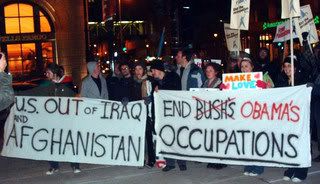
We were at an Iraq Moratorium vigil in downtown Milwaukee last week when a young man stopped to say, with a rueful smile, "Can't you give him a little time?"

He was referring to the sign a couple of students were holding, calling for an end to "Obama's occupations."

The vast majority of the people at that vigil voted for Barack Obama. There may have been a few Green votes. I'd bet my bottom dollar there weren't any McCain backers in the crowd.

So, should we be patient?

I pointed out to the young man that while it's true Obama's only been in office a month, that's been enough time for him to decide to send 17,000 more troops to Afghanistan.

Meanwhile, he's waffled on his campaign pledge to bring US troops home from Iraq in 16 months. And the report today is that he is leaning toward a 19-month withdrawal.

What's three more months when you've already been there for six years?

Not much in the grand scheme of things, right?

Unless, of course, you are one of the people who will lose their lives during those extra three months, or be wounded, or widowed, or have a loved one killed or maimed or permanently damaged psychologically.

Depending upon who's counting, more than a million Iraqis have died, several million have become refugees, and 740,000 or more women have been widowed -- almost 10 per cent of the female population between the ages of 15 and 80.

We don't know for sure how many Iraqis have been killed, because we don't even care enough to count their dead.

This is not a time to ask the antiwar movement to be patient, to quietly wait an extra three months.

It's time to ask the question John Kerry asked about Vietnam: Who will be the last one to die for this mistake?

We might add: How many will die for this mistake after Obama had said it would be over?


There's more: "Be patient with Obama on Iraq? While how many more die?" >>

Thursday, February 19, 2009


Congress members: Lobby us to get out of Iraq

This is not exactly a man-bites-dog story, but at least three members of Congress have expressed their support for a campaign to contact members of Congress and urge them to end the occupation of Iraq.

And a fourth has joined protesters at their regular vigil.

Representatives Barbara Lee, Lynn Woolsey, and George Miller -- all California Democrats -- have written the Raise Hell for Molly Ivins campaign to encourage it to continue raising hell. Meanwhile, Rep. John Conyers, a Michigan Democrat, joined a vigil in Wyandotte, MI. (He's at left in photo)

The Ivins campaign has been urging people to use the Third Friday of every month -- Iraq Moratorium day -- to contact Congresspeople in their home offices and ask them to get US troops out of Iraq. Friday, Feb. 20, is Iraq Moratorium #18.

"Please keep fighting," wrote Lee, a longtime opponent of the Iraq war.

Late last fall, Woolsey, Lee and Maxine Waters organized 92 members of Congress to sign a letter putting then-President Bush on notice that "we will only authorize funding for Iraq that is used for the safe and orderly redeployment of our troops and military contractors," Woolsey said. "We will have many serious issues to deal with in the coming months under a new President, but I will not forget that ending this occupation must be a priority for this Congress and for this nation," her letter said.

Miller cited President Obama's promise to bring the troops home from Iraq in 16 months, and said he and others will be working to accomplish that. He also "heartily endorsed" the Ivins efforts.

Miller, however, did not sign the Woolsey letter, which had its critics, too, including David Swanson of AfterDowningStreet.

The proof, of course, will be in the pudding. Letters and statements from members of Congress are encouraging, but actions speak louder. All three have a track record of opposition to the war.

Miller voted against the war to begin with, and said this in 2006:

Mr. Speaker, there is no more pressing issue in our country today than bringing an end to the war in Iraq as quickly as possible.


But Miller's recent letter to the Ivins campaign reads more like a polite acknowledgement of contact from a constituent, blames everything on Bush and says Obama will change things.

So, don't set aside your skepticism, or even your cynicism.

But do try to meet with, talk with, and confront your member of Congress personally when they are back in the district. And ask them for a commitment to end the war and occupation. Not a statement saying how much they admire what you do -- a commitment about what they will do.

Friday, Feb. 20, marks the 18th monthly observance of the Iraq Moratorium, a grassroots movement uniting people and groups who act to call for an end to the war and occupation of Iraq.

Many activities, individual and collective, large and small, are planned. The Iraq Moratorium website includes a listing as well as ideas for individual actions.

If your plans aren't listed there, please submit them here.

Afterward, please send a brief report of what you did, with photos or videos if they're available. Here's the easy form to do that: Form. It only takes a minute, and sharing your experiences can inspire others to act.

One more thing: The Iraq Moratorium, an all-volunteer operation, is a low budget organization. But it can't operate as a no-budget organization. If you can, please make a donation of whatever you can spare, knowing that we will put it to immediate and effective use in the cause of peace. Here's the link.

Thanks for all that you do, on Friday and every day, to help bring peace.


There's more: "Congress members: Lobby us to get out of Iraq" >>

Friday, January 16, 2009


An easy thing to do today for Iraq Moratorium


Today (Friday, Jan. 16) is the day: Iraq Moratorium, a day to interrupt our daily routines and do something, whatever it may be, to call for an end to the war and occupation of Iraq.

Here's one simple thing you can do that only takes a minute:

With the inauguration of Barack Obama just days away, ask Obama, through his change.gov website, to act at once to begin the process of withdrawing US troops. Tell him how strongly you feel about it.

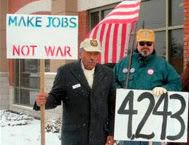
Here's another simple, warm, indoor activity, while we in Wisconsin and elsewhere (like the people pictured in Rice Lake WI) endure sub-zero temperatures: Help keep the woefully underfunded Iraq Moratorium alive with a contribution, large or small, one-time or monthly. Just click here to donate. We'll put it to immediate and effective use in the cause of peace

Whatever you decide to do, please send a report (photos or videos, too, if you have them) by using this brand new, even simpler form.

Folks across the country would like to hear about what you do, even an individual action. You can inspire others to act.

Thanks for whatever you do in the cause of peace.


There's more: "An easy thing to do today for Iraq Moratorium" >>

Tuesday, November 11, 2008


Iraq vets ask Obama to end war and occupation


On Veterans Day, let's pause to consider the words of Iraq Veterans Against the War, in an open letter to President-Elect Barack Obama:
We appreciate your inspiring words spoken at Grant Park in Chicago on Tuesday night - words which should give all Americans hope for our future. But we also remember the hope your words gave to many Americans in an August 2007 speech - especially those serving in our military:
"Ending this war will be my first priority when I take office. There is no military solution in Iraq. Only Iraq's leaders can settle the grievances at the heart of Iraq's civil war."
Much has changed in our country since that speech, and the prevailing sentiment among Americans is that our faltering economy must now be your first priority. We understand and share their concern, but we believe that our faltering economy cannot be corrected if we continue the costly occupation of Iraq – an immense financial cost which is simply unsustainable. The American people are giving billions of dollars every week to continue an occupation that is draining our wallets, our respect, our security, and the lives of thousands of U.S. and Iraqi men, women, and children.
Of course it is all connected.

Yesterday, after the ACLU reminded Obama of his pledge on another topic, with a full page ad in the New York Times, the Obama team said he would keep his promise to close the military prison at Guantanamo Bay. Interestingly, a Google search of Obama and Guantanamo made it clear that is much bigger news abroad than in the US. British, Irish, Canadian and Australian newspapers and the BBC all carried more about it than US news outlets.

Yes, he made a lot of promises during that long campaign. And he'll have to prioritize; they can't all happen on Day One. The economy demands attention.

But it's up to us to remind him in no uncertain terms that a major reason he became the Democratic nominee was the belief that he was more committed than Hillary Clinton to ending the war in Iraq.

Obama assured us, when John McCain was suspending his campaign to focus on the ecoomy, that he was capable of doing more than one thing at a time. Let's make sure he does.

One way to send a message that we want the war and occupation to end quickly is to take part in Iraq Moratorium activities on the Third Friday of every month. It's a day to interrupt our daily routines and take some action to call for an and to the war and occupation. Join us. Do something. Keep the pressure on.

UPDATE U.S. Labor Against the War seconds IVAW's motion:
The Obama campaign was launched and gained momentum based on his pledge to end the war. That was what distinguished Senator Obama from all his major primary competitors. The election reaffirms the mandate given to the Congress in the election of 2006, but which the majority in Congress chose to ignore. It is a mandate to end the war and occupation in Iraq, to remove all foreign military forces and mercenaries, bring them all home, and truly care for them when they return.


There's more: "Iraq vets ask Obama to end war and occupation" >>

Tuesday, July 22, 2008


Walking the walk to witness against war

In some ways, much of Kathy Kelly's adult life has been a walk against war. So it was completely in character for her to be walking through Milwaukee Monday, on a 450-mile trek to St. Paul and the Republican national convention.

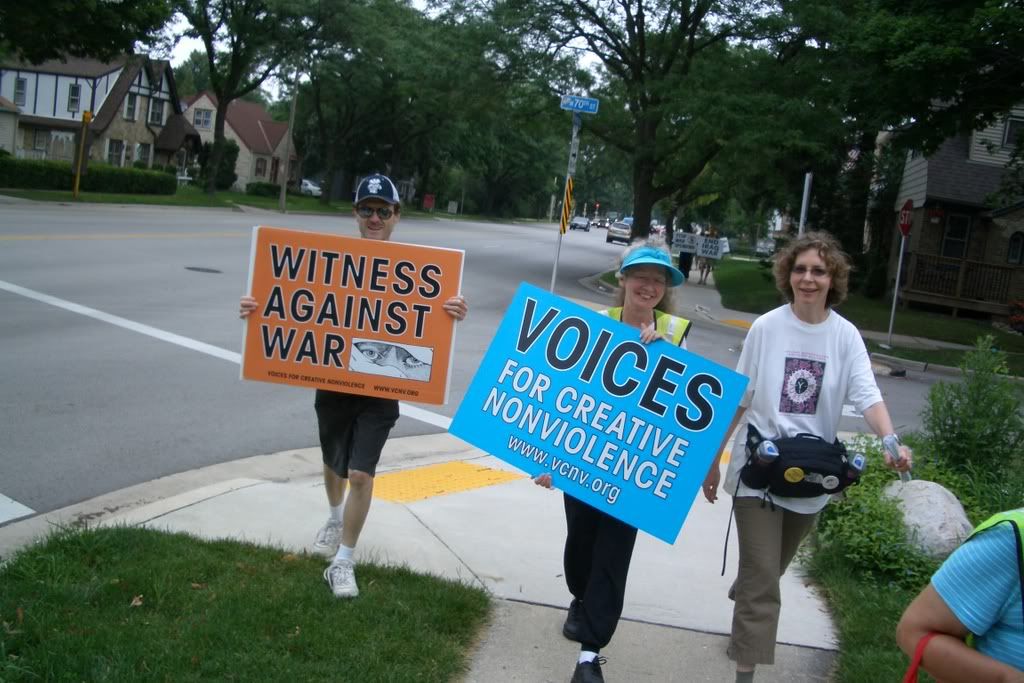
Kelly, (left) a high school and community college teacher, has repeatedly risked her life and her freedom as an advocate for non-violence. She is now affiliated with Voices for Creative Nonviolence, based in her hometown of Chicago, which organized Witness Against War now making its way across Wisconsin.

A three-time nominee for the Nobel Peace Prize for her work , Kelly is a longtime pacifist who refuses to pay war taxes. She's served prison time for planting corn on nuclear missile silo sites and for crossing the line as part of an ongoing effort to close the School of the Americas, an Army military combat training school at Fort Benning, GA.

She helped initiate Voices in the Wilderness, a campaign which brought medicine and toys to Iraq in open violation of UN/US sanctions against Iraq. Voices in the Wilderness organized 70 delegations to visit Iraq in the period between 1996 and the beginning of "Shock and Awe” warfare in 2003. Kelly has been to Iraq 24 times since January 1996, when the campaign began.

In October 2002, Voices in the Wilderness declared their intent to remain in Baghdad, alongside Iraqi civilians, throughout a war they still hoped they could prevent. Kelly and the team stayed in Baghdad throughout the bombardment and invasion and maintained a household in Baghdad until March, 2004. During 2007, she spent five months in Amman, Jordan, living amongst Iraqis who’ve fled their homes and are seeking resettlement.

The 450 mile Witness Against War walk is a continuation of the effort to challenge and nonviolently resist our country’s continuing war in and occupation of Iraq.

The walk left Chicago on July 12 and had logged 108 miles, nearly one-fourth of the total distance, when it left Milwaukee on Monday morning, after a potluck and program at the Friends Meeting House that drew more than 100 people on Sunday night.


The core group of walkers numbered eight on Monday (it's an accordion-like group that expands and shrinks as some members drop out to take care of personal business, then drop back in). An equal number of local folks joined them for the day and the 10-mile hike from Zeidler Park in downtown Milwaukee to the Unitarian Univeralist church across the Waukesha County line in suburban, conservative Brookfield.

The group included Kelly's co-workers at Voices for Creative Nonviolence. an Iraq veteran from Minnesota, a young woman from Sweden, Helene Hedberg (with mileage sign) who met Kelly at a human rights conference, and others who were attracted to the cause and were able to make the time commitment for much or all of the walk. They are joined every day by local supporters who want the war and occupation to end; in Milwaukee that included members of Peace Action, a staff member from Casa Maria, a Catholic Worker hospitality house, and one young man who just joined us as we walked along Wisconsin Avenue. (I'm hesitant to try to name too many names, because I didn't ask everyone and took few notes. The ones I do mention I'm sure of.)

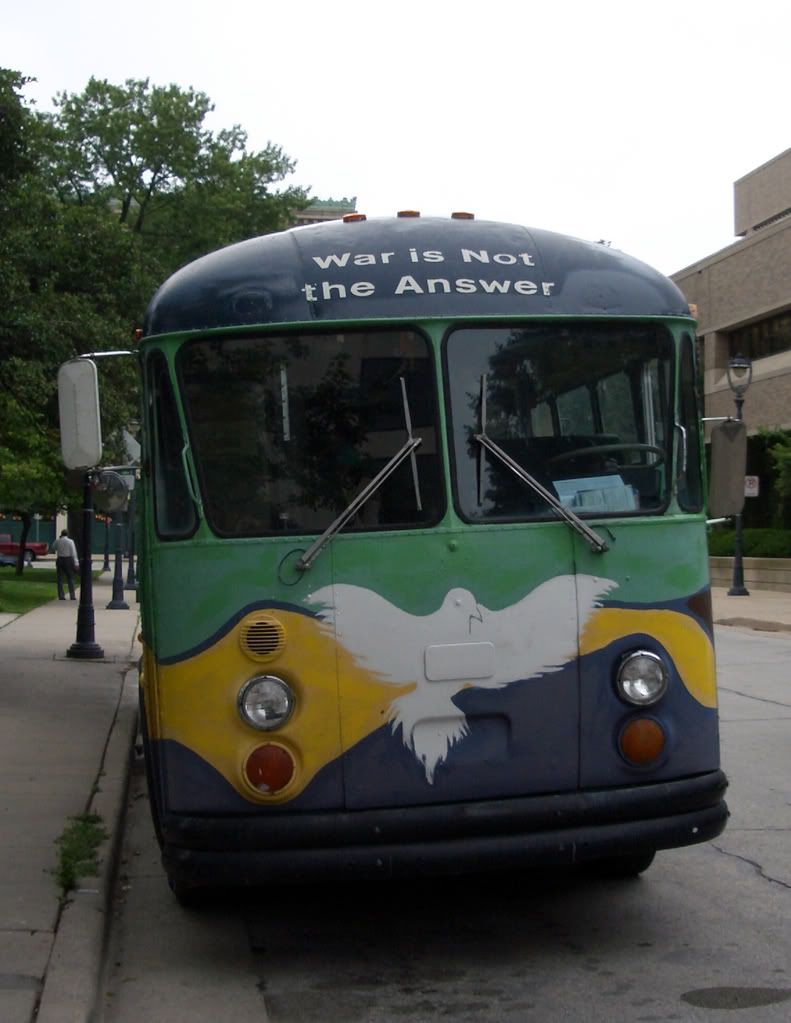
Two television cameras, the local NBC and ABC affiliates, showed at Zeidler Park for a brief informal news conference before the walk kicked off, with a colorful bus, provided by the Anathoth community in Luck, WI. That is major media for antiwar event, as any organizer who's tried to get coverage will attest. Monday morning's daily paper carried a photo of the group with supporters who greeted them when they arrived on Sunday. But no story accompanied it, and no reporters went along for the day, although it seemed to me, as a former reporter and editor, that it would have offered enough grist for an interesting feature story or column.

To walk with them for a day is energizing. It offers a chance to walk with different people for a stretch at a time, hear some of their stories, and get an idea about what motivates them. That helps the time pass, and the walk moves at a pretty good clip of 2 to 2.5 miles an hour. Monday's walk took five hours, including a lunch stop (Subway box lunches and healthy snacks) along the road.

Paul Melling, the Iraq veteran, (pictured giving his feet a break at the end of the day) has just finished an associate degree in computer networking at a St. Cloud, MN technical college and decided to do the seven-week walk before starting a new job. He spent 14 months in Iraq as an artillery crew member, in 2004-05. Melling said he was somewhat conflicted for a time about whether to speak out on the war while others were still fighting it, but decided the best way to support those troops still in Iraq is to work to get them home.

Unfortunately, Melling was taking a break in the bus to prepare a talk he was to give that night when we encountered an Army recruiter on Blue Mound Road, who pulled across the crosswalk and confronted our small band of sign-carriers. He challenged us on whether any of us had served, so I stepped forward, wearing my Vietnam Veterans Against the War T-shirt, and assured him there were some veterans in the group. He said he was an Afghanistan vet and said what we were doing was undermining the troops. The US military is in Iraq to keep the Iraqi sects from killing each other, he said -- seemingly unaware, as we pointed out, that hundreds of thousands of Iraqis have died because we are there. After he threatened to break my camera if I took a photo, I put him down as unpersuadable and let others take up the debate. (I had signed a non-violence pledge in order to join the walk, and tend to be nonviolent by nature anyway, although it was tempting to take another photo and see what developed. Maybe we would have actually made the newspaper; violence seems to get covered. He apparently didn't know I had already taken the one that appears here.)


Other than that, the walk was uneventful, although the walkers got a nice reception from a group awaiting them at Marquette. All of the walkers carried signs, whch promoted some friendly horn-blowing, waves and yells of encouragement from drivers along Wisconsin Avenue, Blue Mound Road, Highway 100 and North Avenue. The Chicago crew also leafleted when there was an opportunity.

The Wisconsin Network for Peace and Justice, a statewide coalition of local organizations, is helping coordinate the walk and find lodging and meals and arrange programs along the route.

Anyone's welcome to join the walk for a day or more if you can. There are some stretches across rural Wisconsin where there may not be any organized groups, so company and support might be especially welcome. Here's the schedule for the rest of July:

7/22 Tues 7 pm Witness Against War - The Iraqi Refugee Crisis – Waukesha. 1st Congregational Church, 100 E. Broadway. Contact: Judith Williams of the Waukesha Catholic Worker House at 262-524-8278.

7/24 Thurs 5:30 – 8:15 pm ‘Witness Against War’ speaks at ‘Democrats of Jefferson County’ Picnic – Lake Mills. Commons Park in downtown; Main and Madison. Schedule: 5:30 pm -a kids parade around the park, 6 pm - dinner, 7-8:15 speakers, including Jeff Leys of Voices for Creative Nonviolence - followed by video cast of Obama speech. Contact: Anne Johnson amjlakemills(at)yahoo.com 608.576.0498 or Ray Murawski of the Watertown peace group.

7/27 Sun 8 am – 3 pm WITNESS TO WAR WALK– Madison.- We are inviting members of the community to join VCNV, walking 8 miles from Cottage Grove into Madison. The walk will end up at Olbrich Park. (early-morning car-pools for community walkers- leaving from Olbrich Park to Cottage Grove - at 8 am) Check out (www.wnpj.org ) for a form to sign from VCNV if you are interested in participating in the walk. Contact: Joy at jsfirst@tds.net

7/27 Sun 5 - 9 pm ‘Witness Against War’ - Dinner and Presentation by Kathy Kelly - Madison. St. Bernard's on Atwood Ave- Everyone welcome! Raging Grannies and Will and Dot Williams sing…..and more! Contact: Joy First at jsfirst@tds.net. WNPJ is co-hosting the event today - Contact info@wnpj.org o call 608-250-9240

7/28 Mon 12 noon SPECIAL Vigil for Peace with ‘Witness Against War’ - Madison. In front of the Post Office on MLK Blvd. Contact: Mary Beth Schlagheck at mbspeace1@charter.net .

7/29 Tues 3:30 – 5:30 pm Witness Against War - Waunakee. At the Village Park. There will be an informal conversation and/or a talk. A welcome of the marchers by concerned residents of Waunakee and surrounding towns would be most appreciated. For further information, contact Hildegard Dorrer, 608-849-4219

7/30 Wed 3:30 – 4 pm (flexible – when the Walkers arrive) WAW Vigil with Women in Black - Sauk City. Meet on the Bridge. We gather to silently mourn ALL that is lost to war – wherever this occurs. We stand in solidarity with those throughout the world who suffer from oppression, violence, and injustice. Contact – Mary Ann Novascone at noasca@verizon.net

7/30 Wed 7 pm Spaghetti Dinner with the WAW Walkers – Sauk City. At Park Hall, 307 Polk Street. www.freecongregation.org. Bring a dish to share. Contact: Maggie McGlone at msmcglone@verizon.net or Sally Dahir at sdahir@chorus.net

And here is the map and schedule for the whole thing.


There's more: "Walking the walk to witness against war" >>

Monday, July 7, 2008


National Assembly offers antiwar action blueprint

This report on the National Assembly to End the Iraq War and Occupation held June 28-29 in Cleveland is overdue, but was delayed to await an official summary of the actions taken there. Unless you were in the room almost all of the time for the debate and votes, it was impossible to know exactly what decisions the 400-plus participants made. And I confess to spending a good chunk of time "networking" and kibitzing in the halls.

Now the organizers have produced their summary and evaluation, which you can read it its entirety here.

The Assembly urged united and massive mobilizations on both coasts in the spring to end the war, while also endorsing demonstrations at the Republican (Sept. 1-4) and Democratic (Aug. 25-28) conventions, local actions on October 11 -- the date Congress passed the resolution authorizing the Iraq war -- and proposing Dec. 9-14 as dates for local actions across the country demanding the immediate withdrawal of troops from Iraq and Afghanistan.

The group also voted almost unanmously to endorse local Iraq Moratorium actions on the Third Friday of every month, although that is not specifically mentioned in the organizers' report. That's disappointing to me, as part of the group who worked to make that part of the action agenda passed by the participants. But in the grand scheme of things, as one of my compatriots said, "This is just one document, produced by some exhausted folks in the aftermath of a complex event." The proof, as usual, will be in the pudding.
Organizers believe the Dec. 9-14 actions provide the best potential for uniting the entire movement in the months ahead:

ANSWER and the Troops Out Now Coalition have endorsed them and the hope is that United for Peace and Justice will do the same. The need now is to take these proposed dates to local antiwar coalitions; labor groups, especially U.S. Labor Against the War; veterans and military families organizations: the faith community; Black, Hispanic, Asian, Arab, Muslim and other nationalities, racial and ethnic groups; students; women’s peace organizations; the Iraq Moratorium; and other social forces that can be drawn into antiwar activities. All actions are viewed as springboards for building massive, united, independent and bi-coastal Spring 2009 demonstrations against the war.
In other action, the Assembly:
-- Expressed its strong opposition to attacks against Iran, as well as sanctions and other forms of intervention into that country’s internal affairs; registered determination to join other antiwar forces in massive united, protest actions in the event that the U.S. or its proxy, Israel, bombs Iran; and urged that if this occurs an emergency meeting of all the major antiwar forces be called to plan such actions.

-- Added Afghanistan to the name of the Assembly because the U.S. is fighting two unjust, illegal and brutal wars simultaneously and both must be opposed. We are now the National Assembly to End the Iraq and Afghanistan Wars and Occupations.

-- Voted to integrate the issue of Palestine into the broader antiwar struggle and to challenge U.S. support for the Israeli occupation.
It's hard to judge the Assembly's real impact, but just getting activists from a wide variety of groups and causes to spend the weekend in the same room, operating in a civil fashion and emphasizing their unifying beliefs rather than their differences, is an accomplishment in itself.

As one of my Wisconsin friends put it, "The hollering was at a minimum, the crowd lively, (if a bit unfocused), the tone was upbeat."

The Assembly adopted the Big Tent philosophy, and was happy to keep enlarging the tent to make room for everyone. Oppose the war in Afghanistan, too? Come on in. Palestine's your main focus? No problem, there's plenty of room.

While that may have built a broader coalition, it seems like that message may be a harder sell when it comes to trying to mobilize massive numbers of regular folks to act against the war -- and that must be the ultimate objective. With a single focus on Iraq, which two-thirds of Americans think was a mistake, it has still been hard to get people to translate their feelings into action. Adding more issues to the pot will not make it easier, but more difficult.

The group's five points of unity are: (1) “Out Now!” as the movement’s unifying demand, (2) mass action as the central strategy, (3) unity of the movement, (4) democratic decision making, and (5) independence from all political parties. Steps were taken to make the Assembly an ongoing organization, "a network with its mission intact and continuing: to be a catalyst and unifier, striving always to unite the movement in the streets."

There are certain to be some bumps in the road. The one-person, one-vote rule worked in Cleveland, but that meant that Ohio participants had 140 votes while Texas had one. Twenty-five states had no representatives at all. While geography may not be important -- this is an antiwar coalition, not the Electoral College -- it also means that some of the bigger organizations were under-represented. At some point that may become an issue.

But, big picture, was it worth doing? Was it energizing? Am I glad I went?

Yes, yes, and yes.


There's more: "National Assembly offers antiwar action blueprint" >>

Wednesday, June 11, 2008


Heroics

Cross-posted from Lotus - Surviving a Dark Time.

I've tried various ways to start this, wanting to make sure that I say what I mean and only what I mean. But I've come to realize that there is no way that will not be misunderstood, either accidentally or deliberately, by some. So I gave up trying to do anything other than say it outright. Perhaps it will be controversial here, perhaps not.

I am deeply disturbed by the increasing tendency among "progressives" to adulate all things military, and particularly disturbed by the practice of referring to soldiers routinely as "our heroes" or some similar formulation. Let me be clear here: Soldiers are not "heroes." A "hero" is by definition someone who is in some way extraordinary, remarkable, worthy of emulation. It is at best a risky business to define someone as "extraordinary" simply by virtue of wearing a uniform and in fact it is potentially dangerous as it makes it too easy to slip into the militaristic attitude that what soldiers do goes beyond "necessary evil" or just necessary, beyond even honorable, to admirable, to something to celebrate, an attitude that makes it all to easy to promote additional enlistments, additional weapons, and even additional wars.

The root of this, I'm convinced, is that after years of the constant drumbeat from the right that those on the left are "soft" on "national security," that we aren't "tough enough," not ready enough to "do what's necessary" to "protect our way of life," we increasingly have decided to, if you will, fight on those terms; that is, we have absorbed the idea that we have to prove ourselves on "security" issues by proving that we're "tough."

Our means of doing this, a means that first appeared during the Gulf War, was to declare loudly that "We support the troops!" That was our way into the national security debate, a way to (supposedly) oppose the war while, we declared, supporting the men and women sent to fight it. We would prove that we were as committed to the military and national security as the right, just, well, in a sorta different way.

One less important but still revealing example came on Monday during Jon Stewart's interview with Senator Jim Webb. Most of that interview was a discussion about Webb's bill to expand veteran educational benefits, under which, in return for three years in the military, soldiers would receive four years' tuition at their best state college plus the cost of books, plus a monthly stipend. At one point, when Webb said that the least we can do for our soldiers is give them the chance for "a first-class future," the audience burst into loud applause.

And I thought then, as I have before when this bill was being discussed, would there be any chance, any chance at all, of that same sort of reaction if the same proposal was made on behalf of any other group? What if someone proposed paying for four years of college for, say, firefighters? Or cops? How about volunteers in VISTA (now AmeriCorps VISTA)? Or the Peace Corps? The latter two provide some educational benefits for those who put in their time, but nothing vaguely approaching four fully-paid years of college.

What about publicly-funded continuing education for doctors and nurses? Such continuing education is not only a good idea for health care professionals, it's often a requirement for maintaining their licenses to practice. And certainly having doctors and nurses who are up to date on the best knowledge and practice is beneficial to the public. So why not have public financing of that continuing education?

When it comes down to it, why not have public education, tuition-free, taxpayer-supported public education, right up through four years of college for anyone who can show themselves capable of meeting the educational standards for a college degree? Can you seriously imagine a studio audience bursting into spontaneous, enthusiastic applause for someone seriously proposing such an idea?

Why only soldiers? What does it say about us that the idea of paying soldiers' way through college gets ovations while the idea of anyone else getting the same benefit gets at best quizzical stares if not overt sneering rejections? It says that we regard the work of soldiering as inherently more important, inherently more deserving of praise and reward, than the work of others - and the lives of soldiers as inherently more valuable than the lives of the rest of us. That is the attitude we are buying into.

But if it was only things like veterans' benefits, it might not seem particularly important. I say that despite the fact that the amount of money involved in such benefits is not trivial and Webb's argument that his bill just provides the equivalent of educational benefits given to veterans of World War II is quite misleading: For one thing, many of those soldiers had been drafted "for the duration," so it wasn't automatically a matter of three years and out. For another, the avowed purpose of those World War II benefits was to make up for what those soldiers had lost in regard to their civilian careers as compared to those who had not been in the military. That is, they were to insure that soldiers did not wind up being penalized for having been soldiers. They were not intended to give soldiers a leg up over others (or "a first class future") and they most definitely were not presented as being a reward for military service. But that's what they have become over the years and that's how Webb's bill treats them.

I also want to make abundantly clear in case it's not or is willfully ignored that the benefits being questioned here do not include such as medical care, rehabilitation, and counseling for vets wounded either physically or psychologically. But, yes, veterans benefits are too generous to the extent that they become a reward for being in the military. So I am against Webb's bill and I don't give a damn whether it will affect retention rates or not. I am opposed to it so long as soldiers get singled out for an opportunity for higher education that is becoming increasingly financially impossible for many people.

Even so, again, if that's all there was to it, it might not seem like a great big huge deal. But that's not all there is to it, not when we are trying to lay claim to national security chops by out troop-supporting the right, insisting that we're the ones who really support the troops, we're the ones who really support their brave courageous efforts and we prove it by undaunted adulation, blandly treating, with no hint of hesitation, the phrase "have a lot of courage" and the word "soldier" as synonymous.

So we were the ones who loudly decried the lack of body armor and the lack of reinforced plating on military vehicles, accusing the right of "not supporting the troops" as much as we do because of that failure. But as Mark Twain pointed out in "The War Prayer,"

[i]f you would beseech a blessing upon yourself, beware! lest without intent you invoke a curse upon a neighbor at the same time. If you pray for the blessing of rain upon your crop which needs it, by that act you are possibly praying for a curse upon some neighbor's crop which may not need rain and can be injured by it.
In war, in combat, as long as the soldiers are there, there is an unavoidable trade-off: The more you wish for them to remain safe, the more you are wishing for them to kill others. That is what safety in combat means. The more you wish for them to return safely, the more you are wishing for Iraqis not to. The more you wish life for them, the more you are wishing death for others. The more you wish that American mothers, fathers, wives, husbands, sisters, brothers, daughters, sons, don't suffer the loss of a family member, the more you are wishing that Iraqi mothers, fathers, wives, husbands, sisters, brothers, daughters, sons, do.

So when we express "support for the troops" by demanding we "give them the equipment to do the job" and "then come home safely" rather than simply and solely saying "get them the hell out," we are offering a tacit - and sometimes not so tacit - endorsement of the killing. For the sake of the blessing of safety and life for our soldiers, we are calling down the curse of risk and death on Iraqis. When we declare support in terms of equipment rather than withdrawal, that is what we are endorsing. In war, there is no other way.

Undoubtedly, there are those who are prepared to declare American lives are worth more than Iraqi lives. I am not among them.

The emotional embrace of "our heroes" as some sort of disembodied ideal has policy implications beyond the immediate ones. Within that embrace, and the effects can already be seen in various interviews and commentaries, it becomes easy to absorb, absorb so deeply that one is unaware of it, the idea that a veteran's take on the Iraq war - and by extension, all things military - is inherently more valuable than that of others not by virtue of knowledge or logic or informed comment but simply by virtue of being a veteran. We regarded it (correctly) as a scandal when media outlets used retired generals who were actually Pentagon-trained PR flacks as "experts" on military and foreign policy questions in the runup to the Iraq War - but an overlooked point is that the reason retired generals were so prominent in that number was that their status as military people gave them added credibility in the eyes of many viewers and listeners. In our pursuit of "support the troops," we have fallen prey to that same attitude, one that regards the statements of Iraq War veterans as more valuable, more telling, than those of non-veterans. It even has become fairly common to hear dismissive references to those who "never saw combat." At first, that was a legitimate argument, directed as it was against chickenhawks, those rightwingers who were eager for fights, ready for wars, provided they did not have to take part in them. But increasingly it has been used as an all-purpose putdown, even against those on the left who have criticized soldiers - as, I imagine, it would be directed against me (a non-veteran and a Vietnam-era draft resister) were my voice loud enough to attract the attention.

But the real danger is that as the attitude persists, it distorts our way of thinking, drops a magnet on our moral compass. In a bizarre mirror image of the fanatical right, we refuse to blame soldiers who commit atrocities, or, more exactly, we refuse to acknowledge them. We refuse to blame those who shoot civilians even when the attacks are clearly acts of vengeance; we downplay the war crimes and the routine cruelties; we make excuses for those who shoot the wounded or torture prisoners; even when official Pentagon reports casually mention how a US soldier summarily executed a wounded fighter and shot another wounded, unresisting fighter twice in the back, we pay little notice - and if we do, it's usually to brush off complaints with that all-purpose "you've never been in combat" defense. "These things happen in war," we say.

Yes, they do. And "our heroes" are doing them. Which is, even as the deniers seem incapable of recognizing it, the point. Just as the right tries to blame the individuals and exonerate the hierarchy, we want to blame the hierarchy and exonerate the individuals, to remove all their responsibility for their own actions. That is an idea we were supposed to have rejected nearly 60 years ago; apparently, we haven't.

Soldiers are not heroes. They can be heroes, they can act heroically, they can do heroic things - but the act of putting on a uniform and agreeing to put your conscience in a lockbox for the next so many years does not make your life more important than others, it does not make your opinions and insights more worthy of respect than others, it does not exempt you from moral judgment. It does not make you a hero.

And we should not fall prey to hero-worship.

Footnote: This post from Lotus from last October touches on a similar theme. Oh, and by the way, STDD/GTHO.


There's more: "Heroics" >>

Thursday, May 29, 2008


Time to unleash the hounds on pro-war Dems

Writing about the recent House vote against more Iraq war funding, The Nation notes that growing numbers of Democrats in Congress are finding it safer to vote to stop funding the endless war and occupation. Susannah Vila writes:

Since March 2006, eighty Democrats have switched to voting no on war funding, due in part to persistent lobbying by local constituents and peace groups. After voting for funding as recently as December, veteran Democrats like John Dingell and Dale Kildee changed their votes in response to pressure from United for Peace and Justice's Michigan Peace Action Chapter. "They are riding the wave," says UFPJ's Sue Udry of the additions to the nay camp. "Now it's safe to vote against the war. There had been pressure on them from their districts, but it had been building slowly. The grassroots peace movement has been hounding Congress for years, and finally it pushed them over." The lesson of the May 15 vote? "The strength of the peace movement is people's willingness to keep hounding."


The appropriations bill is coming back for a House vote soon, since $193-billion for the war was restored by the Senate. It will almost certainly pass the House this time; it failed last time not only because Dems voted no, but because many Repubs, mostly angry about procedural issues, voted "present" instead of aye. That's unlikely to happen again.

But last time around, while 147 Democrats were voting against more war spending, 85 Democrats in the House voted for the bill. If hounding works, these folks need to be hounded a lot more:
Jason Altmire, Brian Baird, John Barrow, Melissa Bean, Shelley Berkley, Howard Berman, Marion Berry, Sanford Bishop, Dan Boren, Rick Boucher, Allen Boyd, Nancy Boyda, Corrine Brown, Christopher Carney, Donald Cazayoux, Ben Chandler, James Clyburn, Jim Cooper, Jim Costa, Jerry Costello, Bud Cramer, Henry Cuellar, Lincoln Davis, Susan Davis, Artur Davis, Norman Dicks, Joe Donnelly, Chet Edwards, Brad Ellsworth, Rahm Emanuel,

Bob Etheridge, Bill Foster, Gabrielle Giffords, Charles Gonzalez, Bart Gordon, Gene Green, Baron Hill, Ruben Hinojosa, Tim Holden, Darlene Hooley, Steny Hoyer, William Jefferson, Paul Kanjorski, Ron Kind, Nicholas Lampson, Rick Larsen, Sander Levin, Daniel Lipinski, Tim Mahoney, Jim Marshall, Jim Matheson, Mike McIntyre, Charles Melancon, Harry Mitchell, Alan Mollohan, Dennis Moore, John Murtha, Solomon Ortiz, Collin Peterson, Earl Pomeroy, Silvestre Reyes, Ciro Rodriguez, Mike Ross,

Lucille Roybal-Allard, Dutch Ruppersberger, Tim Ryan, John Salazar, Stephanie Herseth Sandlin, Adam Schiff, Allyson Schwartz, David Scott, Joe Sestak, Brad Sherman, Heath Shuler, Ike Skelton, Adam Smith, Vic Snyder, Zachary Space, John Spratt, John Tanner, Gene Taylor, Mark Udall, Peter Visclosky, Timothy Walz, Charles Wilson.
These three Dems didn't vote last time: Diana DeGette, Kirsten Gillibrand, Bobby Rush. It wouldn't hurt to hound them a little, either. Here's the roll call.

Your representative is on a Memorial Day recess and probably back in the district until Tuesday. There's no better chance to tell him/her in person to vote to end the war. If you don't encounter your Congressperson over the weekend, call the office.

UFPJ has all sorts of information, resources and advice about how to have an impact. Here's the link.

And if your representative's name is not on the list of those who supported the war, maybe you'll find them here, among the 147 Democrats who voted no. There's no need to hound them, but a thank you would be nice:
Neil Abercrombie, Gary Ackerman, Thomas Allen, Robert Andrews, Michael Arcuri, Joe Baca, Tammy Baldwin, Xavier Becerra, Timothy Bishop, Earl Blumenauer, Leonard Boswell, Robert Brady, Bruce Braley, G.K. Butterfield, Lois Capps, Michael Capuano, Dennis Cardoza, Russ Carnahan, André Carson, Kathy Castor, Yvette Clarke, William Clay, Emanuel Cleaver, Steve Cohen, John Conyers, Joe Courtney, Joseph Crowley, Elijah Cummings, Danny Davis, Peter DeFazio, Rosa DeLauro, William Delahunt, John Dingell, Lloyd Doggett, Michael Doyle, Keith Ellison, Eliot Engel, Anna Eshoo, Sam Farr, Chaka Fattah, Bob Filner,

Barney Frank, Al Green, Raul Grijalva, Luis Gutierrez, John Hall, Phil Hare, Jane Harman, Alcee Hastings, Brian Higgins, Maurice Hinchey, Mazie Hirono, Paul Hodes, Chris Van Hollen, Rush Holt, Mike Honda, Jay Inslee, Steve Israel, Jesse Jackson, Sheila Jackson-Lee, Eddie Johnson, Hank Johnson, Stephanie Jones, Steve Kagen, Marcy Kaptur, Patrick Kennedy, Dale Kildee, Carolyn Kilpatrick, Ron Klein, Dennis Kucinich, James Langevin, John Larson, Barbara Lee, John Lewis, David Loebsack, Zoe Lofgren, Nita Lowey, Stephen Lynch, Carolyn Maloney, Edward Markey, Doris Matsui, Carolyn McCarthy,

Betty McCollum, Jim McDermott, James McGovern, Jerry McNerney, Michael McNulty, Kendrick Meek, Gregory Meeks, Michael Michaud, George Miller, Brad Miller, Gwen Moore, James Moran, Patrick Murphy, Christopher Murphy, Jerrold Nadler, Grace Napolitano, Richard Neal, James Oberstar, David Obey, John Olver, Frank Pallone, Bill Pascrell, Ed Pastor, Donald Payne, Nancy Pelosi, Ed Perlmutter, David Price, Nick Rahall, Charles Rangel, Laura Richardson, Steven Rothman, Loretta Sanchez, Linda Sanchez, John Sarbanes, Jan Schakowsky, Debbie Wasserman Schultz, Robert Scott, Jose Serrano, Carol Shea-Porter, Albio Sires, Louise Slaughter, Hilda Solis, Jackie Speier, Pete Stark, Bart Stupak, Betty Sutton, Ellen Tauscher, Bennie Thompson, Mike Thompson, John Tierney, Edolphus Towns, Niki Tsongas, Tom Udall, Nydia Velazquez, Maxine Waters, Diane Watson, Melvin Watt, Henry Waxman, Anthony Weiner, Peter Welch, Robert Wexler, Lynn Woolsey, David Wu, Al Wynn, John Yarmuth
This is not to suggest, by any means, that you shouldn't hound your represenative if he/she happens to be a Republican. By all means, hound away. A few may end up doing the right thing. But it's clear that if we're going to end this war, it's the Dems who are going to have to do it. That's who we should sic the hounds on.


There's more: "Time to unleash the hounds on pro-war Dems" >>

Sunday, February 24, 2008


'How I spent my spring break -- stopping the war'

Instead of "Where the Boys Are," the old-time spring breaks that used to bring waves of partying college students to Florida beaches, the theme for some students this spring will be "Bring the Boys Home." (It's not just boys at war any more, of course; that just fit better.) Our Spring Break invites students and young people to Washington DC for a wide range of antiwar actions in March.

Meanwhile, Campus Progress, a project of the Center for American Progress, is sponsoring Iraq Action Camp, three days of education, training and action for students March 15-17 in Washington. It's free for college students, but they should register now.

Says Robin Markle of Drew University SDS in New Jersey:

"I don't think we can rely on the government to stop the war, despite what politicians may say when they're on the campaign trail. I'm really excited about the Iraq Moratorium campaign, which invites anti-war activists to hold actions the third Friday of every month in their communities. I think that locally-based grassroots actions like these, with people talking to their friends, co-workers and neighbors, is our best strategy for steadily growing the movement until it's something that politicians can't simply pay lip service to."
Is antiwar action and energy being transferred to the presidential campaign?

Says Kati Kesh of UNC-Asheville:
From my perspective ... it seems that although some students are very much swept up in the election process most students remember what happened in 2006 when they put their faith in the Democrats--the Democrats failed to do anything about the war. Because it's an election year it seems that the student body is becoming more politicized and wanting to be more active about issues such as the war in Iraq.

More on what students are thinking and doing in this CounterPunch article.


There's more: "'How I spent my spring break -- stopping the war'" >>

Tuesday, January 1, 2008


A resolution: Work to bring the troops home

A New Year’s resolution: To do what I can to end the Iraq war and occupation.

To do something, even if it’s something small, to try to accomplish something big.

It takes a leap of faith, in 2008, to believe that anything you do can make a difference. After nearly five years of being ignored by the Bush administration and the Congress, many are disillusioned and/or cynical.

But, for the most part, they are still planning to vote.

If you believe that your one vote will make a difference in this country’s direction, why wouldn’t you believe that your one voice against the war can also make a difference?

When I wrote recently about the Iraq Moratorium , some readers responded that protests are meaningless or even counterproductive.

Protests not your thing? Fine. Do something else. Contact a member of Congress. Help an antiwar candidate. Wear a button. Whatever. Let a million ideas and individual actions bloom. But do something.

That’s what’s attractive about the Iraq Moratorium, a national umbrella uniting people and groups who want to bring the troops home. There is no “one size fits all” philosophy. There are no rules. People are encouraged to do their own thing. But they are encouraged to do something, and, whatever it is, to do it on the Third Friday of every month.

The Iraq Moratorium website collects information about past and future actions across the country and makes it accessible so people can share ideas and tactics and support and inspire one another.

Since Moratorium #1 in September, there have been several hundred actions in about 30 states, ranging from simple vigils to rallies and marches challenging war profiteers. The next round is scheduled on Friday, Jan. 18, and organizers are beginning now to list their plans on the website.

But group actions are just a part of the Iraq Moratorium. Individuals can take part, too, by doing something on the Third Friday of every month, whether it’s wearing a button or armband to work or school, putting up a sign, writing a letter to the editor, or dozens of other possibilities.

It would be nice if folks would sign the simple pledge on the website:

I hereby make a commitment that on the Third Friday of each and every month, I will break my daily routine and take some action, by myself or with others, to end the War in Iraq.
But even that formality isn’t necessary.

All you need to do is do something, once a month.

The Pentagon and the war machine will operates 24/7/366 this Leap Year.

How about resolving to spend a small amount of time, once a month, to try to make a difference?

Happy New Year.


There's more: "A resolution: Work to bring the troops home" >>

Friday, December 28, 2007


Taking it to the malls: Bringing the war home

Even before the California Supreme Court's ruling that shopping malls can't bar protestors, participants in Iraq Moratorium #4 last week were taking their message to the malls.

Some of the action moved to the malls because that's where the people were, doing holiday shopping four days before Christmas. Most "mall walkers" did just that -- walked the malls wearing antiwar shirts or singing carols, not staging actual protests.

An exception was Madison, Wisconsin, where seven people were "arrested" -- and later "unarrested" at West Towne Mall. Organizer Joy First tells what happened:

When we got to the center [of the mall], we unfurled our banners saying “3896 US soldiers killed in Iraq,” “Over 655,000 Iraqis killed” and “Stop the War Now”. A couple of us began slowly and loudly reading names of Iraqis and US soldiers killed in the war, and a couple handed out leaflets. It was only about 5-10 minutes before the mall security and manager came over and told us we had to stop. We talked to them about why we were there and why we couldn’t stop.

We felt we had the right to be there and that we needed to get this message out. Doing this action at the mall is important to juxtapose the suffering of the Iraqi people with the commercialism of the holiday season in the US. So, we continued and mall security called the police.

Bonnie, Susan, and I laid down on the floor and were covered with the banners we had been holding. Someone laid a red rose on top of each shroud. It is very uncomfortable laying there because once you are covered with the sheet, you cannot see what is going on any more. But I did continue to hear the clear, strong voices of my friends reading the names of people killed in the war as the jolly Christmas music from the mall played in the background.

I could also people walking by – some of them supportive and some not. One comment I heard several times was that we shouldn’t be doing something like this because there were kids around. I am listening to names being read, such as Mariam, daughter of Haider Mujed, age 3, or Ayat, daughter of Jaider Mujed, age 1 or Saif Alwan, age 14, or Ali Hamid, age 2. Do you remember your 2-year old and how sweet and lovable they are at that age? People are complaining that we shouldn’t do this with children present, but I think about all the Iraqi children who are being killed and wonder who will protect them.


You can read the full report and see a video of the entire action on the Iraq Moratorium website. Go to the reports section.

Elsewhere, mall walkers in San Mateo, California confronted Marine Corps recruiters in the mall (right.) Palo Alto and San Jose groups also did mall walks, and protestors sang antiwar carols outside of Macy's in San Francisco. In Nashville, activists held signs along the roadway entering a busy mall.

A group in Hobart, Indiana pioneered the mall walks for peace in October, strolling the mall and buying a few items while wearing "Out of Iraq" T-shirts and armbands.

Being "shoppers" or mall walkers seems to remove some of the legal questions about holding a protest on private property.

There have been arguments over the years that malls are the new town squares, public places where free speech should prevail. The California decision does not answer the broaader question, but dealt with union members asking shoppers to boycott a store.

The First Amendment Center offers a summary and links to stories on some of the cases, most of which have come down on the side of property rights over First Amendment rights:

Court upholds Florida candidate's petition rights in mall
State district court agrees that Kevin Wood should not have been convicted of trespassing for seeking signatures. 02.07.04

'Peace' T-shirt spawns legal fight against N.Y. town, mall
NYCLU argues that since Crossgates Mall receives tax incentives from town of Guilderland, it's a public area in which free speech is guaranteed. 05.31.04

Mall owners can limit speech, Connecticut high court says
Justices rule managers legally prohibited union members from distributing leaflets, saying shopping center is private — not public — entity. 07.20.04

Protesters at Hawaii malls can be prosecuted for trespass
State high court rejects argument that shopping center's common areas should be considered public space where free speech is protected. 08.14.04

La. man wins right to protest in front of Wal-Mart
Federal court order allows Edwin Crayton to picket on public sidewalk in front of store without permit from city. 11.14.06


Prediction for 2008: More mall walks, more protests, more legal challenges as antiwar actions escalate.

Says Joy First in Madison:

We must and we will continue to speak out against the war and occupation. As the devastation in Iraq continues and more and more people are hurt and killed, as more people become refugees, as more US soldiers come home with injuries physical, emotional, and spiritual, as more children in this country are starving and homeless because we are using all resources in Iraq, we will continue to take more and more risks in speaking out against the horrors that are caused by our government’s actions. We cannot and will not remain silent. It is our duty and responsibility to speak out.


Cross-posted on Docudharma


There's more: "Taking it to the malls: Bringing the war home" >>