Click the image to visit TruthToPower.tv and order The Warning on DVD Watch the trailer here
Contribute To OOIBC ▼
This is a non-profit site that requires much time and effort to maintain. Please help us continue the work we do here by donating whatever you can afford, today.
Petition ▼
More than 44,000 people have signed this petition. Click the Badge to see the latest count and sign the petition.
Click Get Badge to embed the Badge on your site.
Formal Petition to Attorney General Eric Holder to appoint a Special Prosecutor to investigate and prosecute any and all government officials who have participated in War Crimes.
Translate ▼
Search OOIBC ▼
Recent Posts ▼
The Myth of AQI Fighting al-Qaeda in Iraq is the last big argument for keeping U.S. troops in the country. But the military´s estimation of the threat is alarmingly wrong. --By Andrew Tilghman
And, that apparently is Richard Perle's story, and he's sticking to it.
Dana Milbank, in the WAPO today, has a fascinating, and hilarious, piece, on one of the Grand Poohbars on the Neocon Society, one of the architects and vociferious advocates of the invasion and occupation of Iraq, dutifully carried out by the Bush Grindhouse.
Here's one, of many, stories, putting Perle at Ground Zero Neoconland, where he infers that Iraq was behind Sept 11th;
Manning already understood that people close to President Bush wanted to go after Iraq, and Tenet of course knew it too. Conspicuous among them, in his mind that night, was the neoconservative agitator and polemicist Richard Perle, an outspoken advocate of removing Saddam Hussein by military force. On the very first page of Tenet's memoir, he tells us that he had run into Perle that very morning -- Sept. 12 -- as Perle was leaving the West Wing of the White House. They knew each other in a passing way, as figures of note on the Washington scene. As Tenet reached the door, Perle turned to him and said, "Iraq has to pay a price for what happened yesterday. They bear responsibility."
No, not that "Prince of Darkness", the one that runs over homeless people in his Corvette.
The Prince of Darkness -- so dubbed during his days opposing arms control in the Reagan Pentagon -- was not about to let details get in the way of his argument that "50 million conspiracy theorists have it wrong," as the subtitle of his article for National Interest put it. "I see a number of people here who believe and have expressed themselves abundantly that there is a neoconservative foreign policy and it was the policy that dominated the Bush administration, and they ascribe to it responsibility for the deplorable state of the world," Perle told the foreign policy luminaries at yesterday's lunch. "None of that is true, of course."
As you can see, Perle is adhering, not to the letter, the rules of Neocon Club.
In real life, Perle was the ideological architect of the Iraq war and of the Bush doctrine of preemptive attack. But at yesterday's forum of foreign policy intellectuals, he created a fantastic world in which:
1. Perle is not a neoconservative.
2. Neoconservatives do not exist.
3. Even if neoconservatives did exist, they certainly couldn't be blamed for the disasters of the past eight years.
"There is no such thing as a neoconservative foreign policy," Perle informed the gathering, hosted by National Interest magazine. "It is a left critique of what is believed by the commentator to be a right-wing policy."
Even when he was pressed;
Richard Burt, who clashed with Perle in the Reagan administration, took issue with "this argument that neoconservatism maybe actually doesn't exist." He reminded Perle of the longtime rift between foreign policy realists and neoconservative interventionists. "You've got to kind of acknowledge there is a neoconservative school of thought," Burt challenged.
"I don't accept the approach, not at all," the Prince of Darkness replied.
As Milbank aptly notes, "there was a sense of falling down the rabbit hole", but this wasn't merely a stumble, this was a head-first, deep-as-the-core-of-the-earth, plunge down that rabbit hole.
Are you aware of the plans to bankrupt our nation?
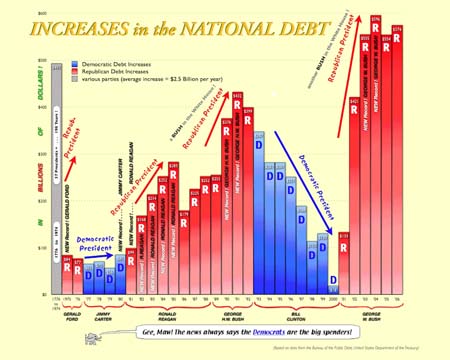
A year ago, I wrote a long article about the goals of Karl Rove and his fellow authoritarian conspirators. The article reviewed Karl's history, goals and underhanded planning expertise, and summarizes his plans for creating a single party state, weakening the federal government's control over business and its assistance for disadvantaged Americans. To do this, Karl and others would bleed "the federal government of its money." After the 2006 Bush tax cuts and years of borrowing for Bush's occupation of Iraq, how's the plan doing? Here's an image to help.
Looks like Karl, Bush, et al., have been quite successful.
Compare their plan with the following quote, "So we are continuing this policy in bleeding America to the point of bankruptcy." This statement was made in a video on October 30, 2004. The speaker in this video was Osama bin Laden.
What about plans to boost the price of oil? Oil economist Dr Mamdouh Salameh reported back in May of this year that if Bush had not lied us into the invasion of Iraq, the cost of oil would be something less than $40.00. Instead, the price of oil in May was $135 a barrel. Think Progress summarized the oil price situation this way, "The Bush administration’s catastrophic decision to invade Iraq, sink the nation into debt to pay for that war, and consequently, weaken the dollar have all caused oil prices to soar astronomically." (Do you suppose that the oil companies have more than made back their political contributions to both Bush campaigns?)
Back in 1998 a book by Jamal Abdul Latif Ismail was published. In a review of this book, Donna Abu-Nasr, of the Associated Press, provided this paraphrased segment from a 54 page interview documented in the book:
Bin Laden claimed the United States has carried out the "biggest theft in history'' by buying oil from Persian Gulf countries at low prices. According to bin Laden, a barrel of oil today should cost $144.
The price of oil earlier this month reached $145. Bush and bin Laden are again on the same page of their respective plans. (Notice something? Bush has out done bin Ladin much as he has out done his father. Just what we need. Two global bullies trying to out do each other.)
What about where Bush and bin Ladin keep and protect their plans from public view?
On the one hand, we have bin Laden's public plans. On the other, we have Cheney's man-sized safe and "executive privilege." Why do you suppose our leaders are hiding their plans? Do you suppose they realize they have something in common with our arch enemy and need to keep us from noticing?
Does it appear to you that bin Laden and our own authoritarian leaders are working toward the same end? Isn't aiding the enemy treason? Isn't treason a high crime? And Congress hasn't yet initiated impeachment proceedings because ...?
Imagine a group of neocons gathered together brainstorming about our dependency on foreign oil. During this meeting, they write down a set of questions for which they discuss the possible answers. Here is one possible list they might develop and their conclusion:
Which country are we trying to remake in our own image?
Which country has more American military personnel than all of our current 50 states?
Which country is getting more money every month from our federal government than any of the current 50 states?
Which country might end up with more military bases than we have Army and Air Force bases in our current 50 states?
Which country now has all the major oil companies gaining a foothold in it's oil industry?
Which country could double our national oil reserves and make a truly big dent in our foreign oil dependency if it became our 51st state?
During an interview with Craig Unger about his new book "The Fall Of The House Of Bush" Amy Goodman of Democracy Now (transcript here) refers to comments made by Dick Cheney in September 1992 after the first Gulf War, in a speech at the Economic Club of Detroit explaining why the George H. W. Bush administration did not go on to Baghdad after Saddam then.
Cheney's comments in the speech show clearly that they knew irrefutably in 2003 before the invasion, not only that Saddam Hussein was no threat militarily to any country, much less to the United States, but that they also knew exactly what the conditions in Iraq likely to be produced by an invasion would be, and that they did it with eyes wide open, with conscious and full intention of producing the humanitarian crisis and chaos and death that has followed.
And knew that the responsibility for it would be theirs.
Cheney's speech begins at about 3 min 50 sec into this Democracy Now Craig Unger interview video:
Parts two and three of the Democracy Now Craig Unger interview follow here:
Jason Leopold of Truthout interviews Craig Unger, a contributing editor for Vanity Fair, on the Rise of the Christian Right and Neoconservatism.
Unger garnered national attention with his previous book, House of Bush, House of Saud. Michael Moore cited it as a key source for Fahrenheit 9/11, and the film popularized the author's reports on Saudi investments in Bush family enterprises.
In his new book, The Fall of the House of Bush: The Untold Story of How a Band of True Believers Seized the Executive Branch, Started the Iraq War, and Still Imperils America's Future, Unger turns his attention to neoconservative officials and theorists. At times he focuses so closely on neocon tactics that he misses other forces driving Bush-Cheney policies. Even so, the book offers a vivid account of the use of disinformation to promote extremism.
Leopold: Craig, thank you for being with truthout today. What are some of the issues in your new book that we don't know about - that the public does not know about?
Unger: Well, I think we've been told again and again that we got into the war in Iraq beacause of intelligence failures - that various things just turned out not to be true - that we made one mistake after another.
I actually think we got into the war for exactly the opposite reason - because of intelligence successes - and by that I mean black propaganda operations - disinformation.
Chris Pepus of Chicago Reader takes the book review further for us with...
When you know the Truth, the facts don't seem so important.
Craig Unger, a contributing editor for Vanity Fair, garnered national attention with his previous book, House of Bush, House of Saud. Michael Moore cited it as a key source for Fahrenheit 9/11, and the film popularized the author's reports on Saudi investments in Bush family enterprises. In The Fall of the House of Bush: The Untold Story of How a Band of True Believers Seized the Executive Branch, Started the Iraq War, and Still Imperils America's Future, Unger turns his attention to neoconservative officials and theorists. At times he focuses so closely on neocon tactics that he misses other forces driving Bush-Cheney policies. Even so, the book offers a vivid account of the use of disinformation to promote extremism.
Unger traces the origins of Bush's foreign policy to the 1970s, when prominent bureaucrats and writers gathered around such converts to conservatism as Irving Kristol and Albert Wohlstetter. The neocons scored their first big success in 1976, when two of their allies in President Ford's administration, Donald Rumsfeld and Dick Cheney, created a group outside the CIA to assess the Soviet threat. That panel, dubbed Team B, was staffed by neocon worthies and led by Richard Pipes of Harvard University. One of the group's advisers was a Wohlstetter protege named Paul Wolfowitz.
Team B concluded that the CIA had vastly underestimated Soviet power and that supporters of detente were merely assisting the Kremlin's drive for world domination. It was an imaginative assessment, given that the economy of the USSR was crippled and its military infrastructure was suffering as CIA officers pointed out. Pipes's group held, for instance, that the USSR had probably deployed a top-secret antisubmarine system, even though U.S. intelligence had found no credible evidence of such a program. As Unger writes, "The absence of evidence, [Team B] reasoned, merely proved how secretive the Soviets were!" It was a bold preemptive attack on fact and logic.
Team B's creativity went unrewarded in the short term, as Jimmy Carter won the presidency that year. But Ronald Reagan would use the panel's report to justify his enormous military buildup (and consequent budget deficits) in the 1980s, and in the '90s Team B alumni and followers took aim at the Clinton administration's Middle East policy. In 1996 a group of neocons led by Richard Perle produced a policy statement, "A Clean Break," that prescribed military action to remove anti-Israel governments like Saddam Hussein's. When George W. Bush entered office, flanked by Cheney, Rumsfeld, and Wolfowitz, it became a blueprint for war.
Unger is at his best in these early chapters, where he convincingly links neocon biases to the Republicans' most disastrous policies. He gleans a thicket of reports and think-tank papers to reveal that the Bush administration's claims about Iraqi weapons programs followed the same pattern as Team B's exaggeration of Soviet power in the 1970s. Likewise, many of the administration's rosy projections for post-Saddam Iraq originated with the authors of "A Clean Break." In 1999 one of them, David Wurmser, stated that Iraq's Shiite majority "can be expected to present a challenge to Iran's influence" instead of aligning with Iran. Wurmser offered no factual support for his claim, but wrote that his thinking had been "guided" by his ideological allies, such as Ahmed Chalabi. By that point, Unger writes, "the neocon echo chamber had begun to rely on itself to reinforce its own myths."
Four and a half years into the Iraq war, the price of upholding those myths is rising. The president and vice president appear smitten by the idea of air strikes against Iran. Unger cites Philip Giraldi, a former CIA specialist in counterterrorism, who argued that in the case of Iran, Bush officials were "using the same dance stepsódemonize the bad guys, the pretext of diplomacy, keep out of negotiations, use proxies. It is Iraq redux." Describing three decades of right-wing gambits, Unger paints a stunning portrait of arrogance and duplicity. The Fall of the House of Bush may be the definitive group biography of the neocons. But he makes a few missteps when the story moves beyond that group. For instance, he calls President Bush a "genuine born-again Christian," despite finding evidence that the president's professions of faith are as cynical as anything Team B ever presented. Bush maintains that Billy Graham converted him to evangelical Christianity in 1985, but Graham has disagreed with that and so has Mickey Herskowitz, a ghostwriter of Bush's 1999 autobiography.
Herskowitz told Unger that Bush couldn't recall the details of his 1985 meeting with Graham and replied negatively when Herskowitz asked him whether Graham had said something like, "Have you gotten right with God?" (Herskowitz was "stunned" by the book's account of Bush's conversation with the minister.) "Witnessing" about your relationship with Christ is a key element of evangelicalism. Lying about your conversion experience for electoral gain is just about the last thing a sincere evangelical would do.
Unger also underplays the importance of oil-industry leaders, including his previous subjects, the Saudis. In his 2006 book Armed Madhouse, journalist Greg Palast writes about a 2000 report by the Joint Task Force on Petroleum, cosponsored by the James A. Baker III Institute (named for and headed by Bush I's secretary of state). The panel, which included oil execs as well as foreign-policy specialists, complained that Iraq was a "swing producer" of oil, with a propensity to "manipulate oil markets."
Saddam Hussein had a history of abruptly suspending and restarting oil production. In fact, he interrupted petroleum exports for 12 days the month the task force began its work. His tactics undermined efforts by the oil companies and Saudi-dominated OPEC to control the price of crude. An earlier assessment by the Baker Institute put it this way: "In a market with so little cushion to cover unexpected events, oil prices become extremely sensitive to perceived supply risks. Such a market increases the potential leverage of an otherwise lesser producer such as Iraq." For its part the task force recommended "an immediate policy review toward Iraq," including military options. Palast says Cheney got its report early in 2001, and its economic considerations may have provided the strongest impetus for war.
Likewise, the Saudis have played a large role in developing Bush's aggressive approach toward Iran and Shiite Muslims throughout the Middle East. (Saudi rulers are Sunnis.) Bush and his aides choose to blame Iran for the disaster in Iraq, even though it's the Sunnis who've inflicted the majority of casualties on U.S. troops. The New Yorker's Seymour Hersh has reported that the administration has joined the Saudis in providing clandestine support to Sunni extremists in Lebanon and Syria. The president hopes these Sunni militias will attack Iran's allies and not America's, even though some of those receiving aid have ideological affinities with Al Qaeda. It's an astonishing policy, completely at odds with the lessons of 9/11 and battlefield realities in Iraq. That contradiction is the best indicator of the House of Saud's continuing grip on Bush-Cheney foreign policy. The administration's close ties with the Saudi royals demonstrate that there are limits to the influence of the neocons, many of whom advocate regime change in Saudi Arabia.
Bush and his aides cite Iran's nuclear capability as justification for air strikes. But Hersh has reported that American intelligence thinks Iran won't have the ability to produce a warhead until sometime between 2010 and 2015. And according to an intelligence estimate released December 3, the country shut down its nuclear weapons program in 2003. These assessments appear to have done little to deter the administration's drive toward confrontation. "Iran will be dangerous if they have the knowledge necessary to make a nuclear weapon," said President Bush in response to the new intelligence estimate. "What's to say they couldn't start another covert nuclear weapons program?"
Zeitgeist: What do Christianity, 911 and The Federal Reserve have in common?
The more you begin to investigate what we think we understand, where we came from, what we think we're doing, the more you begin to see we've been lied to, we've been lied to by every institution...
"Zeitgeist is originally a German expression that means 'the mind of the age', literally translated as 'time (Zeit) mind (Geist)'. It denotes the intellectual and cultural climate of an era." --wikipedia
The very word "secrecy" is repugnant in a free and open society; and we are as a people inherently and historically opposed to secret societies, to secret oaths, and to secret proceedings. ... For we are opposed around the world by a monolithic and ruthless conspiracy that relies primarily on covert means for expanding its sphere of influence -- on infiltration instead of invasion, on subversion instead of elections, on intimidation instead of free choice, on guerrillas by night instead of armies by day. It is a system which has conscripted vast human and material resources into the building of a tightly knit, highly efficient machine that combines military, diplomatic, intelligence, economic, scientific, and political operations.
Its preparations are concealed, not published. Its mistakes are buried, not headlined. Its dissenters are silenced, not praised. No expenditure is questioned, no rumor is printed, no secret is revealed. ... Without debate, without criticism, no Administration and no country can succeed -- and no republic can survive. That is why the Athenian lawmaker Solon decreed it a crime for any citizen to shrink from controversy. And that is why our press was protected by the First Amendment -- the only business in America specifically protected by the Constitution -- not primarily to amuse and entertain, not to emphasize the trivial and the sentimental, not to simply "give the public what it wants" -- but to inform, to arouse, to reflect, to state our dangers and our opportunities, to indicate our crises and our choices, to lead, mold, educate, and sometimes even anger public opinion.
Part 3: 47 min: Don't mind the men behind the curtain
What do Christianity, 911 and The Federal Reserve have in common?
This is the full Zeitgeist production.
"They must find it difficult... Those who have taken authority as the truth, rather than truth as the authority." --Gerald Massey, Egyptologist (1828–1907)
This section explores the little known foundations of the Cult of Equinoctial Christolatry (Christianity) which, unannounced to most, rests in the astrotheological belief systems of the ancient world.
In order to regain its status as the respected leader of the world's nations, America must eradicate the neoconservative movement from its body politic, and the only '08 presidential candidates committed to that goal appear to be Democrat Dennis Kucinich and Republican Ron Paul. If you think the neoconservatives packed up shop subsequent to their Mesopotamia mistake, think again. The neocons not only didn't learn anything from Iraq, they're betting large that nobody else did either--and that's a bet they stand a good chance of winning. ... The top tier candidates from both parties talk of new approaches to the Iraq problem, but none of them--with the possible exception of Barack Obama--offer anything realistic that's substantively different from "stay the course." And though Kucinich and Paul touch on the essential task that lies ahead in setting the course of U.S. foreign policy, the mainstream information gatekeepers continue to treat them like pipsqueaks.
Is it possible that, under the surface, all of America's national profile politicians have crawled into the neocons' pockets? ... With the exception of significantly increasing America's defense spending, the neocons' dreams of U.S. global dominance have dashed themselves against the shoals of reality. Today, though we spend more than the rest of the world combined on defense, friends and enemies alike shun us. We have to kiss up to countries like Turkey and Pakistan while the greatest threats to our national security are backwater outfits like Iran and North Korea, all states whose economies and defense budgets are less than five percent of ours and none of whom would amount to a pimple on our posterior if we hadn't let the neocons persuade us to stick said posterior into the crack its in now. Moreover, our security, prosperity and principles are more in peril than they have been since the beginning of World War II, and as recent events in Pakistan illustrate, our efforts to promote political freedom abroad have been dismal failures. ... If America were still a true republic, the neocons would have been ridden out of town two years ago at the latest; they don't have enough tar, feathers or rails in Washington D.C. to give those characters the kind of send off they deserve. But they're still around and reeking havoc. Dick Cheney still lurks in undisclosed locations in between appearances at GOP fundraising and warmongering functions. Cheney side buoys like David Addington continue to infest the White House. Backyard variety chicken hawks such as John Bolton, Fred Kagan, Paul Wolfowitz, Richard Perle and Newt Gingrich hang out in the Scholars and Fellows lounge of the influential neoconservative think tank American Enterprise Institute.
Enter George W. Bush. He had the best chance to patch up relations after 9-11 and he blew it. The U.S. and Iran both opposed the Taliban and Iran believed Bush and Cheney, as ex-oilmen, would lift sanctions. Unknown to many, the U.S. and Iran held secret, one-on-one high-level talks in Paris and Geneva from the fall of 2001 through May 2003, talks led on the U.S. side by Ryan Crocker and Zalmay Khalilzad.
In early May 2003, through Swiss intermediaries, the Iranians also presented an offer for comprehensive negotiations (reprinted in the annex to my book). Bush, full of hubris over Iraq, did not even give the Iranians the courtesy of a reply. The Europe talks ended, meanwhile, after yours truly wrote about them on the front page of USA TODAY and al-Qaeda bombings took place in Saudi Arabia that the White House said were linked to al-Qaeda detainees in Iran.
The Iranians did not give up, however. In late 2005 and through the spring of 2006, Ali Larijani, their new national security adviser, sought backchannel talks with Steve Hadley. Larijani went so far as to publicly accept a prior U.S. offer of talks on Iraq in March 2006. Supreme leader Khamenei publicly endorsed the talks, something he had never done before. Again, Bush sawed off the limb. The upshot: Larijani was weakened, Khamenei humiliated and Iran accelerated its nuclear program and its intervention in Iraq.
There is much more, including an intelligence assessment in early 2003 that invading Iraq would spur the two members of the Axis of Evil with real nuclear programs -- Iran and North Korea -- to intensify their efforts. Also the fact that the White House did not even ask the intelligence community for an assessment of the regional impact of toppling Saddam before invading.
It simply assumed that all would go well and that Tehran would be the next evildoer to fall. Instead of dividing our enemies by negotiating with Iran, the Bush administration has united them. And now -- like the child who shot his parents and complains he's an orphan -- the White House blames Iran for taking advantage of the strategic opportunities the United States has provided.
It's useful though quite troubling to be reminded that our current problems with Iran were entirely self-inflicted by this administration.
Just a few minutes ago Senator Graham, being interview by Wolf Blitzer on CNN, clearly stated that if the current government of Iraq cannot pull off political reconciliation of all the disparate groups of Iraq within 90 days, he will admit that the current government will never be able to do so, and then "we" will have to consider replacing the al-Maliki democratically elected government with a government that can achieve American goals in Iraq. This is the very height of chutzpa, gall, arrogance, and stupidity that shows the world what total frauds comprise the American government. The very idea of overthrowing al-Maliki's government after all the flowery words of the phony bastids we have running our government about the "purple finger" elections, hailed at the time as the first and greatest step towards a functioning democracy, is repugnant beyond belief and shows America cares not one wit about democracy and everything about gaining control of Iraqi oil, for it is al-Maliki's failure to gain agreement on the draconian oil law written by Americans for American Big Oil that is spelling the doom of al-Maliki.
All that remains to be seen now is whether we enable internal political parties to stage a coup, or whether we just have an American sniper put a bullet in al-Maliki's head.
At this point I think my money is on the bullet, as bush has no compunctions at all with ordering the extra-judicial killing of anyone he so desires.
America, soon to be destroying a freely elected democracy near you.
Incinerated body of an Iraqi soldier on the "Highway of Death," a name the press has given to the road from Mutlaa, Kuwait, to Basra, Iraq. U.S. planes immobilized the convoy by disabling vehicles at its front and rear, then bombing and strafing the resulting traffic jam for hours. More than 2,000 vehicles and tens of thousands of charred and dismembered bodies littered the sixty miles of highway. The clear rapid incineration of the human being [pictured above] suggests the use of napalm, phosphorus, or other incendiary bombs. These are anti-personnel weapons outlawed under the 1977 Geneva Protocols. This massive attack occurred after Saddam Hussein announced a complete troop withdrawal from Kuwait in compliance with UN Resolution 660. Such a massacre of withdrawing Iraqi soldiers violates the Geneva Convention of 1949, common article 3, which outlaws the killing of soldiers who "are out of combat." --War Crimes
The 1990/91 Gulf War, The Death Of Reason, the ensuing long years of the sanctions war against the people of Iraq, the 2003 invasion of the country, and the ongoing occupation of Iraq since, are all aspects of and symptoms created by something much larger and much more insidious: War On Terror: The Rise Of The Politics of Fear.
To help shake off and counteract what Maryscott O'Connor called "the System's monopoly over opinion-moulding", watch the following BBC documentary from Adam Curtis. It's a long one, three hours in total, split into three one hour segments. I highly recommend it for a fuller and clearer historical context and understanding of how we got to where we are today.
Editor's Note:This 3-hour, BBC documentary shows that the "threat of terrorism" is to a very large extent, "a fantasy manufactured by politicians, national security profiteers and Islamic terrorists in order to project and consolidate their own political power". The documentary reveals the origins of the "war on terrorism" in the Reagan Administration under the influence of Neocons like Michael Ledeen and their ally, former CIA Chief, William Casey. The two videos below offer a taste of the entire documentary which is linked below the following brief video excerpts. - LMB (Les Blough, AxisOfLogic)
Here are two short excerpts: (You can watch the full 3 hour production in 3 parts, on the flip)
Video Excerpt: Interview of Melvin Goodman, Head of Office of Soviet Affairs, 1976-1987: "The CIA's chief of Soviet affairs from 1976 to 1987 admits Ronald Reagan had nothing to do with the downfall of the Soviet Union".Video Excerpt: CIA admits that "lies became reality" while hyping the Soviet threat. (includes Michael Ledeen, pro-war neocon, and his argument installing "democracy" by force in other sovereign nations. Melvin Goodman describes the beginning of the mythological "war on terror" under Ronald Reagan.)
Watch the full 3 hour production in 3 parts, on the flip The first 2 1/2 minutes of each video below have the same intro.
Always, we have betrayed them. We backed "Flossy" in Yemen. The French backed their local "harkis" in Algeria; then the FLN victory forced them to swallow their own French military medals before dispatching them into mass graves. In Vietnam, the Americans demanded democracy and, one by one - after praising the Vietnamese for voting under fire in so many cities, towns and villages - they destroyed the elected prime ministers because they were not abiding by American orders.
Now we are at work in Iraq. Those pesky Iraqis don't deserve our sacrifice, it seems, because their elected leaders are not doing what we want them to do.
Does that remind you of a Palestinian organisation called Hamas? First, the Americans loved Ahmed Chalabi, the man who fabricated for Washington the"'weapons of mass destruction" (with a hefty bank fraud charge on his back). Then, they loved Ayad Allawi, a Vietnam-style spook who admitted working for 26 intelligence organisations, including the CIA and MI6. Then came Ibrahim al-Jaafari, symbol of electoral law, whom the Americans loved, supported, loved again and destroyed. Couldn't get his act together. It was up to the Iraqis, of course, but the Americans wanted him out. And the seat of the Iraqi government - a never-never land in the humidity of Baghdad's green zone - lay next to the largest US embassy in the world. So goodbye, Ibrahim.
Then there was Nouri al-Maliki, a man with whom Bush could "do business"; loved, supported and loved again until Carl Levin and the rest of the US Senate Armed Forces Committee - and, be sure, George W Bush - decided he couldn't fulfil America's wishes. He couldn't get the army together, couldn't pull the police into shape, an odd demand when US military forces were funding and arming some of the most brutal Sunni militias in Baghdad, and was too close to Tehran. ...>> There you have it. We overthrew Saddam's Sunni minority and the Iraqis elected the Shias into power, and all those old Iranian acolytes who had grown up under the Islamic Revolution in exile from the Iraq-Iran war - Jaafari was a senior member of the Islamic Dawaa party which was enthusiastically seizing Western hostages in Beirut in the 1980s and trying to blow up our friend the Emir of Kuwait - were voted into power. So blame the Iranians for their "interference" in Iraq when Iran's own creatures had been voted into power.
And now, get rid of Maliki. Chap doesn't know how to unify his own people, for God's sake. No interference, of course. It's up to the Iraqis, or at least, it's up to the Iraqis who live under American protection in the green zone. The word in the Middle East - where the "plot" (al-moammarer) has the power of reality - is that Maliki's cosy trips to Tehran and Damascus these past two weeks have been the final straw for the fantasists in Washington. Because Iran and Syria are part of the axis of evil or the cradle of evil or whatever nonsense Bush and his cohorts and the Israelis dream up, take a look at the $30bn in arms heading to Israel in the next decade in the cause of "peace".
Maliki's state visits to the crazed Ahmedinejad and the much more serious Bashar al-Assad appear to be, in Henry VIII's words, "treachery, treachery, treachery". But Maliki is showing loyalty to his former Iranian masters and their Syrian Alawite allies (the Alawites being an interesting satellite of the Shias).
These creatures - let us use the right word - belong to us and thus we can step on them when we wish. We will not learn - we will never learn, it seems - the key to Iraq. The majority of the people are Muslim Shias. The majority of their leaders, including the "fiery" Muqtada al-Sadr were trained, nurtured, weaned, loved, taught in Iran. And now, suddenly, we hate them. The Iraqis do not deserve us. This is to be the grit on the sand that will give our tanks traction to leave Iraq. Bring on the clowns! Maybe they can help us too.
From Bear Republic Action Group. This is what is being done in Iraq in your name, while Republicans continue to support George W. Bush and the Democrat controlled Congress refuses to stop funding and put an end to George W. Bush's occupation of that country:
Warning: This video is ugly, savage and without a doubt not for the kids or the squeamish….But it is what George W. Bush and his ‘Rubber Stamp Republican Party’ are doing in the full light of day. Send a link to this to anyone you know who thinks the ‘Surge’ is working or that, in fact, the people ‘running’ this brutal, illegal occupation have any fucking idea what they are doing. And I do mean any idea at all.
It strikes me as I listen to the ongoing debate about Iraq that the Republicans are so split because they are beginning to realize that the Greatest Heist the World has Ever Seen is failing. And it scares them spit-less, as no operation of this size has ever been pulled off, and the American people are unwilling to any longer play the willing sheep to the Big Bad Wolf that is the GOP.
The sheer logistics involved, the numbers of people who had to be either corrupted or shut up, the stealing of billions and billions of dollars from hapless Americans in order to strike the jackpot of the old, "Black gold, Texas tea," and steal from the Middle Eastern countries control of all their oil fields is staggering to the mind.
As I see it (and this is admittedly pure speculation, but speculations drawn from reasonable inferences) the plan went something like this: From the very moment bush/cheney were put into office by the Supreme Court they began planning to attack Iraq. On an otherwise unmarked map of Iraq, cheney and his consultants on his "Energy" task force literally divided the spoils of the war that was to be and broke up the distribution rights to all that Iraqi oil. The only thing the maladministration lacked was a casus belli to attack Iraq, and we already know that bush was so desperate to get his end of the plan going that he deliberately tried to provoke Iraq into an attack on American or UN resources to justify war.
Then September 11, 2001, happened. 14 Saudi Arabians and a few others hijacked commercial airliners, flew them into the WTC, and, manna from heaven, now bush could obtain virtually any authority to form any response he thought necessary. Did he think it necessary to attack those who attacked us, the Saudis who ostensibly were allies, or, knowing it would be impossible to attack the world's leading gas station, did bush/cheney decide it was more important to manufacture an enemy in closer proximity to the Iraqi oil fields? It had to be an country adjacent to Iraq for logistical purposes, Osama Bin Laden played the convenient villain, and Afghanistan was already such a war-torn, run-down, and easy country to attack that it filled bush/cheney's original purposes perfectly. (They made very sure that all the rest of the Bin Laden family, many of them in business with the Bush family, got out of the country safely when no one else in America could fly anywhere.)
Afghanistan went much too well for bush/cheney, the boogey-man Bin laden became trapped at Tora Bora, and our forces were ordered to allow his escape so the "war on terror" could continue. After all, by then bush had ordered the diversion of funds meant for Afghanistan to the build-up towards the war he really wanted, war with Iraq.
The neocons, including bush, fancied that they could dispense with plans many years in the making by our military experts and believed they could blast in with "shock and awe," install a puppet government and grab command of the oil fields. The puppet government would be required to sign the Profit Sharing Agreements (PSAs) that would give American Big Oil 85%-87% of all oil profits for the next thirty years.
The plan was proceeding brilliantly, handing out no-bid contracts to cronies who in turn kicked back billions to the government "off the books," I would imagine, for how else could anyone steal billions and billions of dollars from the mightiest fighting force in the world without some complicity from those handing out wheelbarrows full of cash? Over ten billion dollars stolen! A very small down payment compared to the trillions of dollars of oil profits to be had.
Then something went seriously wrong. The insurgency wasn't it, because any competent military planner would plan for peace as well as war. Did competent people draw up this plan, ignoring the thousands of years of history, or was it the failure to be able to install an Iraqi-American government favorable to this entire endeavor that caused things to go awry? Or did the government we installed come to the realization of our intent to take their oil and decided to fight even harder against the U.S.? Why should they give away trillions of dollars, not a penny of which would be spent to benefit Iraq?
The only way the Iraqi's can seek to hold onto what rightfully belongs to them is to stall, harass, and harangue and continue their insurgency against the U.S.
Now time is running out with the American people, who have grown weary watching their loved ones die to satisfy bush's imperial goal of giving all that oil to American Big Oil. bush now regularly states that the oil agreement is the single-most important thing for Iraq to do. Now the parliament won't meet, vacations while our troops die, can't form a quorum, and failed to meet bush's deadline of June 30th for signing of the oil agreements.
This means that bush/cheney must get a new, more pliable government in place before the American public really rises up and forces troop withdrawal.
Then the failed plan will come to light. The greatest theft of money from our country in history so far, but a theft that will seem miniscule in comparison if bush/cheney manages to steal all that oil.
Until very recently bush never consulted the Democratic members of congress at all, so there is a good chance SOME congresspersons are not party to this grandiose scheme, but Republicans have been briefed every step of the way and I believe large numbers of the Republicans know exactly why we are in Iraq and support this theft on a global scale. That's why so many of them are running scared and trying to distance themselves from the Greatest Failed Robbery in History, for if my speculations here are true, there will be lots and lots of heads rolling for attempting the theft at all, plus tremendous public outrage at finding that this war was not for noble purposes, but was strictly a plan to steal what does not belong to us, killing many thousands of Americans and committing genocide against the Iraqi people in violation of everything for which America used to stand.
It's stealing. It's dying for stealing. It's killing in untold numbers to steal. It's causing incalculable damage to the world in general, and Iraq specifically, just to steal oil.
And meanwhile, China is circling the globe quietly purchasing every oil contract they can snap up, for a fraction of the cost in lives and treasure that the Greatest Attempted Heist in History will cost America.
Watch the Republicans squeal, twist, turn, and scream like a stuck pig as their continuing perfidy becomes clear to the world, they start turning on bush/cheney, and attempting to deny the role of the GOP and their own support for this failed theft.
The Bush Administration, and Republicans and Democrats in Congress alike, repeat almost daily that they will not defund the troops, with both sides vying for public support with the same bullshit.
It's the biggest load of crap there is.
The Democratic Leadership apparently is afraid of not funding the Iraq occupation either because they are afraid of being attacked by Bush and the GOP for not funding the troops, or because they want to continue the occupation.
The continuous whine that "we don't have the votes" is part of the big lie.
If the Democrats stand up NOW and announce that they will no longer fund the occupation and that there will be no more emergency supplementals introduced when the current one runs out, the situation will become one of NO votes needed to NOT pass a bill. The ball will be in Bush's court.
The Democrats have absolute power in this debate. What good is it and why should voters let them retain it next year if they are too weak kneed to use it to end the Debacle? If they will not, then by default they proclaim their complicity with Bush.
The argument that 'defunding endangers the troops' is utter bullshit and is completely and irrefutably debunked. Let the rethugs try to accuse Democrats of it. Democrats will win that political argument, but ONLY if they have the cohones to do what they know is the right thing.
At the next presidential press conference, I'd suggest question 1-5 be the following: "Are you Mr. President, and Mr. Secretary, prepared to leave troops in Iraq without adequate supplies?"
Watch them squirm, watch them dance. They will not be able to say "yes." This is what the media and the Democrats should have been asking, over and over again, to frame this debate properly.
If the Democrats don't want to do the right thing... it becomes obvious that they want to continue the occupation.
For what? Cheap gasoline? Or the neocon vision of world domination?
What has been needed all along and is needed now is for the Democrats to show that they have some balls and display A Measure of Morality in Congress:
If you could secretly tell a magic genie "Yes" and suffer horribly and die but save the lives of a million people you've never met, would you say No? This one they don't even ask in philosophy school, much less Congress. But let's think about it for a minute. What's the worst fate a Congress Member could face as a result of voting against funding the war? For most it must be the loss of their seat. How horrible is that? Some of these congress members are freshmen, first elected last November campaigning on promises to end the war. Now they're prepared to vote $100 billion for the war in hopes of getting elected again in 2008. What in the hell did they want to get elected for in the first place? What district is going to receive less money if we end the war and redirect our spending to useful projects than if we continue the war but fund special pieces of pork here and there?
While it is important for supporters, activists, and leaders of the peace movement to engage in some thoughtful soul searching over program and strategy, I am concerned that the most urgent activity the peace movement should be organizing is going neglected. We need a massive showing of anti-war sentiment in the fall of 2007, and this can only happen if the major peace organizations launch the initiative now.
An overwhelming majority of the American public wants the war in Iraq ended and the troops brought home now. If anyone believed the Democrats in Congress were going to end the fiasco without massive pressure from the peace movement, that illusion just flew out the window with the Democrats acquiescing in funding the war without even any deadlines for withdrawal. Whether one thinks of it as making more Democratic lawmakers afraid to anger the peace movement, or showing sympathetic Democrats that the peace movement can cover their backs when Republicans try to pin the disaster on any who vote to cut off funding, is of little practical importance. The overwhelming antiwar sentiment that already exists must be mobilized.
It has to be in the fall of 2007 because spring 2008 is too late. First, most Americans understand that every month that passes is more American and Iraqi lives lost for absolutely nothing. Second, the Democrats in Congress will face important choices in September, so that is when the pressure needs to be applied. And third, by spring 2008 too many supporters and activists in the peace movement will be drawn into primary campaigns. Unless we have made ourselves vocal and visible as an oppositional movement, the pressure to subordinate peace politics to the strategies of the candidates will be overwhelming.
Would you support the Congress' setting a binding withdrawal date of March 31, 2008 by announcing that after March 31, 2008 (or an earlier date), it will not fund the Iraq War?
** END THE IRAQ DEBACLE TO AVOID A DEMOCRATIC ELECTORAL DEBACLE IN 2008 **
The entire debate about NOT funding the occupation of Iraq and George W. Bush's Iraq and Mid-East Debacle revolves around one piece of propaganda that has been sold to the public in one of the most heinous aggregations of misperceptions, disinformation, and outright lies ever foisted on a public that cares for the lives of the American troops sent into Iraq, of which there are huge mis-perceptions and an incredible amount of disinformation, i.e. lies, spread by republicans and democrats and trolls.
The Bush Administration, and Republicans and Democrats in Congress alike, repeat almost daily that they will not defund the troops, with both sides vying for public support with the same bullshit.
It's the biggest load of crap there is.
The Democratic Leadership apparently is afraid of not funding the Iraq occupation either because they are afraid of being attacked by Bush and the GOP for not funding the troops, or because they want to continue the occupation.
They know it is a lie when Bush says it.
Yet they turn right around and tell people (repeating the lie) that advocating not funding the occupation is advocating not funding the troops.
Emergency supplemental funding for a war or for an occupation is not for the troops. It never has been for the troops. It will never be for the troops.
NOT passing emergency supplemental funding does not hurt the troops. It never has hurt the troops. It will never hurt the troops.
Not passing emergency supplemental funding is simply NOT FUNDING the occupation. That is all it is.
UPDATE June 12:
DEAN BAKER, Co-director of the Center for Economic and Policy Research: [h/t to MO Blue]:
"The latest version of the 'hide behind the troops' mode of argument is to claim that Congress lacks the ability to end the war. The story goes that President Bush is commander in chief of the armed forces, and that if he does not want to end the war, then Congress cannot force his hand.According to this argument, if Congress were to use its control of the budget to restrict funding, it would jeopardize our troops stationed in Iraq by denying them the supplies and ammunition needed to defend themselves.
"This argument is garbage. Congress has the authority to require the top military commanders in Iraq to produce a plan for safely withdrawing our troops from the country. It can also require these commanders to give their best estimate of the cost of this plan. It can then appropriate this money, specifying that the funds be used for the withdrawal plan designed by the military."
The situation is process analogous to to a business enterprise that has, for example, 100 employeees to whom they pay salaries and provide food and lodging. The budget for that is something planned for every year. We'll call that the budget for the 'troops'.
One year they decide to take on an extra contract to complete a project in another city and they send those 100 employees (troops) to the new city.
The project will require incurring added costs over and above the budget for the employees (troops), so management arranges a bank loan to pay for the added costs for transportation, materials, overtime, extra fuel required, etc. etc.
They then begin to run into delays, extreme competition from a better suited and skilled company, and start incurring huge cost overruns, which they cover with repeated visits to the bank for more loans.
Eventually the bank says look - this is bankrupting you and placing your employees in danger of being abandonded in the new city if you continue down this path - here is your last loan - it will cover you for 90 days, after which the bank will provide no more money for this project. Your regular budget covers your employment (troop) costs. Bring them home to their original city and continue operating there. Your project in the new city is failing.
None of the bank loans had anything to do with the regular budget for the employees (troops).
On numerous occasions, Congress has exercised its constitutional authority to limit the President’s ability to escalate existing military engagements. Here are just a few examples:
Cambodia – In late December 1970, Congress passes the Supplemental Foreign Assistance Appropriations Act prohibiting the use of funds to finance the introduction of United States ground combat troops into Cambodia or to provide U.S. advisors to or for Cambodian military forces in Cambodia.
Vietnam – In late June 1973, Congress passes the second Supplemental Appropriations Act for FY1973. This legislation contains language cutting off funds for combat activities in Vietnam after August 15, 1973.
Somalia – In November 1993, the Department of Defense Appropriations Act includes a provision that prohibits funding after March 31, 1994 for military operations in Somalia, except for a limited number of military personnel to protect American diplomatic personnel and American citizens, unless further authorized by Congress.
Bosnia – In 1998, Congress passes the Defense Authorization Bill, with a provision that prohibits funding for Bosnia after June 30, 1998, unless the President makes certain assurances.
When President George Bush claims that the money is for the troops, he is quite simply lying. The funding is not for the troops.
When Senator Barack Obama or Senator Carl Levin claims to want to pressure Bush to end the war, while at the same time promising to fund the war forever in the name of funding the troops, we are being told something that cannot possibly make any sense. The funding is not for the troops. It is for the war. You can't end the war while providing it. You can't hurt a troop by denying it.
...the money that would be required to bring our troops safely home is such a small fraction of the Pentagon's budget, or even of the cash that the Pentagon has "misplaced" in Iraq, that there can be no question of ever cutting it off. The Pentagon could fund a withdrawal and never notice the financial expense. So, when we talk about cutting off funding "for the troops," what are we really talking about?
We must be talking about their meals and armor and vehicles. But there are several problems with making that sort of claim. First, by cutting off funding after a certain date and demanding that the troops be brought home before that date, you are not denying them anything they need while they are deployed.
Second, we have never provided them adequate supplies and services, and the Congress Members who have pushed to cut off the war funding are some of the same ones who have pushed hardest to try to change that.
Third, the war funding has nothing to do with changing the level of equipment and services we provide the troops; the big bucks go to mercenaries, not troops; and the really big bucks go to the profiteers providing the worst services for the highest prices.
Fourth, if we start to talk about the need for troops to protect other troops, we get into an inescapable escalation without end.
When the Democrats or anyone else claim that the money is for the troops, they, just like George Bush, are quite simply lying. The funding is not for the troops.
The TROOPS are funded by regular appropriations. DOD budget. Emergency supplemental funding has nothing to do with "funding the troops".
It does buy, among other things such as logistical support from Halliburton, Parsons, and DynCorp, fuel, in theater equipment maintenance, bullets, cluster bombs, etc., etc., IOW all the "stuff" needed to continue the occupation. The troops use that "stuff" in the continuance of that occupation, and to defend themselves and stay alive (as best they can) while continuing that occupation. Defunding the occupation of Iraq and withdrawing or redeploying the troops does not hurt the troops. It helps them to stay alive.
Emergency supplemental funding is only for the occupation. When Bush says differently, or when the Democratic Leadership says differently, or when a troll here says differently.... it is a lie.
The "war" has been funded with emergency supplemental funding for years. There is plenty of money for withdrawing in regular budget without the emergency supplemental the Democrats recently passed.
"Since 9/11, Congress has passed at least one emergency bill to cover war costs, making supplemental spending the method of choice for the majority of funding for operations in Iraq, Afghanistan, and the war on terror," Alexander added. "Of the $510 billion spent thus far, $331.8 billion (about 65 percent) has come from supplemental spending legislation. If the so-called "bridge fund" included in the fiscal year 2007 appropriations bill is included, the total rises to $401.8 billion. That means nearly 80 percent of all funding for these wars was the result of emergency and supplemental spending, not regular budgetary means."
The total funds requested by the Defense Department for emergency spending is $163.4 billion, including $70 billion already provided as part of DOD's regular fiscal year appropriations plus a new supplemental request of $93.4 billion.
"If enacted, DOD's funding would increase by 40 percent above the previous year and would more than double from the FY2004 funding level," the Congressional Research Service (CRS) report says.
In Newsweek, Jonathan Alter has a long article defending -- as lamentably necessary -- the decision of the Democrats to fund the Iraq war without any limitations. ... Both of the premises which Alter sets forth here are correct: (a) de-funding does not even arguably constitute "endangerment or abandonment of the troops," but (b) "Americans have been convinced that it does." And therein one finds what is the most extraordinary and telling fact of our political landscape. Namely, our Iraq war policy was just determined, in large part if not principally, by a complete myth: that de-funding proposals constitute an abandonment or, more ludicrously still, "endangerment" of the troops.
Emergency Supplementals, besides the things I mentioned above, also pay for:
a U.S. force in Iraq that is effectively double the size that most people are aware of, and a system where national duty is outbid by profits:
Many Americans are under the impression that the US currently has about 145,000 active duty troops on the ground in Iraq. What is seldom mentioned is the fact that there are at least 126,000 private personnel deployed alongside the official armed forces. These private forces effectively double the size of the occupation force, largely without the knowledge of the US taxpayers that foot the bill.
Working for U.S. companies like Blackwater, Triple Canopy and DynCorp and companies from other countries, according to Scahill's investigations:
Some contractors make in a month what many active-duty soldiers make in a year. Indeed, there are private contractors in Iraq making more money than the Secretary of Defense and more than the commanding generals.
Here is a video of Jeremy Scahill's testimony to the House Appropriations Subcommittee on Defense about the impact of private military contractors on the conduct of the Iraq War: The full text of Jeremy Scahill's testimony is in his May 11, 2007 article at The Nation, "Outsourcing the War".
I repeat, Emergency Supplemental Funding is not for the troops. It is only for the occupation. When Bush says differently, or when the Democratic Leadership says differently, or when a troll here says differently.... it is a lie.
The "war" has been funded with emergency supplemental funding for years. There is plenty of money for withdrawing in regular budget without the emergency supplemental the Democrats just passed.
It's time for the Democrats in Congress to stop lying and start being honest with the public.
The lies are killing the sons and daughters of that public.
Congress appropriates funding for the Iraq war much like the Administration prosecutes it: recklessly, and without being honest with the American people.
Once again, funding for the Iraq and Afghanistan wars--$50 billion in this case--are provided as an `emergency supplemental' in this bill. All told, Congress will have provided the Defense Department with $450 billion of emergency funding for this war.
To treat funding for the Iraq war as an unexpected emergency is a perversion of the term. By way of comparison, the Vietnam War required only a single supplemental, after which it was financed through the regular budget process.
While not an emergency, this funding is provided as such because it is politically expedient. It allows the Administration and the Congress to avoid the budgetary tradeoffs and to hide the full cost of the war. It is part of the Administration's strategy of providing the facts about Iraq on the installment plan.
In April of 2003, the President signed the first Iraq supplemental providing $62.6 billion for the Defense Department. This was after the President's budget director told the New York Times that the war would cost between $50 and $60 billion.
In November of 2003, when the President signed a second supplemental providing $64.9 billion for the Defense Department, the White House termed it a 'one-time, wartime supplemental.' Nine months later Congress provided $25 billion of additional emergency funding.
In May of 2005, the President signed a third supplemental providing $75.7 billion for the Defense Department and told us that democracy was taking root in Iraq. Seven months later, as civil war rocked Iraq, Congress provided an additional $50 billion of emergency funding.
This week, Congress passed another $65.8 billion supplemental. The same day, in a surprise visit to Iraq, the President once again linked the Iraq war and the attacks of September 11th--an assertion that is patently false and that only he and the Vice President appear to still believe.
In this bill, the House will approve another $50 billion more in emergency funding for Iraq to cover operations through the spring of 2007. As was the case with previous Iraq supplementals, these costs will be tacked on to this President's greatest legacy--a massive $300 billion plus deficit. The result is that future generations will be forced to pay the financial costs of the President's failed Iraq policy.
For several years, I have asked the Administration to come forward with 5-year estimates of the war costs so that Congress could get a better sense of how to balance the books. The FY 2005 Defense Appropriations Conference Report included a general provision requiring the Administration to do just that. No such report was ever provided. The President chose to waive the requirement by certifying in writing that providing these cost estimates would harm national security.
The only harm that would come from providing estimates of future war costs would be to the political fortunes of those who insist on funding this war through emergency supplementals instead of being honest with the public about the war's real cost. More than three years into this war it is clear that honesty is too much to expect from this Administration.
The United States maintains it is not building permanent military bases in Iraq or Afghanistan, where the local population distrusts America's long-term intentions.
But for the first time, a major factor in the growth of war spending is the result of a dramatic rise in "investment costs," or spending needed to sustain a long-term deployment of American troops in the two countries, the report said. These include the additional purchases of protective equipment for troops, such as armored Humvees, radios, and night-vision equipment; new tanks and other equipment to replace battered gear from Army and Marine Corps units that have been deployed numerous times in recent years; and growing repair bills for damaged equipment, what the military calls "reset" costs.
So the only way the funding can be said to be "for the troops" is if the intention is to keep them in Iraq for many years.
The Pentagon, which had previously made public its own estimate of operating costs, has not released up-to-date war costs.
The Congressional Research Service report estimates that after Congress approves two pending bills, the total war costs since Sept. 11, 2001, will reach about $509 billion. Of that, $379 billion will cover the cost of operations in Iraq, $97 billion will be the price tag for Afghanistan operations, and $26 billion will have gone to beefed-up security at US military bases around the world. ... Another major war cost is for infrastructure -- bases, landing strips, repair shops -- for the forces in Iraq and Afghanistan. These "operations and maintenance" costs remained steady at about $40 billion per year in 2003, 2004, and 2005, but have spiked to more than $60 billion this year.
Those factors alone, however, are "not enough to explain" the spiraling increase in operating costs, according to the report.
"You would expect [operating costs] to level off if you have the same level of people," said the report's principal author, Amy Belasco, a national defense specialist at the Congressional Research Service. "You shouldn't have as much cost to fix buildings that were presumably repaired when you got there. It's a bit mysterious."
The Pentagon has not provided Congress with a detailed accounting of all the war funds, making it impossible to conduct a full, independent estimate of how much Americans are spending in Iraq and Afghanistan -- or to predict what future costs might be.
PERHAPS no fact is more revealing about Iraq’s history than this: The Iraqis have a word that means to utterly defeat and humiliate someone by dragging his corpse through the streets.
The word is "sahel", and it helps explain much of what I have seen in three and a half years of covering the war. ... Listen to Iraqis engaged in the fight, and you realize they are far from exhausted by the war. Many say this is only the beginning.