
Wednesday, September 17, 2008


UNCLE SAM'S MISGUIDED CHILDREN

.
EVEN IN DEATH, A JARHEAD CAN'T HARDLY CATCH A BREAK

HAWAII HERO MARINE DENIED HIGHEST HONOR


Dubya Grabs Foto Op, Dumps "Wetback's" Body On Mom's Lawn

United States Marine Corps Sergeant Rafael Peralta, 25, of San Diego, California, with the Third Regiment, 1st Marine Division, Kaneohe, Hawaii, was denied the nation's highest honor today by George Dubya Bush, deserter, traitor and coward, and his minions in the Satanic Pentagon.

Mr. Peralta died in Falluja, Iraq, in 2004 after taking multiple gunshot wounds to the face and body, and then throwing himself on an enemy hand grenade to save his fellow Marines. He was successful in his last mission. By taking the initiative and sacrificing himself, he saved the lives of five other men. To those men, and their fellow Marines, and all their families, Sergeant of Marines Peralta will always be a hero, no matter what the Crotch says.
.

.

The Commanding General of the First Marine Division took the initiative, also. Rather than simply honor the sergeant, General Natonski had the bullets dug out of Peralta's body and forensically identified. Since some evidently came from "friendly fire" by other U.S. troops, Sergeant Peralta's sacrifice was downgraded by the top brass, Defense Secretary Robert Gates.

This may have had something to do with the fact that Peralta was, in effect, from the Halls of Montezuma. Peralta was born in Mexico, and moved to San Diego with his family as a child, without proper documentation. He was dark-skinned and had Indian features, and probably spoke English with an accent. He did not become a citizen until after enlisting in the Corps, and his mother and sister only followed his example much later. His mother still does not speak English. Not exactly a Republican poster boy. In any case, he didn't get the Medal of Honor.

Peralta's Mother was shocked and hurt by the deliberate humiliation of her dead son. After all, Dubya himself had called her to try to clinch a few Hispanic votes in the next election. But, since most Latino's, like most everyone in America, are trending Democratic, the "President" dropped the pretense, and spit in Mrs. Perata's grieving face instead. Rush Limbaugh would be proud.

What difference it makes that a man who covered a live grenade with his own body was first hit by accidental fire from his own side, only Satan knows. God Himself is flummoxed on this one. Speaking as a former gyrene myself, all I can say is "F*CK THE SUCK!!!"

Semper Fi, Peralta. Guard those streets of Heaven well, Marine.


MARINE CORPS TIMES
"Peralta to be given Navy Cross posthumously"

' Navy Secretary Donald C. Winter will award the Navy Cross medal — the nation’s second-highest combat award for valor in combat — to Sgt. Rafael Peralta, who pulled an enemy grenade to his body before it exploded, the Marine Corps announced Wednesday. Peralta, 25, died Nov. 15, 2004, while he and members of Alpha Company of 1st Battalion, 3rd Marine Regiment, were in the second week of fighting in the Battle of Fallujah when he barged into a house with a rifle squad. They immediately came under fire from insurgents inside the house. “Peralta was caught in a deadly crossfire between insurgents and his Marines, leaving him mortally wounded,” officials said in an announcement released by I Marine Expeditionary Force at Camp Pendleton. “After the initial exchange of gunfire, the insurgents broke contact, throwing a fragmentation grenade as they fled the building.” The grenade stopped near Peralta’s head, they said, and “without hesitation and with complete disregard for his own safety, Peralta reached out and pulled the grenade to his body, absorbing the brunt of the blast and shielding fellow Marines only feet away. Peralta succumbed to his wounds.” '

YAHOO NEWS
"Marine praised by Bush won't get Medal of Honor "
' The family of Sgt. Rafael Peralta, who was posthumously nominated for the nation's highest military honor, told the North County Times of Escondido, Calif., they were disappointed he was not receiving the Medal of Honor. "I don't understand why if the president has been talking about him," his mother, Rosa Peralta, told the newspaper, which was the first to report the bestowing of the Navy Cross. Rosa Peralta said she was informed during a meeting with Marine Corps Lt. Gen. Richard Natonski that a committee could not agree on awarding the Medal of Honor to her son, who Marine Corps officials say was first wounded by friendly fire. She said the general mentioned the friendly fire aspect as part of her son's death during the discussion. '

USA TODAY
"Some upset Marine sergeant won't receive Medal of Honor"
' A rare decision by Defense Secretary Robert Gates to reject a Marine Corps recommendation that one of its heroes receive the Medal of Honor has angered Marines who say Sgt. Rafael Peralta sacrificed his life to save theirs. Peralta's family was notified of the decision Wednesday by Lt. Gen. Richard Natonski, a top Marine Corps commander. Col. David Lapan, a Marine spokesman, said he was unaware of any recent award nomination that was denied in this way. '

HONOLULU ADVERTISER
"Hawaii-based Marine who died in Iraq won't get Medal of Honor"
' On Memorial Day 2005, President Bush singled out Peralta for his valor, saying he "understood that America faces dangerous enemies, and he knew the sacrifices required to defeat them." Rosa Peralta previously said an undersecretary of the Navy had told her the Medal of Honor had been approved and needed the president's signature. "I don't want that medal," Rosa Peralta said yesterday, referring to the Navy Cross. "I won't accept it. It doesn't seem fair to me." The decision is "almost like somebody called me a liar," said Marine Sgt. Nicholas Jones, 25, who was with Peralta on the day of the firefight. Jones, a recruiter, said Peralta's actions have become part of Marine Corps lore, as drill sergeants and officer-candidate instructors repeat it to new Marines. "His name is definitely synonymous with valor," said Jones, who was wounded by shrapnel from the grenade blast. "My honest opinion (of the medal decision)? It's BS," said Robert Reynolds, a corrections officer and former Marine who credits Peralta with saving his life that day in Fallujah. "I was in that house. I was next to Sgt. Peralta," Reynolds, 31, said. "I saw him with my own eyes reach out and pull that damn grenade in." Peralta did exactly what other Marines did who have been awarded the Medal of Honor, Reynolds said. "You know honestly how I think it is (that he didn't receive the Medal of Honor)?" Reynolds asked. "I think it's because he's an immigrant. I think it's because he's from Mexico." Reynolds said the Corps never once called him to talk about his eyewitness account. "Last year, I got a call from Headquarters Marine Corps," Sabga said. "They were asking me, 'What's the immigration status of Mrs. Peralta and the rest of her family?' I thought it was kind of weird. Why would they be inquiring about that?" '

SAN DIEGO UNION-TRIBUNE
"Feinstein, Boxer sign letter backing Peralta for Medal of Honor "
' “Eyewitness accounts verify that he knowingly picked up the grenade and absorbed the full impact with his body,” the members of Congress wrote in their letter, which is being delivered to the White House on Friday. “Clearly, Sergeant Peralta, as confirmed by the award citation, made a deliberated decision to absorb the grenade blast in order to protect the lives of Marines fighting directly by his side,” the letter said. The letters signers include Reps. Duncan Hunter, R-Alpine; Susan Davis, D-San Diego; Bob Filner, D-San Diego; Brian Bilbray, R-Carlsbad; Darrell Issa, R-Vista; and Joe Baca, D-San Bernardino. '

UNITED STATES MARINE BAND
"The Marines' Hymn"
' From the Halls of Montezuma
To the shores of Tripoli
We fight our country's battles
In the air, on land, and sea;
First to fight for right and freedom
And to keep our honor clean;
We are proud to claim the title
Of United States Marine.
Our flag's unfurled to every breeze
From dawn to setting sun;
We have fought in every clime and place
Where we could take a gun.
In the snow of far-off Northern lands
And in sunny tropic scenes;
You will find us always on the job --
The United States Marines.
Here's health to you and to our Corps
Which we are proud to serve;
In many a strife we've fought for life
And never lost our nerve.
If the Army and the Navy
Ever look on Heaven's scenes,
They will find the streets are guarded
By United States Marines.
'

(Cross-posted at blog me no blogs.)
.
.


There's more: "UNCLE SAM'S MISGUIDED CHILDREN" >>

Tuesday, September 16, 2008


Why was Nino Scalia at …

(The pics that will make you hurl!)

A “Lady Liberty” dinner honoring long-term ACLU President Nadine Strossen?

First, we have Nino getting a hug from Nadine, while fellow Supreme Court Justice David Souter DOES look like he’s going to hurl. Or crap his pants. Or like he's already crapped his pants.

Or, maybe he's struggling to hold in a bad joke.

But, that’s not the best!

HERE’S the best. Nadine making love eyes at Nino.
Nadine, did you smoke a cigarette afterward? Did you use protection? Did you ask him to lock you up in a mock Gitmo cell? Did he offer to waterboard you?

Anyway, back to the rhetorical question:

Why was Nino Scalia at a “Lady Liberty” dinner honoring long-term ACLU President Nadine Strossen?

That would be like the Sierra Club inviting Dick Cheney to a Carl Pope dinner. (Of course, that, too could still happen, given the last six months at Sierra.)

OK, that would be like Defenders of Wildlife inviting Sarah Palin to a fundraising banquet.

I saw this with my own orbs on page 11 of the summer 2008 issue of “Civil Liberties,” the ACLU’s national newsletter, and then Google Imaged for the pics.

This is the same issue where hypocritical Executive Director Anthony Romero (after being hired as ACLU’s executive, he was teaching major U.S. companies how to comply with the Patriot Act, and when an ACLU board brouhaha broke out, Strossen supported him) has the P1 column entitled “Fighting for Justice at Guantánamo.”

Excuuusseee me, but hasn’t your biggest adversary in the judicial branch been Antonin Scalia?

Maybe if the ACLU had Dick Cheney’s shotgun to raffle, with part of the prize including a free shot or two at Nino, but otherwise …


There's more: "Why was Nino Scalia at …" >>

Sunday, September 14, 2008


WAR WITH SARAH

.
EXACTLY HOW IGNORANT IS OUR SARAH?

ABOUT THE SAME AS DUBYA. AND JUST AS READY FOR WAR. ANY WAR.

YOUTUBE: ABC NEWS
"Palin ABC interview - Part 1 -- September 11, 2008 -- Sarah Palin interviewed by ABC's Charles Gibson"


"Palin ABC interview - Part 2 -- September 11, 2008 -- Sarah Palin interviewed by ABC's Charles Gibson"


YOUTUBE: NBC
"Miss Teen USA 2007 - South Carolina answers a question"


Iran, Iraq, Afghanistan, Pakistan, Russia, China, Palin's Ready To Fight 'Em All

Unfortunately, she has no clue about the situation with any of these countries. Unfortunately for us McCain will be almost certainly be dead within a year. Look what the job did to far younger men. He seems to be relieved that he doesn't have to really run or prepare or pretend to be the President now that Governor Barracuda has stepped into his tired old shoes. All she had to say was: "WOW! WHAT AN OPPORTUNITY!"
.


Unfortunately, the 'Cuda just ain't up to the job. (She couldn't even handle college on the Big Island of Hawaii, at lame-o rich kid tanning university HPU.) Being Commander in Chief of the planet's most deadly military machine, and enforcer for its' increasingly monstrous economy, the job of President of the United States of America, the richest and most powerful country in the history of the world, is a teeny bit more complicated than following orders from the oil companies and the Alaska Republican Party (population 100,000) while skinning a moose.

Unfortunately, the job requires that you take an interest in economic, trade, diplomatic and military strategy and tactics. It's not enough to be able to say, like a precocious five year old, "Oh, Russia, I know where that country is! It's right over there!" You have to know what it means to be playing chicken with them in the Black Sea, and now the Caribbean. It's not enough to be able to parrot the notions, "Bush good," and "terrorism bad."

Unfortunately for Sarah, and the world, you have to actually know what the so-called Bush Doctrine (more like a cocktail napkin) did to warp and wreck our military and foreign policy in Iraq, Iran, Afghanistan, Pakistan and India, Israel and Turkey, Poland and Georgia, North Korea and Burma. You have to read a few headlines, and maybe even a couple of paragraphs of the news stories that they put under them sometimes. You know, the wordy things next to the pictures? Or maybe you could even read one of those book thingies they used to have in the lieberry before you closed it down and burned all the books, in your dreams.

Unfortunately, this will all come out when Joe Biden debates Sarah Palin on national TV. Unless, as usual, they have one of those softball not-hardly-in-the-same-room affairs where no one actually says anything for a whole hour or more. If they did get to exchange ideas, once she ran out of "zingers" and pat phrases, Palin would be easy pickins for Senate Foreign Relations Committee Chairman Biden. She could barely handle herself with warm and fuzzy Good Morning America eunuch Charlie Gibson. She kept calling him "CHAR-lie," like a first-year kindergarten teacher trying to control her class, and her anger at her class.

Unfortunately, the Repukelickin's have run raw rank incompetents and arrant fools for high office before. In fact, that's what they usually run. And they win. Stupid people love 'em, smart people get too disgusted to vote. But this time, the even lamer half of the ticket has the background of a bowling champion, and she WILL have to do the Biggest Job In The World for real in a matter of months. She crows arrogantly that she's ready for it. "Never batted an eye" when McCain asked her to run with him. That's her idea of wise consideration of complex problems fraught with danger: Never bat an eye. What's the female equivalent of ignorant stupid macho bravado? Macho bitcho?

Unfortunately, we may be about to find out. The illiterate beauty queen's "moose in the headlights" act may not play so well when she tries it on Hu or Putin, Kim or Khamenei. And they will come a-knockin' soon as McCain croaks. They're right next door, dontchya know?


THE NATION
"Palin Channels Cheney's 9/11-Iraq Falsehoods"

' When everyone's attention was focusing on Alaska Governor Sarah Palin's less-than-reassuring interview about foreign policy with ABC News anchor Charlie Gibson, the Republican nominee for vice president was off delivering a speech in which she suggested a dramatically greater ignorance of recent history and international affairs than was on display in the interview. Speaking at Alaska's Fort Wainwright on Thursday, where she hailed the combat deployment of her son's Army unit to Iraq as a "righteous cause," Palin explicitly and repeatedly renewed the discredited claim that the invasion and occupation of Iraq was initiated as a necessary and credible response to the September 11, 2001, terrorist attacks on the World Trade Center and the Pentagon. '


YOUTUBE: ABC NEWS
"Sarah Palin 20/20 ABC Interview II September 12, 2008 With Charlie Gibson Part 1/4"


YOUTUBE: ABC NEWS
"Sarah Palin 20/20 ABC Interview II September 12, 2008 With Charlie Gibson Part 2/4"


YOUTUBE: ABC NEWS
"Sarah Palin 20/20 ABC Interview II September 12, 2008 With Charlie Gibson Part 3/4"


YOUTUBE: ABC NEWS
Sarah Palin 20/20 ABC Interview II September 12, 2008 With Charlie Gibson Part 4/4


MORE TAGS: corporatist, Bush-clone, bumbling, inexperienced, yokel, radical right-winger, religious extremist, hypocritical fundamentalist, anti-choice, anti-gun-control, pro-war, anti-stem-cell-research

[Cross-posted at blog me no blogs.]
.
.


There's more: "WAR WITH SARAH" >>

Thursday, September 11, 2008


Josh Marshall has free passes for Georgia

Well, actually, the TPM honchos freebies are for the Obama-Biden campaign on Georgia, as Josh claims it has a significant difference with McCain-Palin on this issue.

Here’s Josh:

It's true that Obama and Biden both favor Georgia's accession into NATO -- a very bad policy position, as I've argued before. However, I do not think that their positions and McCain's positions are equal. The best analogy I can point to is the nominal agreement on Iraq policy (embodied in the Iraq Liberation Act) between the Clinton administration and the most radical neocons in the late 1990s. Nominally, they shared a policy. In practice, however, it was one group that was completely nuts and gung-ho in favor of a reckless idea and another that was sort of dabbling in and passively favoring the same policy. Not that that is saying much in the latter's favor. But there's a big difference.

And, here’s my response:
Given the ultimate reason WHY both political campaigns of the “bipartisan foreign policy establishment” want Georgia in NATO — a three-letter word called “oil” — I think your “Clinton ain’t a neocon” analogy doesn’t carry the freight, Josh.

BOTH campaigns favor the same thing — NATO membership. Neither has proposed NATO observer status or some other “NATO lite.”

Both campaigns, in essence, we’re willing to back Georgia in a war against Russia.

(Either that, or they’re lying through their teeth.)

As I’ve said before on my blog, this bears a lot of parallels to Iraq, which Obama criticized in 2002. In this case, we’ve got a “friendly” regime already in power, it’s just a question of keeping it in power for oil access, which NATO membership would ramp up.


There's more: "Josh Marshall has free passes for Georgia" >>

"Empty Sky" -- Dave P. von Eber and a few questions

There are many eloquent memories of September 11, 2001 flourishing on the internet. And there is no lack of analysis.

Here is a link to Dave von Eber's blog, "Journal of the Plague Year".
http://journalplagueyear.blogspot.com/

It breaks my heart to hear that people still think the US invasion and occupation of Iraq is a response to 9/11 or that it is "protecting" us from further violence.

How can we say that it is the "first" terrorism on this soil, when enslaved people were kidnapped, and brought on a hellish journey to experience "servitude" in this New World?

Were not the acts of domination (to be euphemistic) committed against the Indigenous people of this continent (and all of the islands)terrorism?


There's more: ""Empty Sky" -- Dave P. von Eber and a few questions" >>

Wednesday, September 3, 2008


The Shifting Geopolitical Balance Of Power


On August 14 we saw F W Engdahl explain in Nuclear War By Miscalculation, and The Russo-Georgian War and The Balance of Power how Russia went into Georgia to essentially deliver a message to America and the world that Russia was not prepared to submit to being encircled by the US and was taking steps to reassert its power on the global stage and limit neocon expansion.

In that same post we also read an in-depth intelligence background briefing from George Friedman, president of Stratfor, on the situation in Georgia and explaining the re-emergence of Russia as a major world power.

Friedman then on August 18, 2008 described for us "The Real World Order" that has been developing while Bush and the neocons were busy getting the US bogged down in quicksand in the Middle East.

Today Engdahl elaborates on the theme to expand our understanding of world events as he describes an "ironic" US foreign policy of trying to create an 'iron curtain' around Russia, and following the video George Friedman in "The Medvedev Doctrine and American Strategy" once again provides a very detailed geopolitical intelligence briefing of the current situation, it's roots, and the multipolar world that is being forced upon an unwilling US foreign policy establishment and a political leadership in denial.


September 3, 2008 - 4 min 45 sec
F W Engdahl : US in decline as Russia asserts its rising power
US tries to create an 'iron curtain' around Russia

President Dimitri Medvedev criticized the European Union for having a biased approach in regards to the Georgian conflict. Medvedev however stated that the EU acted in a rational manner by not implementing sanctions against the Russian Federation. F William Engdahl believes the EU response mirrors its dependence on Russian oil and gas. Engdahl goes on to further state that the US provoked Russia to respond militarily and the US as the dominant power is beginning to stumble and "to look desperately for ways to hold on to that power."

F William Engdahl is an economist and author and the writer of the best selling book "A Century of War: Anglo-American Oil Politics and the New World Order." Mr Engdhahl has written on issues of energy, politics and economics for more than 30 years, beginning with the first oil shock in the early 1970s. Mr. Engdahl contributes regularly to a number of publications including Asia Times Online, Asia, Inc, Japan's Nihon Keizai Shimbun, Foresight magazine; Freitag and ZeitFragen newspapers in Germany and Switzerland respectively. He is based in Germany.
The Medvedev Doctrine and American Strategy

NOTE: As Stratfor is a mostly paid site, you must be a paid subscriber for the internal links in this article to work.

By George Friedman
Stratfor
September 2, 2008

The United States has been fighting a war in the Islamic world since 2001. Its main theaters of operation are in Afghanistan and Iraq, but its politico-military focus spreads throughout the Islamic world, from Mindanao to Morocco. The situation on Aug. 7, 2008, was as follows:
  1. The war in Iraq was moving toward an acceptable but not optimal solution. The government in Baghdad was not pro-American, but neither was it an Iranian puppet, and that was the best that could be hoped for. The United States anticipated pulling out troops, but not in a disorderly fashion.

  2. The war in Afghanistan was deteriorating for the United States and NATO forces. The Taliban was increasingly effective, and large areas of the country were falling to its control. Force in Afghanistan was insufficient, and any troops withdrawn from Iraq would have to be deployed to Afghanistan to stabilize the situation. Political conditions in neighboring Pakistan were deteriorating, and that deterioration inevitably affected Afghanistan.

  3. The United States had been locked in a confrontation with Iran over its nuclear program, demanding that Tehran halt enrichment of uranium or face U.S. action. The United States had assembled a group of six countries (the permanent members of the U.N. Security Council plus Germany) that agreed with the U.S. goal, was engaged in negotiations with Iran, and had agreed at some point to impose sanctions on Iran if Tehran failed to comply. The United States was also leaking stories about impending air attacks on Iran by Israel or the United States if Tehran didn’t abandon its enrichment program. The United States had the implicit agreement of the group of six not to sell arms to Tehran, creating a real sense of isolation in Iran.
In short, the United States remained heavily committed to a region stretching from Iraq to Pakistan, with main force committed to Iraq and Afghanistan, and the possibility of commitments to Pakistan (and above all to Iran) on the table. U.S. ground forces were stretched to the limit, and U.S. airpower, naval and land-based forces had to stand by for the possibility of an air campaign in Iran — regardless of whether the U.S. planned an attack, since the credibility of a bluff depended on the availability of force.

The situation in this region actually was improving, but the United States had to remain committed there. It was therefore no accident that the Russians invaded Georgia on Aug. 8 following a Georgian attack on South Ossetia. Forgetting the details of who did what to whom, the United States had created a massive window of opportunity for the Russians: For the foreseeable future, the United States had no significant forces to spare to deploy elsewhere in the world, nor the ability to sustain them in extended combat. Moreover, the United States was relying on Russian cooperation both against Iran and potentially in Afghanistan, where Moscow’s influence with some factions remains substantial. The United States needed the Russians and couldn’t block the Russians. Therefore, the Russians inevitably chose this moment to strike.

On Sunday, Russian President Dmitri Medvedev in effect ran up the Jolly Roger. Whatever the United States thought it was dealing with in Russia, Medvedev made the Russian position very clear. He stated Russian foreign policy in five succinct points, which we can think of as the Medvedev Doctrine (and which we see fit to quote here):
  • First, Russia recognizes the primacy of the fundamental principles of international law, which define the relations between civilized peoples. We will build our relations with other countries within the framework of these principles and this concept of international law.

  • Second, the world should be multipolar. A single-pole world is unacceptable. Domination is something we cannot allow. We cannot accept a world order in which one country makes all the decisions, even as serious and influential a country as the United States of America. Such a world is unstable and threatened by conflict.

  • Third, Russia does not want confrontation with any other country. Russia has no intention of isolating itself. We will develop friendly relations with Europe, the United States, and other countries, as much as is possible.

  • Fourth, protecting the lives and dignity of our citizens, wherever they may be, is an unquestionable priority for our country. Our foreign policy decisions will be based on this need. We will also protect the interests of our business community abroad. It should be clear to all that we will respond to any aggressive acts committed against us.

  • Finally, fifth, as is the case of other countries, there are regions in which Russia has privileged interests. These regions are home to countries with which we share special historical relations and are bound together as friends and good neighbors. We will pay particular attention to our work in these regions and build friendly ties with these countries, our close neighbors.
Medvedev concluded, “These are the principles I will follow in carrying out our foreign policy. As for the future, it depends not only on us but also on our friends and partners in the international community. They have a choice.”

The second point in this doctrine states that Russia does not accept the primacy of the United States in the international system. According to the third point, while Russia wants good relations with the United States and Europe, this depends on their behavior toward Russia and not just on Russia’s behavior. The fourth point states that Russia will protect the interests of Russians wherever they are — even if they live in the Baltic states or in Georgia, for example. This provides a doctrinal basis for intervention in such countries if Russia finds it necessary.

The fifth point is the critical one: “As is the case of other countries, there are regions in which Russia has privileged interests.” In other words, the Russians have special interests in the former Soviet Union and in friendly relations with these states. Intrusions by others into these regions that undermine pro-Russian regimes will be regarded as a threat to Russia’s “special interests.”

Thus, the Georgian conflict was not an isolated event — rather, Medvedev is saying that Russia is engaged in a general redefinition of the regional and global system. Locally, it would not be correct to say that Russia is trying to resurrect the Soviet Union or the Russian empire. It would be correct to say that Russia is creating a new structure of relations in the geography of its predecessors, with a new institutional structure with Moscow at its center. Globally, the Russians want to use this new regional power — and substantial Russian nuclear assets — to be part of a global system in which the United States loses its primacy.

These are ambitious goals, to say the least. But the Russians believe that the United States is off balance in the Islamic world and that there is an opportunity here, if they move quickly, to create a new reality before the United States is ready to respond. Europe has neither the military weight nor the will to actively resist Russia. Moreover, the Europeans are heavily dependent on Russian natural gas supplies over the coming years, and Russia can survive without selling it to them far better than the Europeans can survive without buying it. The Europeans are not a substantial factor in the equation, nor are they likely to become substantial.

This leaves the United States in an extremely difficult strategic position. The United States opposed the Soviet Union after 1945 not only for ideological reasons but also for geopolitical ones. If the Soviet Union had broken out of its encirclement and dominated all of Europe, the total economic power at its disposal, coupled with its population, would have allowed the Soviets to construct a navy that could challenge U.S. maritime hegemony and put the continental United States in jeopardy. It was U.S. policy during World Wars I and II and the Cold War to act militarily to prevent any power from dominating the Eurasian landmass. For the United States, this was the most important task throughout the 20th century.

The U.S.-jihadist war was waged in a strategic framework that assumed that the question of hegemony over Eurasia was closed. Germany’s defeat in World War II and the Soviet Union’s defeat in the Cold War meant that there was no claimant to Eurasia, and the United States was free to focus on what appeared to be the current priority — the defeat of radical Islamism. It appeared that the main threat to this strategy was the patience of the American public, not an attempt to resurrect a major Eurasian power.

The United States now faces a massive strategic dilemma, and it has limited military options against the Russians. It could choose a naval option, in which it would block the four Russian maritime outlets, the Sea of Japan and the Black, Baltic and Barents seas. The United States has ample military force with which to do this and could potentially do so without allied cooperation, which it would lack. It is extremely unlikely that the NATO council would unanimously support a blockade of Russia, which would be an act of war.

But while a blockade like this would certainly hurt the Russians, Russia is ultimately a land power. It is also capable of shipping and importing through third parties, meaning it could potentially acquire and ship key goods through European or Turkish ports (or Iranian ports, for that matter). The blockade option is thus more attractive on first glance than on deeper analysis.

More important, any overt U.S. action against Russia would result in counteractions. During the Cold War, the Soviets attacked American global interest not by sending Soviet troops, but by supporting regimes and factions with weapons and economic aid. Vietnam was the classic example: The Russians tied down 500,000 U.S. troops without placing major Russian forces at risk. Throughout the world, the Soviets implemented programs of subversion and aid to friendly regimes, forcing the United States either to accept pro-Soviet regimes, as with Cuba, or fight them at disproportionate cost.

In the present situation, the Russian response would strike at the heart of American strategy in the Islamic world. In the long run, the Russians have little interest in strengthening the Islamic world — but for the moment, they have substantial interest in maintaining American imbalance and sapping U.S. forces. The Russians have a long history of supporting Middle Eastern regimes with weapons shipments, and it is no accident that the first world leader they met with after invading Georgia was Syrian President Bashar al Assad. This was a clear signal that if the U.S. responded aggressively to Russia’s actions in Georgia, Moscow would ship a range of weapons to Syria — and far worse, to Iran. Indeed, Russia could conceivably send weapons to factions in Iraq that do not support the current regime, as well as to groups like Hezbollah. Moscow also could encourage the Iranians to withdraw their support for the Iraqi government and plunge Iraq back into conflict. Finally, Russia could ship weapons to the Taliban and work to further destabilize Pakistan.

At the moment, the United States faces the strategic problem that the Russians have options while the United States does not. Not only does the U.S. commitment of ground forces in the Islamic world leave the United States without strategic reserve, but the political arrangements under which these troops operate make them highly vulnerable to Russian manipulation — with few satisfactory U.S. counters.

The U.S. government is trying to think through how it can maintain its commitment in the Islamic world and resist the Russian reassertion of hegemony in the former Soviet Union. If the United States could very rapidly win its wars in the region, this would be possible. But the Russians are in a position to prolong these wars, and even without such agitation, the American ability to close off the conflicts is severely limited. The United States could massively increase the size of its army and make deployments into the Baltics, Ukraine and Central Asia to thwart Russian plans, but it would take years to build up these forces and the active cooperation of Europe to deploy them. Logistically, European support would be essential — but the Europeans in general, and the Germans in particular, have no appetite for this war. Expanding the U.S. Army is necessary, but it does not affect the current strategic reality.

This logistical issue might be manageable, but the real heart of this problem is not merely the deployment of U.S. forces in the Islamic world — it is the Russians’ ability to use weapons sales and covert means to deteriorate conditions dramatically. With active Russian hostility added to the current reality, the strategic situation in the Islamic world could rapidly spin out of control.

The United States is therefore trapped by its commitment to the Islamic world. It does not have sufficient forces to block Russian hegemony in the former Soviet Union, and if it tries to block the Russians with naval or air forces, it faces a dangerous riposte from the Russians in the Islamic world. If it does nothing, it creates a strategic threat that potentially towers over the threat in the Islamic world.

The United States now has to make a fundamental strategic decision. If it remains committed to its current strategy, it cannot respond to the Russians. If it does not respond to the Russians for five or 10 years, the world will look very much like it did from 1945 to 1992. There will be another Cold War at the very least, with a peer power much poorer than the United States but prepared to devote huge amounts of money to national defense.

There are four broad U.S. options:
  1. Attempt to make a settlement with Iran that would guarantee the neutral stability of Iraq and permit the rapid withdrawal of U.S. forces there. Iran is the key here. The Iranians might also mistrust a re-emergent Russia, and while Tehran might be tempted to work with the Russians against the Americans, Iran might consider an arrangement with the United States — particularly if the United States refocuses its attentions elsewhere. On the upside, this would free the U.S. from Iraq. On the downside, the Iranians might not want —or honor — such a deal.

  2. Enter into negotiations with the Russians, granting them the sphere of influence they want in the former Soviet Union in return for guarantees not to project Russian power into Europe proper. The Russians will be busy consolidating their position for years, giving the U.S. time to re-energize NATO. On the upside, this would free the United States to continue its war in the Islamic world. On the downside, it would create a framework for the re-emergence of a powerful Russian empire that would be as difficult to contain as the Soviet Union.

  3. Refuse to engage the Russians and leave the problem to the Europeans. On the upside, this would allow the United States to continue war in the Islamic world and force the Europeans to act. On the downside, the Europeans are too divided, dependent on Russia and dispirited to resist the Russians. This strategy could speed up Russia’s re-emergence.

  4. Rapidly disengage from Iraq, leaving a residual force there and in Afghanistan. The upside is that this creates a reserve force to reinforce the Baltics and Ukraine that might restrain Russia in the former Soviet Union. The downside is that it would create chaos in the Islamic world, threatening regimes that have sided with the United States and potentially reviving effective intercontinental terrorism. The trade-off is between a hegemonic threat from Eurasia and instability and a terror threat from the Islamic world.
We are pointing to very stark strategic choices. Continuing the war in the Islamic world has a much higher cost now than it did when it began, and Russia potentially poses a far greater threat to the United States than the Islamic world does. What might have been a rational policy in 2001 or 2003 has now turned into a very dangerous enterprise, because a hostile major power now has the option of making the U.S. position in the Middle East enormously more difficult.

If a U.S. settlement with Iran is impossible, and a diplomatic solution with the Russians that would keep them from taking a hegemonic position in the former Soviet Union cannot be reached, then the United States must consider rapidly abandoning its wars in Iraq and Afghanistan and redeploying its forces to block Russian expansion. The threat posed by the Soviet Union during the Cold War was far graver than the threat posed now by the fragmented Islamic world. In the end, the nations there will cancel each other out, and militant organizations will be something the United States simply has to deal with. This is not an ideal solution by any means, but the clock appears to have run out on the American war in the Islamic world.

We do not expect the United States to take this option. It is difficult to abandon a conflict that has gone on this long when it is not yet crystal clear that the Russians will actually be a threat later. (It is far easier for an analyst to make such suggestions than it is for a president to act on them.) Instead, the United States will attempt to bridge the Russian situation with gestures and half measures.

Nevertheless, American national strategy is in crisis. The United States has insufficient power to cope with two threats and must choose between the two. Continuing the current strategy means choosing to deal with the Islamic threat rather than the Russian one, and that is reasonable only if the Islamic threat represents a greater danger to American interests than the Russian threat does. It is difficult to see how the chaos of the Islamic world will cohere to form a global threat. But it is not difficult to imagine a Russia guided by the Medvedev Doctrine rapidly becoming a global threat and a direct danger to American interests.

We expect no immediate change in American strategic deployments — and we expect this to be regretted later. However, given U.S. Vice President Dick Cheney’s trip to the Caucasus region, now would be the time to see some movement in U.S. foreign policy. If Cheney isn’t going to be talking to the Russians, he needs to be talking to the Iranians. Otherwise, he will be writing checks in the region that the U.S. is in no position to cash.

............................................................
This report may be forwarded or republished on your website with attribution to www.stratfor.com
............................................................
Strategic Forecasting, Inc., more commonly known as Stratfor, is a private intelligence agency founded in 1996 in Austin, Texas. Barron's once referred to it as "The Shadow CIA".
George Friedman is the founder, chief intelligence officer, and CEO of the company.

Stratfor's client list is confidential, but the company's publicity list includes Fortune 500 companies and international government agencies.


(bold emphasis added -- Edger)


There's more: "The Shifting Geopolitical Balance Of Power" >>

A day with a war injured child

I awoke one Saturday morning (August 30, 2008) at the Asheville Friends Meeting House, and then went upstairs to wake up the dozen or so college students who had spent the night there. They were in town for a regional meeting of the Students for a Democratic Society, and were busy planning their trip up to St. Paul to protest the Republican Convention. I then went to pick up Adrianne and her daughter Willa – we had a big day planned for Rusul and her dad.

Rusul, which I have written about in the past, here, and here, was in Greenville getting medical treatment for her war injuries. She and her father, Abu Ali, were staying at the Ronald McDonald House. Just the day before, Rusul had her cast removed from her right leg. Her right foot had been badly damaged in a US missile strike while she was playing hopscotch outside her home in Fallujah. Rusul’s sister, Salee, had lost both of her legs above the knees in the same attack, and Rusul’s brother and a neighborhood child had been killed. Abu Ali has pictures of the body parts of his son, but I have not yet asked to see them. He only shows them to people who ask. All of this happened in November 2006.

The day started out well, but about half way down to Greenville, Adrianne started getting calls about problems in the apartment complexes she is managing. One of the problems was a flea infestation, another was someone was locked out, and Adrianne made dozens of calls to try and resolve these issues. We were well on the way to Greenville at this point, and I did not want to be REALLY late, so we kept going and decided that we would get Adrianne back to her apartment building after we got Rusul and her dad and took them to the Islamic Education Center in Asheville. On the way down to Greenville, Adrianne talked about ‘bombing’ the apartment with fleas, which is a standard way of talking about fumigating for bugs. But on the way back to Asheville, with Rusul and Abu Ali in the car, it started to bother me that she was saying “bomb” so much on the phone….. and that I could not fully explain to Abu Ali what exactly we were talking about. Adrianne also said she would like to “shoot” her husband – which is, of course, just an expression. But it got me thinking about how violent our language is here in the USA, and how little we really think about that. Anyway, I was stressing about that, and stressing about leaving Abu Ali and Rusul at the Nature Center by themselves while I took Adrianne across town, but that turned out to be fine with Abu Ali.

On the drive up, Abu Ali communicated “nice” at all the beautiful vistas we saw. We did manage to communicate that Kurdish areas of Iraq also have beautiful mountains. He also said that Bush-bad, McCain-bad, Obama-hope good. He rather liked Obama. His English is far better than my Arabic.

Anyway, I dropped them at the Islamic Education Center, drove Adrianne to her home and came back. Abu Ali took to this Center like a fish to water, but Rusul seemed bored in the children’s education class. There were 15 children in the class. They told a long story in English, which she did not understand. They also covered a few words in Arabic and did the Arabic alphabet, which I think Rusul found too easy to be interesting. Willa, however, really likes this class – so this child of a Quaker may take up Islamic studies. Rusul, however, does not complain. Abu Ali was in worship, which was part in English and part in Arabic. Someone there made a point of thanking me for bringing him.

We were due to meet a local man who would be an interpreter for our trip to the WNC Nature Center at 2:30, so I got Abu Ali out of worship and into the car. When I got there, I called Wail (interpreter) and he said he would not get there for another 20 minutes. So we went inside, and Rusul discovered that if she stood on the air conditioning vent in the gift shop, it would blow up her dress. This was probably the highlight of her day – she thought it was very funny. There are pictures of her doing this, and other pictures from the day, on my blog.

One thing I had not counted on – I was told that the Islamic Center would serve pizza for lunch. It turns out they didn’t, and that meant all of us were getting hungry. In retrospect, we should have eaten before going to the Nature Center. However, I felt we need to be there on time for the interpreter, who came an hour late!

Anyway, we went ahead into the Nature Center and walked on down to the butterfly exhibit. Willa really was into trying to get the butterflies on her hand, which they use sugar water to attract them. Abu Ali was into this too, but Rusul did not know what to make of the butterflies, so she was leery of them. I have some pictures of her making faces on my blog.

This was when Rusul started getting worn out. It is hard work to hop everywhere you go, using a walker. So we went into the log cabin and waited for the interpreter and his daughter to show up. As we were sitting there, it is easy to see the shrapnel wounds that Rusul has in her arms and legs. At this point, we pretty much decided that we all were starving, and we needed to eat! Abu Ali wanted ‘hamburger’ and Rusul likes potatoes. Neither one seems to like sweets.

As we were leaving the area, Abu Ali kept saying “nice” which was his way of saying the scenery was beautiful. Both the Islamic Center and the Nature Center are close to my condo, and this made me think of the time, about six years ago, when I was camping out on top of Rich Mountain in Madison County (NC). I was asking myself why I was so upset and so concerned about the talk and the plans to invade and occupy Iraq….. I had a history of opposing all prior wars, including Afghanistan, but the injustice and utter stupidity of what our leaders were proposing with an invasion of Iraq really took me by storm. And, on top of that mountain in the middle of the night, all I could come up with was “It is a beautiful world. I don’t want to see it wrecked.” Little did I know that six years later I would be escorting a war-injured child and her father, who had paid a horrible price for this illegal invasion and occupation.

And it ain’t over……

As I drove them back to Greenville, Rusul slept soundly in the back seat. Adrianne and Willa had gone home, so it was a quiet drive. I got back in time to run home, take a shower, and head back to the Asheville Friends Meeting House for my chaperon ‘duties’. While I was waiting for the SDS students to arrive, I took a book off the shelves in the library, and opened it randomly to this:

“Wisdom born of experience should tell us that war is obsolete. There may have been a time when war served as a negative good by preventing the spread and growth of an evil force, but the destructive power of modern weapons eliminates even the possibility that war may serve as a negative good. If we assume that life is worth living and that man has a right to survivial, then we must find an alternative to war. …..Our world is threatened by the grim prospect of atomic annihilation because there are still too many who know not what they do.” (Martin Luther King, Jr in “Strength to Love”)

Yes, there are many who “know not what they do”. And little children playing hopscotch outside their homes end up paying the price – with their lives, their body parts, their health, and their future. It is the vastly ignorant ones, sitting in the middle of this land of plenty and astounding beauty, who do not see what they have done and make no effort to even become aware of the cost that innocent children have paid.

And in the middle of this land of plenty and astounding beauty, we spend our time making weapons to visit horror on other people (and in the anthrax attacks, we visited it upon ourselves) and making plans to obtain what is not ours to feed an addition to oil. We seem to know no bounds on our not knowing what we are doing, and no ability to see what we are headed towards.

And this ain’t over……

If you would like to help a war-injured child and their families, please go to No More Victims website. I have a video of how things are in Baghdad in July 2008, and another video about what has happened to Iraqi girls in the first half of 2008. The photos from Iraq (from news sources) are posted on my blog Faces of Grief.

And if you are coming through western North Carolina, check out the WNC Peace Coalition blog for peace and social justice events. Our downtown is very torn up, but the mountains here are NICE.


There's more: "A day with a war injured child" >>

Tuesday, September 2, 2008


Scott Ritter & Ray McGovern on McCain, Palin and the Iraq War


This one needs no intro from me. They speak quite eloquently on their own...


September 2, 2008 - 18 min 8 sec

Scott Ritter and Ray McGovern on Palin and what McCain knew about false info that led to Iraq war
(Pt. 1
)


There's more: "Scott Ritter & Ray McGovern on McCain, Palin and the Iraq War" >>

Monday, September 1, 2008


There Will Be Blood

The U.S. is returning control of heavily-Sunni-dominated Anbar Province (and former Decline and Fall stomping ground) to the Shi'a-dominated Iraqi government and hailing it as an example of the success of the "surge" in that area. While I am all for pulling our military out of Iraq as soon as possible, there's very little to be hopeful for in terms of Iraqi internal security in the short term, and there's no reason to attribute the significant downtick in violence in Anbar over the last year and a half to the troop surge, the vast majority of which was centered on Baghdad and the Diyala province.

Violence went down in Anbar because we started paying them, to the tune of $300 per month to more than 100,000 people, a somewhat substantial salary in a province where people still raise livestock in relatively dense urban areas, such as Fallujah and Ramadi. These payouts went to the Awakening groups, composed largely of former insurgents, many of whom had spent time in American-run prisons such as Abu Ghraib and Camp Cropper. The idea was that if the violence could be brought to a more manageable level, political space might open up for negotiations between the Maliki government and Sunni militants. That hasn't been so successful.

My guess is that life is about to get a lot worse for the average Anbar resident, because as soon as we remove ourselves from the area and/or stop cutting those Awakenings checks all bets are off. Maliki's government, widely considered illegitimate among Sunnis, has already started cracking down on Awakening movement members in and around Baghdad, driving them from their homes and arresting them. From the WaPo story:

Shiite officials have attacked the movement as illegitimate and have recently issued more than 650 arrest warrants for people in areas west of Baghdad to shut the movement down.

Abu Zakaria, an Awakening leader, said the move by the Iraqi Army could destroy the security gains in the province.

"We don't want to see al-Qaeda come back but if this keeps happening we will be in serious danger of seeing an explosion of attacks," he said.

In western Baghdad's Abu Ghraib district, members of the Awakening have fled their homes and their posts to avoid capture. Residents said that violence has recently spiked and members of the Sunni insurgent group Al-Qaeda in Iraq have returned.
In other words, the negotiations went nowhere, and the U.S. has just handed the central Iraqi government a geographically enormous area populated by well-armed, well-organized and U.S.-legitimated domestic enemies. The American hope that these "former" insurgents would be absorbed into the Iraqi military has been dashed by Maliki, who can't afford to (and isn't inclined to) bring them all under the umbrella of a legitimate Iraqi military and/or police force. In the interest of short-term security gains (laudable as those might be, especially for the servicemembers deployed there) America funded, armed, trainedand granted legitimacy to an enormous faction of internal dissidents with a proven record of violence and (somewhat understandable) hostility to the Iraqi central government.

When I was in Fallujah and elsewhere in Anbar, I met many of these so-called "Sons of Iraq" and observed hundreds of them in their daily jobs. What I saw was a group of people divided between their tribal loyalties (tribes are still the dominant form of social and political organization in Anbar, and the Awakening movement's success can be greatly attributed to the cooperation of Tribal Sheikhs, who simply ordered members of their tribes to join the Awakening, sometimes personally delivering them to recruitment centers)and their still-seething hatred for America, Iraqi Shi'a and the Maliki government. Sometimes it was unmistakable: the cold hatred I saw in the eyes of many "Sons of Iraq" toward me seemed to say, "if I had my way I would have killed you by now." I was not reassured by the fact that so many of them were armed with loaded AK-47s. These were many of the same people who had fought tenaciously against U.S. forces as recently as the year before in Fallujah and elsewhere, and old grudges die hard.

Caught in the middle of all this is the vast majority of people in Anbar who never explicitly sided with the insurgents or supported their operations only tacitly and out of fear. As the Iraqi Military, Police and Ministry of Interior expands into Anbar, the most likely outcome will be sectarian repression, mass arrests and attempts to wrest power from Tribal Sheikhs. Any of these would be enough to spark a return to 2004-2006 levels of violence, and soon there will be few U.S. troops to provide any counterbalance.

Again, I'm glad our servicemembers are being taken out of harm's way in Iraq; and it's about time we refocused on Afghanistan, which wehad a legitimate reason to invade. But get ready for the proverbial rivers of blood. Bribing insurgents was short-sighted and irresponsible, because no thoughtful analysis could conclude that those people's motivation for laying down their arms (then picking up ours) was a desire to see the Maliki government succeed. (I don't know if those payments are set to stop, but even if they continue tensions are likely to boil over.) They are still as concerned with resisting the central government as they ever were, and almost no one in Anbar believes the Sunnis are going to get a fair shake in Iraqi politics without forcing Maliki's hand. If anything, our policies made the long-term problem worse: they're better-trained, better-organized, and have a patina of respectability now.

I sincerely hope this doesn't come about, and that Maliki and the Sunni Sheikhs find a way to work together. History doesn't give us much reason for hope, however. These are people fighting for power in an internal struggle that American policy created and exacerbated through policies that paid scant attention to the underlying causes of sectarian violence in Anbar and elsewhere. Remember that as U.S. officials pat themselves on the back for a job well done.

(Cross-posted at Decline and Fall.)


There's more: "There Will Be Blood" >>

Sunday, August 31, 2008


497-mile walk against war crosses finish line in St. Paul in time to greet GOP

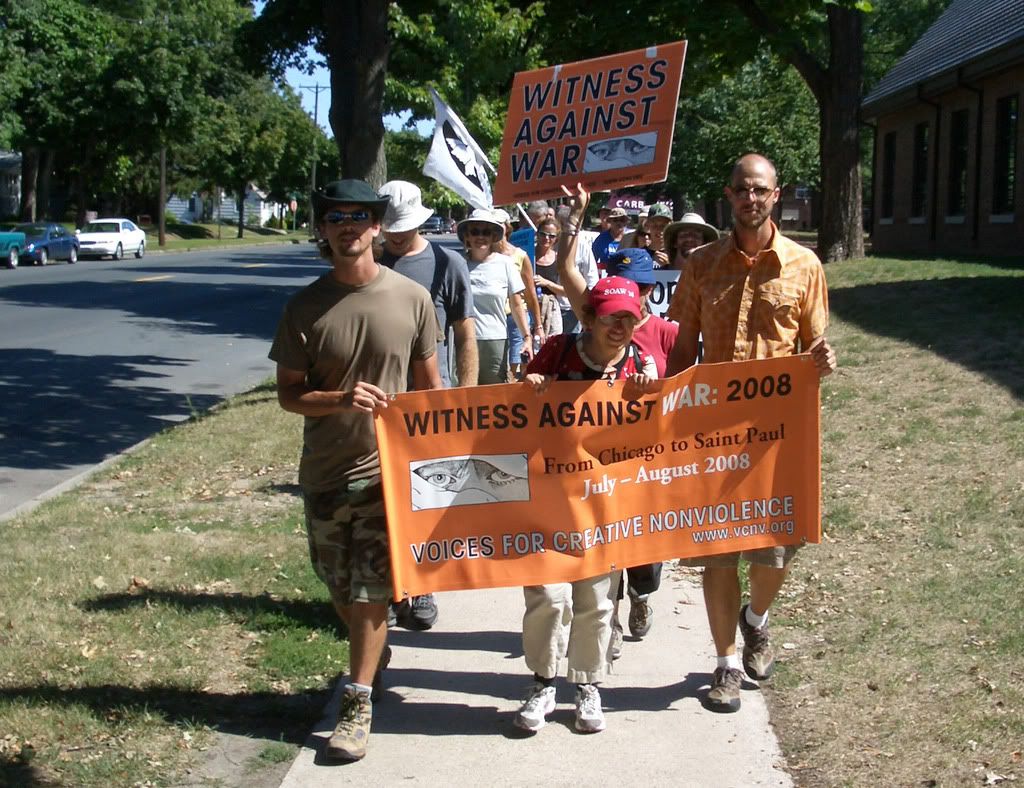
Witness Against War, a seven-week, 497-mile walk to promote peace and nonviolence, crossed its finish line Saturday in St. Paul, in time to greet delegates to the Republican national convention.

A delegation from the national Veterans for Peace convention, taking place in nearby Bloomington, joined the core group of walkers for the last 2.7-mile segment of the trek, which began in Chicago in mid-July.

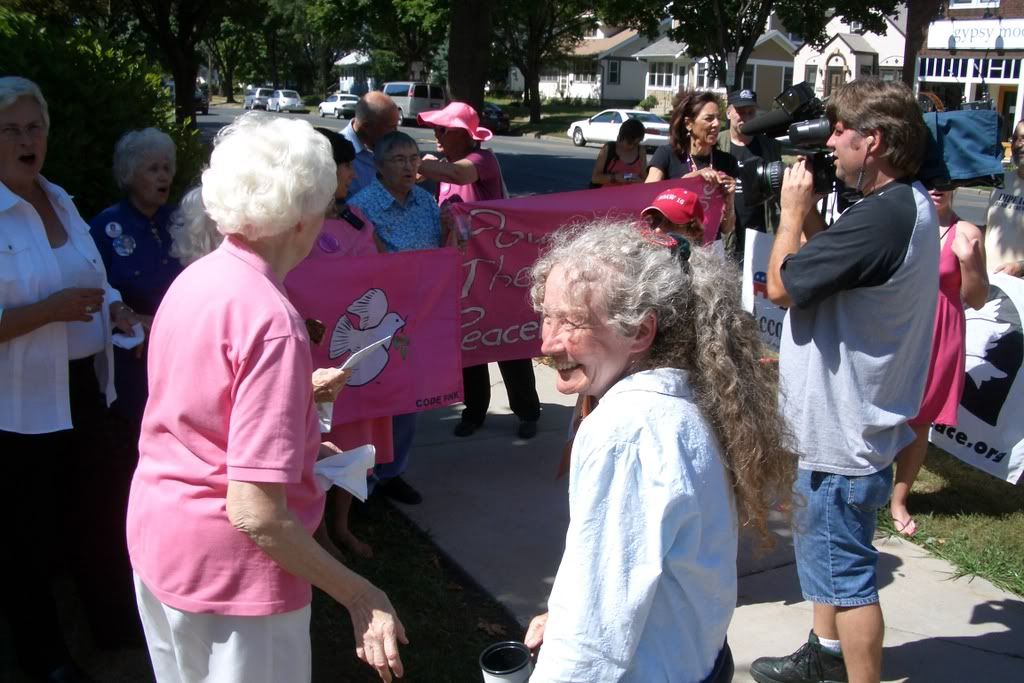
Members of Code Pink and the Sisters of St. Joseph greeted the walkers and hosted a celebration at St. Joseph Church to mark the end of the journey.

Voice for Creative Non-violence organized the walk, and the full route and reports from along the way can be found on its website.

Kathy Kelly (pictured in foreground), a two-time Nobel Peace Prize nominee who is co-coordinator of Voices, was to visit the Veterans for Peace convention later Saturday. The walkers plan to link up with VFP and others during the GOP convention to call for an end to the war and occupation of Iraq.


There's more: "497-mile walk against war crosses finish line in St. Paul in time to greet GOP" >>