Click the image to visit TruthToPower.tv and order The Warning on DVD Watch the trailer here
Contribute To OOIBC ▼
This is a non-profit site that requires much time and effort to maintain. Please help us continue the work we do here by donating whatever you can afford, today.
Petition ▼
More than 44,000 people have signed this petition. Click the Badge to see the latest count and sign the petition.
Click Get Badge to embed the Badge on your site.
Formal Petition to Attorney General Eric Holder to appoint a Special Prosecutor to investigate and prosecute any and all government officials who have participated in War Crimes.
Translate ▼
Search OOIBC ▼
Recent Posts ▼
The Myth of AQI Fighting al-Qaeda in Iraq is the last big argument for keeping U.S. troops in the country. But the military´s estimation of the threat is alarmingly wrong. --By Andrew Tilghman
The rate of Blackwater violence is at least twice that of DynCorp International and Triple Canopy, the other security companies operating in Iraq.Blackwater’s hired guns are just that, discharging weapons, on average, twice every convoy.(The other companies frequently escort convoys completely without incident.)
“You can find any number of people, particularly in uniform, who will tell you that they do see Blackwater as a company that promotes a much more aggressive response to things than other main contractors do,” a senior American official said. “Is it the operating environment or something specific about Blackwater?” asked one government official. “My best guess is that it is both.”
While the bloody rampage at the Nissour traffic roundabout was the most shocking in the level of wanton killing, the modern-day Pinkerton's of Blackwater are under investigation in six other episodes that left ten people dead and at least 15 wounded.
Slowly, American officials are accepting the position that Blackwater's behavior in Iraq is counterproductive to the stated 'mission' by fueling resentment among the local population.
“They’re repeat offenders, and yet they continue to prosper in Iraq,” said Representative Jan Schakowsky, an Illinois Democrat who has been broadly critical of the role of contractors in Iraq. “It’s really affecting attitudes toward the United States when you have these cowboy guys out there. These guys represent the U.S. to them and there are no rules of the game for them.”
[keep reading]
Currently, there are approximately 10,000 armed mercenaries running around Iraq, under contract to various branches of the United States government and NGOs.I know it sounds bizarre, but there is no central oversight authority to which they must answer.
Pragmatically, it just makes sense to bring all armed civilians who are under contract to American government agencies and NGOs, as well as the American military under one authority.It would mean, effectively, that those armed civilians would no longer have multiple bosses at multiple levels and a disparate set of rules.Pentagon officials say it would allow for better coordination and communications between the American military and the private security personnel.
When contractors get in trouble, they call on the US military to bail them out.Fully 30% of the incidents in which the military was called on to save mercenary bacon involved movements and convoys that the military was not even aware had mobilized.
Also on Tuesday, the Iraqi parliament hammered out draft legislation that would repeal Order 17, the imperialistic, extraterritorial immunity granted to mercenaries by Paul Bremmer on his way out of town when the CPA turned over authority to the Iraqi government. Order 17 exempts mercenaries who commit wanton murder of Iraqi civilians (and any other crimes) from prosecution in Iraqi courts.
It was already a given that State was not going to be of much help to their hired guns. Indeed, it has been known for a while now that Blackwater is on it's way out of Iraq, and State will not be renewing their contracts. But the constant barrage of evidence pointing up the incompetence and fecklessness of the State Department under Condi Rice, including the revelation less than 24 hours before the agreement was made that State Department investigators had sanctioned Blackwater lawlessness by routinely issuing immunity to mercenaries involved in shooting incidents, Gates got less resistance from State than was expected.
Diego Garcia is a small island in the Indian ocean. It is owned by the British and was leased to the United States. It currently houses a joint United States/United Kingdom air and naval refueling station and support facilities. Currently, the base is used to house and refuel stealth bombers that were used during the invasion of Afghanistan and Iraq.
The Bush administration has asked for $88 million dollars, tucked into a war funding supplemental, to upgrade stealth bombers so they are capable carrying the bunker buster bombs. The request was based on an "urgent operational need". The bunker buster bomb was originally conceived as a conventional weapon, however, there is another "bunker buster" bomb; one that carries a nuclear warhead.
The Bush administration has repeatedly denied that it is readying to attack Iran. It claims that they are trying every diplomatic option to work out our differences with Iran. This is laughable. The "diplomacy" that President Bush used with Saddam Hussein was to force Iraq to prove a negative; disarm the WMD's you don't have or face invasion. The diplomacy that President Bush is using with Iran? Dismantle the nuclear weapon program you don't have or we attack you.
I say "don't have" in reference to Iran for two reasons; 1) as a signatory to the Non-Proliferation Treaty, Iran has every right to develop peaceable nuclear energy, and 2) even with the Additional Protocol forced upon Iran, the IAEA has no evidence of a weapons program. Still, the Bush administration clings to the rhetoric that Iran is trying to develop a nuclear weapon and we have to stop them at all cost. This leads us to the latest statement made by President Bush; "if you are interested in averting WWIII, you don't want to see a nuclear armed Iran".
So, understand this entire process that President Bush is using:
- We force an Additional Protocol on Iran for IAEA inspections that produces no evidence of a weapon, but, the rhetoric increases. - Our "diplomacy" with Iran consists of sharpening the rhetoric that Iran is trying to build a nuclear weapon and if they don't stop we will attack them. - Since Iran doesn't stop what we have no evidence they are doing, we instill sanctions on their country. - We are now readying the stealth bombers to carry the bunker busters, which will include carrying the nuclear bunker busters.
Why is this path leading to WWIII? Russia and China.
Russia and China have already held two joint military exercises since our invasion of Iraq. The "missile defense" system President Bush is trying to put on Russia's doorstep isn't to stop Iran, it is to stop Russia from being able to back Iran if we do attack. Russia knows this and is taking steps to block it. China holds most of our debt for the Iraq war and can easily plunge our country into economic ruin if it dumps that debt onto the world market all at once.
The war in Iraq, and by default, the entire Middle East, is about oil and getting U.S. military bases into the Middle East to protect/control that oil. That has been American foreign policy since the 1950's. That is why in 1953 the CIA pulled the coup in Iran to instill the pro-western Shah. That is why we supported Saddam Hussein as he was gassing the Kurds in the 1980's. That is why we are supporting General Mousharraf in Pakistan; another dictator. That is why President Bush is clamoring for regime change in Iran and Syria today. It is all about getting friendly puppet governments into power so we can build military bases and shut out Russia and China from having access to the oil.
President Bush's entire gambit at this time is to bet that even if he attacks Iran, even if he drops a nuclear bunker buster or two, countries like Russia and China will not put the entire world at risk by retaliating with a nuclear strike against the United States. But, this premise also hinges on the fact that Russia and China will be willing to sit back and watch the United States take over the Middle East one country at a time, even by nuclear means, until they are shut out totally. This is a mistake of catastrophic proportions; Russia has formally backed Iran.
President Bush is taking a page out of history. In 1940 and 1941, President Truman put so many sanctions on Japan that eventually Japan attacked Pearl Harbor thereby drawing the United States into WWII. Then, President Truman, to stop the war, used nuclear weapons to bomb Japan into submission. Today, President Bush is using sanctions to try and goad Iran into attacking the United States to give him the justification to start a war with Iran. Unfortunately, as we saw with Iraq, even without provocation President Bush will merely lie his way into the war. This time, America may start with nuclear ordnance instead of end with it.
The stealth bombers are already being fitted to use them. The rhetoric is getting worse, not better. The lies are told repeatedly that Iran has a nuclear weapon program despite the fact no evidence has yet been discovered. The sanctions are already being put into effect and military forces gathered.
...we progressives constantly find ourselves banging our heads against the wall or just shaking our heads as we read, see or hear about yet another situation where our core values are being sold out for reasons that I can't fathom. ... Why is this? Is it out of fear? Is it out of complacency? Is it out of not wanting to rock the boat in order to potentially win big next year? Either way, the answer isn't a good one. Right now, we are at a crossroads as the general public still trusts Democrats more on nearly every issue, yet we have always been good at being ahead of the curve.
What happens if a few things that I mention above backfire?
If Americans prove incapable of even admitting we have a problem, let alone working on solutions, in the coming months, then America might be in need of an intervention.
It appears that that intervention is happening, and has been in the works for some time.
The world has had enough of George W. Bush and Dick Cheney, and of those who enable them.
Time to pay attention, Nancy. Now you are free to concentrate on avoiding an electoral debacle in 2008, by ending the occupation of Iraq.
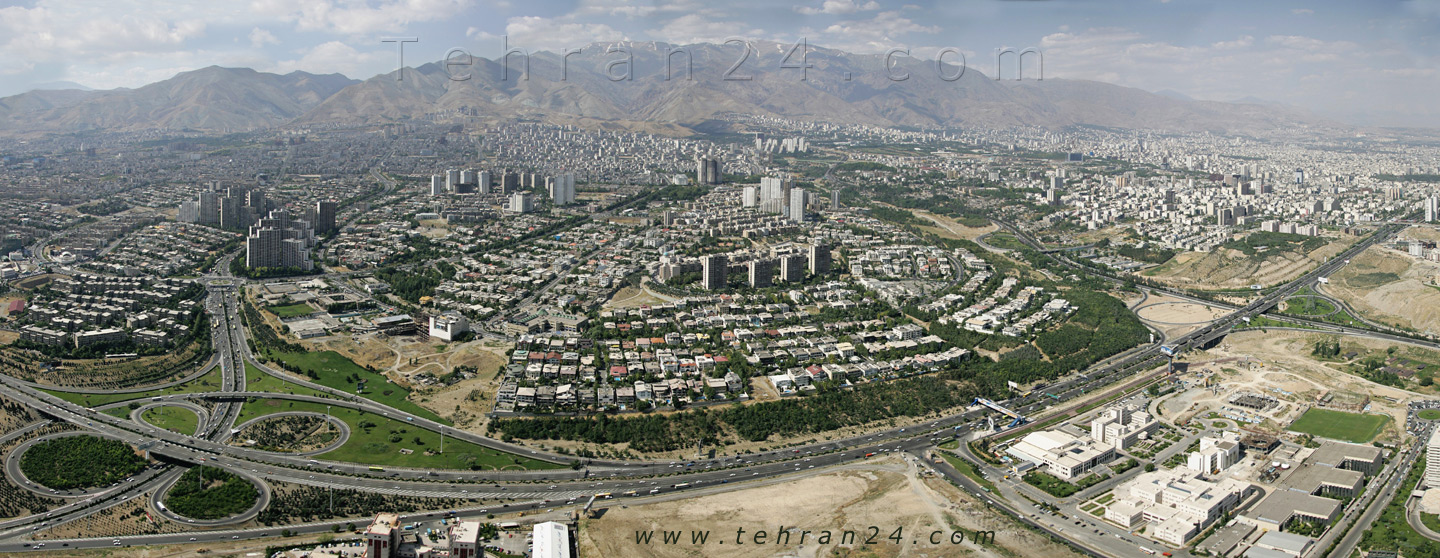
Iran's Capital, Tehran.
This is the country that Nancy Pelosi and the Democratic Leadership, through their complicity and their refusal to do what they were elected in November 2006 to do - stop funding and end the Iraq Occupation - are helping George W. Bush and Dick Cheney to expand their Iraq Debacle into with the continued funding that they provide to Bush.
Fortunately, there are clearer heads in the world than Bush's, Cheney's, or Pelosi's, and if the Democrats will not put a stop to or set a limit to Bush's insanity, it now appears that our old "enemies" the Russians, will. Pepe Escobar wrote in Asia Times on Friday of something that has been, as many things are, almost completely ignored by our complicit mainstream media:
The barely reported highlight of Russian President Vladimir Putin's visit to Tehran for the Caspian Sea summit last week was a key face-to-face meeting with Supreme Leader Ayatollah Ali Khamenei.
A high-level diplomatic source in Tehran tells Asia Times Online that essentially Putin and the Supreme Leader have agreed on a plan to nullify the George W Bush administration's relentless drive towards launching a preemptive attack, perhaps a tactical nuclear strike, against Iran.An American attack on Iran will be viewed by Moscow as an attack on Russia. ... Iranian hawks close to Ahmadinejad are spinning that Putin's proposal involves Iran temporarily suspending uranium enrichment in exchange for no more United Nations sanctions. That's essentially what International Atomic Energy Agency chief Mohammad ElBaradei has been working on all along. The key issue is what - in practical terms - will Iran get in return. Obviously it's not the EU's Solana who will have the answer. But as far as Russia is concerned, strategically nothing will appease it except a political/diplomatic solution for the Iranian nuclear dossier.
US Vice President Dick Cheney - who even Senator Hillary Clinton now refers to as Darth Vader - must be foaming at the mouth; but the fact is that after the Caspian summit, Iran and Russia are officially entangled in a strategic partnership. World War III, for them, is definitely not on the cards.
And it's not only the Russians drawing a line in the sand. China and other Asian countries are also doing their best to box Bush And Cheney and the necocons in and render their imperialist ambitions impotent. Unfortunately their strategies will likely impact all of us.
Pluto, a currency trader, noted in a comment at Docudharma last Thursday that from a monetary standpoint:
...the World is killing us:
Last night (while you were sleeping) Japan, China and Taiwan sold U.S. Treasuries at the fastest pace in at least five years in August.
Japan cut its holdings by 4% to $586 Billion, China cut its holdings 2.2% to $400 Billion, and Taiwan's holdings slid 8.9% to $52 Billion... Japan's selling was at the fastest pace since 2000, China's since 2002, and Taiwan's since 2000...
This sell off was the biggest sell off of Treasuries since Russia defaulted in 1998.
Stick a fork in the U.S.
We're done.
We can't borrow any more money to kill people.
The funny thing is that the entire world knows this. And is talking about it today. Only the Americans are kept clueless.
My focus is on global markets and currencies (with side orders of petroleum and commodities). Meanwhile, the world's focus is on deliberately kicking America's ass (even if it hurts them in the short term). Many nations are willing to take a hard economic hit to rid the world of a dangerous invading nation with an insane leader threatening to "throw atomic bombs" at his make-believe enemies. As a result, experienced U.S. investors have been dumping their US dollars (frantically over the past ten days)
The world has had enough of George W. Bush and Dick Cheney and the neocons, has run out of patience, and is now sending multiple messages that make it obvious that if we don't put a stop to the idiocy ourselves, we will be slapped down by the world.
Justice Department officials grappling with bringing to account the Blackwater mercenaries involved in the murderous rampage in Nissour Square on September 16got a nasty surprise. Investigators from the State Department - who lacked the authority to do so - offered Blackwater USA security guards immunity in exchange for their statements. State Department protocols require that Diplomatic Security agents investigate and report all incidents in which force is used. Last week, the chief of the Diplomatic Security Bureau, Richard J. Griffin, resigned abruptly. Presumably, his inability to control Blackwater was at the root of his sudden departure, but now it looks like he may have left in advance of this information becoming public.
FBI agents took over the State Department's investigation two weeks after the Sept. 16 killing spree, but the damage was already done. None of the information obtained during questioning of the guards by the department's Bureau of Diplomatic Security, the division of the State Department that oversees security contractors, will be admissible. (I believe that defense attorneys call this "fruit of the poisoned tree.")
Subsequently, some Blackwater guards have cited promises of immunity from State, and refused to even be interviewed by the FBI. The Justice Department is not precluded from bringing charges using other evidence, but the inadmissibility of their initial statements complicates matters significantly.
Most of the guards who took part in the Sept. 16 shooting were offered what officials described as limited-use immunity, which means that they were promised that they would not be prosecuted for anything they said in their interviews with the authorities as long as their statements were true. The immunity offers were first reported Monday by The Associated Press.
The officials who spoke of the immunity deals have been briefed on the matter, but agreed to talk about the arrangement only on the condition of anonymity because they had not been authorized to discuss a continuing criminal investigation.
The precise legal status of the immunity offer is unclear. Those who have been offered immunity would seem likely to assert that their statements are legally protected, even as some government officials say that immunity was never officially sanctioned by the Justice Department.
Spokesmen for the State and Justice Departments would not comment on the matter. A State Department official said, “If there’s any truth to this story, then the decision was made without consultation with senior officials in Washington.”
This complicates an already-dicey legal situation. Blackwater and other mercenary outfits are immune from prosecution under Iraqi law under Order 17, signed by Paul Bremmer on his way out of town. The order still stands, the Iraqi parliament has not repealed it. They can't be tried in military courts (at least not yet.) And it is unclear what American criminal statutes apply to armed Americans operating in a war zone.
A review panel sent by State to investigate the incident determined that the legal standing to hold the Blackwater mercenaries to account under U.S. federal statute was lacking, and urged Congress to address this gaping loophole in accountability and oversight authority. To date, the House has passed a bill with an overwhelming majority that would hold all security contractors* liable under the Military Extraterritorial Jurisdiction Act; the Senate is considering similar legislation. Some legal experts have suggested that the Nissour Square killings be the first cases prosecuted through the act once it is extended.
But...(Isn't there always a great big But...?)
For a case to be tried in federal court, evidence is only admissible when it meets a very high chain-of-custody bar, designed to put in place guarantees that evidence has not been tampered with. Evidence gathered by foreign investigators and turned over to U.S. investigators is reflexively seen as suspect on it's face, and the admissibility of the evidence would be contested by any first year law student. Additionally, the Constitutional guarantee of the accused to cross-examine witnesses is problematic in these instances, requiring foreign witnesses be transported to the United States to appear in court.
What was from the outset a brutally difficult case to bring was complicated further by the actions of the State Department investigators.
So was it incompetence? Could the Keystone Kops run a better State Department?
Or was it obstruction? Yet another instance of sand in the umpires eyes?
Most could see the problems with the PKK coming and many could see a way to avert them. Unfortunately none of those people were in the Bush administration' State Department. A Missed Moment In Iraq
The Bush administration has only itself to blame for the quandary it faces with Turkish forces poised to intervene in northern Iraq. The Turks want to retaliate against the Kurdistan Workers' Party (PKK), whose insurgents killed 12 Turkish soldiers Sunday. A massive retaliation would be a major misfortune for Turkey, Iraq and the United States.
First, it would undermine the stability of the only part of Iraq where the United States is welcome. Second, it could plunge Turkey into an Iraq quagmire of its own.
Sadly, this crisis was predictable and predicted. U.S. officials have long known that a Turkish incursion was just one terrorist event away. As tensions mounted, the administration had numerous opportunities to engage in preventive diplomacy. A combination of lack of imagination, incompetence and sheer lack of knowledge at the State Department has caused this impasse. To make matters worse, on Tuesday the department tried to shift the blame to the Iraqi Kurds, expressing unhappiness over their inaction.
A missed opportunity
The irony is that both Iraqi Kurds and the AKP government directly or indirectly signaled the Bush administration that they were interested in a deal. I know that senior Iraqi Kurds have forwarded ideas to U.S. officials. The AKP, on the other hand, sought to test the waters first by sending its intelligence chief two years ago to talk to the Kurds -- something the government is loath to do officially -- and by organizing a private meeting this year between the Kurdish Regional Government's prime minister, Nechirvan Barzani, and then-Turkish Foreign Minister Abdullah Gul. The chief of the Turkish general staff, Yasar Buyukanit, who in a fiery speech warned the government not to talk to the KRG, scuttled Gul's meeting.
The Bush administration missed an opportunity when it failed to see and support the desire for such dialogue and use its good offices to construct a "grand bargain" between the Iraqi Kurds and Ankara. At minimum, such a bargain would have required the Iraqi Kurds to dislodge the PKK from Iraq and for the Turks to offer guarantees on trade and security to the Iraqi Kurds.
For the United States, this would have meant the consolidation of northern Iraq; paradoxically, a Kurdish north at peace with Turkey is the best antidote to separation from Iraq. In short, this would have been a winning situation for all.
The best the administration can hope for now is to persuade the Turks to engage in a limited cross-border military operation. That might contain public anger and assuage a vitriolic press.
The only other thing to hope for is bad weather. With the onset of winter and dwindling military activities, Washington will perhaps have the diplomatic window of opportunity it almost closed. Three years late, it will be much harder to succeed.
Of course we are dealing with a State Department headed by Condoleezza Rice - the most incompetent National Security advisor in history who became the most incompetent Secretary of State in history. She has zero respect and credibility in the world so don't expect this or any other "diplomatic" efforts to be successful until 2009.
A 105mm M1 Abrams tank, outside the Tank-Army Automotive and Armaments Command (TACOM) Detroit Arsenal, Warren, MI
On Monday, ten specially trained auditors, criminal investigators and acquisitions experts will descend on the Tank-Army Automotive and Armaments Command (TACOM) north of Detroit to begin an audit of a sampling of approximately 6000 contracts worth $2.8 billion issued by an Army office in Kuwait that has been identified as a hotbed of corruption.
The office in question, located at Camp Arifjan, buys supplies and gear to support American G.I.'s as they rotate in and out of Iraq. Nearly two dozen Army, military and civilian employees have been charged with accepting bribes and kickbacks, and $15 million has changed hands. Depending on what the investigators discover, the number of individuals charged will likely grow. Currently the Army Criminal Investigations Command has 83 ongoing corruption investigations relating to contract fraud.
The highest profile corruption case to be charged so far involves Army Maj. John Cockerham, who stands accused of bribery, conspiracy, money laundering and obstruction. Prosecutors charge that Cockerham, in concert with his wife and sister, took at least $9.6 million in bribes in 2004 and 2005 during the time he was a contract officer in Kuwait.
Some of the red flags that have been raised include contracts awarded to vendors outside the usual competitive bidding process and contracts that went through the motions of the bidding process, then were awarded to the highest rather than the lowest bids. In other instances, what was purchased was not what was delivered.
"Is there anything in there that might indicate to us that there might be some potential fraudulent activity?" Jeffrey Parsons, director of contracting at Army Materiel Command, said in an AP interview. "If there are patterns that we start to identify, then we're going to do further review."
Contracts with significant problems will be forwarded to the Army Audit Agency and the Army Criminal Investigation Command. If there's credible evidence of wrongdoing, the FBI and prosecutors from the U.S. Justice Department are called in.
In Warren, Mich., home to a large Army acquisition center, the contracting review team will examine 314 of the Kuwait contracts, each worth more than $25,000 and issued between 2003 and 2006.
In Kuwait, a separate team of 10 at Camp Arifjan is already going through 339 contracts of lesser value and awarded during the same time period, according to Army Materiel Command at Fort Belvoir, Va.
Both reviews are to be finished before the end of the year.
Preliminary results of an investigation into the contracts coming out of Camp Arifjan in 2007 has wrapped up, and the investigators uncovered numerous problems with the office, including high staff turnover, slip-shod record keeping, inadequate staffing, and lack of oversight. Those personnel problems, coupled with billions of dollars of war funding, create an environment where corruption, malfeasance and misconduct find fertile soil.
The investigative teams in both Michigan and Kuwait will be reviewing paper records, but they will also be using data-mining techniques to search electronically stored data for signs of wrongdoing. "Do we have contractors with different names but the same address?" Parsons said. "That would cause some suspicion." He also indicated that the investigators would be relying on tips provided by individuals familiar with the imperfect process.
If a contractor and an acquisitions officer conspire to break the rules for personal gain, uncovering the corruption can be extremely difficult. "You can have a contract file that is pristine - all the documentation is there," Parsons said. "Just going through the contract files doesn't necessarily give you 100 percent assurance that something else might not have been going on."
Beating the checks and balances in the federal procurement process is a difficult trick to pull off, requiring attention to detail and precise planning. It takes someone schooled in the system to know how to evade it. Unfortunately, the Army had some very smart "bad apples" who knew how to pull it off.
The 6000 contracts that came from the office in Kuwait spawned 18,000 transactions for myriad support items, from laundry and warehouse services to bottled water and food. Every transaction presented an opportunity for fraud to be committed.
In 2005, two Lt. Generals who were top commanders in Iraq, Steven Whitcomb and John Vines, became so concerned about allegations of corruption that they pushed for the Criminal Investigation Command to establish field offices in Iraq and Kuwait.
The Army investigating the allegations of fraud, abuse, bribery, corruption and kickbacks is a good start, but it is time to take a page from history. It is time for a reprise of the Truman Committee.
In 1940, as World War II gripped the globe and United States involvement in the conflict became more and more likely, the United States appropriated $10 Billion in defense contracts in preparation for that eventuality.
Early in 1941, reports of malfeasance and abuses by the contractors reached Missouri Senator Harry S Truman, and the news did not sit well with WW I Infantry Captain “Give ‘em Hell Harry.” In typical Truman fashion, he set out to seek the truth, not by summoning “experts” but by embarking on a 10,000 mile tour of military installations. On this fact-finding tour, he discovered that the companies that received the contracts were clustered in the east, with a mere handful divvying up most of the largesse. He also discovered that they were receiving a fixed-profit, regardless of performance.
He returned to the Senate convinced that the defense efforts of the United States were being undermined by waste and corruption, and he proposed the notion of a special Senate committee that would investigate the National Defense Program.
President Roosevelt was convinced to let Truman head up the committee, being sympathetic to the President and his administration. The President was assured that the committee would not be too much trouble, as it would only be allotted $15,000 to investigate billions in defense contracts.
The Truman Committee was created by unanimous Senate decree on 01 March 1941. Over the next three years, with Senator Truman at the helm, the committee held hundreds of hearings, traveled thousands of miles to conduct field inspections, and saved millions of dollars in cost over-runs. Senator Truman was not shy about threatening executives with prison time as he whacked greedy corporate snouts out of the public trough.
During her campaign, she seized on my the idea of a modern day Truman Committee to investigate waste, fraud and corruption in the reconstruction of Iraq. During a speech in Harry S Truman’s hometown of Independence last year, she spoke admiringly of the former President and his diligence in reining in war profiteers. "He was fearless. He uncovered enormous undeserved profits. I believe we need a new Truman Committee. I will fight for such a committee.”
Less than a year after she was elected, and a mere nine months after taking her seat, she is very close to bringing the notion to fruition. The Senate recently agreed to a plan from Senators McCaskill and Webb to get a handle on the Pentagon’s scattershot method of awarding private contracts for work in Iraq. It was added to the Defense Authorization Bill for 2008.
The audits that get underway on Monday certainly underscore the need for the the oversight body that would be created from the legislation offered by Webb and McCaskill. In fact, they demand it.
This is the country that George W. Bush and Dick Cheney want to expand their Iraq Debacle into by attacking.
This is the country that Nancy Pelosi and the Democratic Leadership, through their complicity and their refusal to do what they were elected in November 2006 to do - stop funding and end the Iraq Occupation - are helping George W. Bush and Dick Cheney to expand their Iraq Debacle into by attacking.
Fortunately, there are clearer heads in the world than Bush's, Cheney's, or Pelosi's, and if the Democrats will not put a stop to Bush's insanity, it appears that our old "enemies" the Russians, will.
The barely reported highlight of Russian President Vladimir Putin's visit to Tehran for the Caspian Sea summit last week was a key face-to-face meeting with Supreme Leader Ayatollah Ali Khamenei.
A high-level diplomatic source in Tehran tells Asia Times Online that essentially Putin and the Supreme Leader have agreed on a plan to nullify the George W Bush administration's relentless drive towards launching a preemptive attack, perhaps a tactical nuclear strike, against Iran. An American attack on Iran will be viewed by Moscow as an attack on Russia. ... Iranian hawks close to Ahmadinejad are spinning that Putin's proposal involves Iran temporarily suspending uranium enrichment in exchange for no more United Nations sanctions. That's essentially what International Atomic Energy Agency chief Mohammad ElBaradei has been working on all along. The key issue is what - in practical terms - will Iran get in return. Obviously it's not the EU's Solana who will have the answer. But as far as Russia is concerned, strategically nothing will appease it except a political/diplomatic solution for the Iranian nuclear dossier.
US Vice President Dick Cheney - who even Senator Hillary Clinton now refers to as Darth Vader - must be foaming at the mouth; but the fact is that after the Caspian summit, Iran and Russia are officially entangled in a strategic partnership. World War III, for them, is definitely not on the cards.
It feels so different watching an aircraft carrier group coming toward you than watching it sailing away from you toward another part of the world.
I'm an American who used to live in New York City. All my life, when I heard about warships, it was US warships going places far away. I never even imagined hostile warships sailing toward New York. Now I'm in Tehran, and aircraft carrier USS John C. Stennis is heading our way. And as it sails, people are discussing Israel and/or the US bombing Iran as if my family and 69 million other people weren't even here. I'm getting scared.
Most Iranians that I know don't worry about this as much as I do, though they're wondering how the sanctions will affect the economy. Khomeini had a famous saying that we actually saw on a sign yesterday in another town: "America can't do anything to us." Some friends here speculate that Bush just needs an enemy so that he can continue his programs in the US, and that Iran is the enemy du jour. I wish I could believe that.
The way I see it, somebody has to stop the US president right now, and it's very upsetting that the Congress isn't doing it. My frustration is greater because I'm in a country where the Internet is not completely available. For example, I tried to send a donation to Dennis Kucinich, but PayPal wouldn't take it because of the embargo. I tried to write to my Congressperson, but the Islamic Republic blocked the communication, presumably because it was with the US government. (Sometimes news stories that I want to read are blocked, too, but there are ways around that.)
If the US and/or Israel attack Iran, it will be a war based on lies, just like the Iraq war. Iraq didn't have WMD, but Iraqis died in the hundreds of thousands. The lies about Iran seem intended to, first, make Iran look like the new Nazi state that must be bombed so as to avoid a new Holocaust, and second, make Americans fear that Iran will hurt our soldiers in Iraq or give nuclear weapons to terrorists who will hurt us in "the homeland."
History shows that Americans are very susceptible to demonization of particular leaders of countries that the US wants to attack. Remember Castro? Noriega? Saddam? Now it's Ahmadinejad. Whatever people think of views attributed to Ahmadinejad, it remains the case that it's not morally acceptable to kill people because of their president, whether that president be Saddam Hussein, Mahmoud Ahmadinejad, or George Bush.
I want to discuss six big lies we are hearing to justify expanding the war to Iran. LIE NUMBER 1: President Ahmadinejad "has repeatedly threatened to wipe Israel off the map."
Even Al Jazeera English version based in Qatar keeps saying that. Why hasn't this mistranslation been corrected after it's been thoroughly exposed? (in the Guardian and prisonplanet.com)
Juan Cole, in Informed Comment, explained how "wiped off the map" was a mistranslation; Ahmadinejad was restating the official Iranian policy that the government system based on Zionism must end. And why the heck can't newscasters learn to pronounce the man's name? Anyone who knows Farsi could teach them in a minute. Why should we think they know what he said, in Farsi, if they can't even say his name?
LIE NUMBER 2: The Iranian government is run by 1930s-style anti-Semites.
Last Spring, a story was planted that the Iranian parliament had passed a law forcing Iranian Jews to wear yellow badges. "Fourth Reich," screamed a banner headline on one of the New York City tabloids. In a few days, the neocon source was disclosed and the story was completely retracted by the Canadian paper in which it was first published. The New York paper never apologized. When I mention the "yellow badges" to people here in Iran, they look incredulous. "But ... that didn't happen." I know. But I'll bet there are some Americans, and Israelis, who actually believe Jewish Iranians are walking around wearing yellow badges.
LIE NUMBER 3: Iran is bent on wiping out the Jews.
Maybe Americans should have a little humility and remember how recalcitrant the US was about accepting Jewish refugees fleeing Hitler during WWII. Iran has a very good history, under Cyrus the Great, of protecting the Jews. The long history of Jews in Persia is indicated by a monument to the Jewish prophet Daniel in the south of Iran. As for the European Holocaust deniers who were among the speakers at the Holocaust conference in Tehran, I just can't figure it out, unless Ahmadinejad is trying to win popularity points with pro-Palestinian regional populations by appearing to be unafraid of Israel and the US. Or he could be a fool and/or a religious fundamentalist (like some other presidents who shall go unnamed).
LIE NUMBER 4: Iran is causing trouble in Iraq and threatening Arab states.
Everyone should be very clear: Who's meddling in Iraq, who's flying thousands of missions shooting at Iraqi citizens, who attacked whose diplomatic mission, who is detaining whose citizens, and who has announced that it is supporting subversive operations inside whose country and across whose border (from Iraqi Kurdistan)? Most likely some of the undemocratic and unpopular rulers in the Middle East are afraid that their own citizens may be attracted to the Iranian model. That may concern the US oil men and financiers who have business and military ties with them, but it's not a reason for Americans to back destruction of Iran.
LIE NUMBER 5: Iran is dangerous to humanity because it's trying to get nuclear weapons.
Other people who know more than I are writing about the nuclear issues. But regarding threats by Israel and the US to bomb Iranian nuclear research sites, that's a violation of international law, not to mention a danger to innocent civilians. Regulating nuclear activities is the responsibility of the IAEA. So far, the IAEA has declared that Iran does not have nuclear weapons and is in compliance with the nuclear non-proliferation treaty. That's more than we can say about the USA, which is supposed to be actively disarming its 10,000 warheads, not refurbishing them and developing new kinds of nuclear weapons. Though there are good reasons to think Iran does not want nuclear weapons, let's imagine, just for the sake of argument, that Iran would someday acquire them. Humanity has managed to live with other countries having nukes. The only reason Iran's having nukes would be of greater concern would be if the lies spelled out above were true. But they're lies.
LIE NUMBER 6: Iranians are looking to the USA to bring them democracy, just like the USA has brought democracy to Afghanistan and Iraq.
I'm living here in Tehran, Iran, now, with my family, as are many other Americans, Europeans, Asians, and other foreigners. We are inviting friends and relatives to come and visit. The skiing's fine. More democracy and more civil liberties would be better, but there are elections and there are laws and there are non-governmental organizations and you can approach public officials. Whatever's not right with this country is the business of the people here to work on. Some Iranians living in other countries want the US to "save" Iran. I don't know, but I suspect people like that would like the US to magically bring back the good old days when the US-allied Shah sat on his throne and the well-off classes had a fine life. If anyone finds any overseas Iranians who actually are willing to see Iran bombed, I hope the reporters ask them if they have any relatives currently living in Iran. I hope Americans don't take these has-beens too seriously.
---------- Rosa Schmidt Azadi is a long-time peace activist, an anthropologist, and a retired civil servant who's also a wife, daughter, sister, aunt, great-aunt, godmother, and the mother of two college students. After walking out of the smoke of the 9-11 attacks in New York City and returning to participate in the recovery effort, Rosa began working to prevent further death and destruction in other countries at the hands of the U.S. government. Participating in a peace vigil at the World Trade Center site for more than three years gave her the privilege of talking with thousands of people from all over the world about things that matter most. Dr. Azadi has earned two advanced degrees and is still learning. Currently, she's splitting her time between Tehran, Iran, and upstate New York.
Contrary to popular belief, it appears that Israel's attack on Osirak [Iraq's nuclear reactor] in June of 1981 did nothing to hinder Iraq's nuclear aspirations. Although it temporarily set back its capabilities, it served rather to reinforce and increase Saddam's desire for a nuclear arsenal. ... With regard to Iran, there is no reason to believe that an attack on the facilities in Bushehr, Arak, or Natanz would have any different consequence than the Osirak example. Such an attack would likely embolden and enhance Iran's nuclear prospects in the long term. In the absence of an Iranian nuclear weapon program, which IAEA inspectors have yet to find, a preemptive attack by the United States or Israel would provide Iran with the impetus and justification to pursue a full blown covert nuclear deterrent program, without the inconvenience of IAEA inspections. Such an attack would likely be seen as an act of aggression not only by Iran but most of the international community, and only serve to weaken any diplomatic coalition currently available against Iran.
The most troubling aspect of such a scenario is that, unlike Iraq in 1981, Iran is not dependent on foreign imports for nuclear technology and already has available the raw materials, and most of the designs and techniques, required to pursue a nuclear weapons program. Iran has the necessary know-how and has already produced every stage of the nuclear fuel cycle.[31] Furthermore, Iran has uranium mines in Yazd and is in the process of constructing milling plants to manufacture yellow cake uranium and conversion plants that convert it to UF6 gas.[32] Iran has also begun manufacturing its own gas centrifuges used to enrich uranium. Even if Natanz, Arak, and Bushehr were destroyed in a preemptive strike, Iran probably has duplicate equipment that can be activated and has the know-how to produce more, to pursue a more vigorous and unabated nuclear weapons program in the long term.
Effect on Iran's Relationship Vis-a-Vis the IAEA and International Coalition
In the event of an unprovoked preemptive attack on its nuclear facilities, Iran could justifiably argue that it requires nuclear weapons to guard against aggression and protect its sovereignty, effectively announcing its intention to withdraw from the NPT and altering the current international dynamic. Especially given the recent lack of substantiation in the Iraqi WMD case, such a strike would undoubtedly result in U.S. or Israeli diplomatic isolation.
The practical diplomatic consequences of a preemptive attack in Iran are worth considering. In the aftermath of such a strike, it is highly unlikely that the United States would be able to convince members of the UN Security Council to impose sanctions on Iran. Without international sanctions, Iran will be able to allocate greater financial and human resources to its nuclear program. If the Iraqi Osirak example is any indication, the size of Iran's nuclear program would probably increase dramatically, as the Iranian government touts an expanded nuclear program as the key to deterring Iran's enemies.
As the target of an unprovoked attack, Iran gains by pointing to justifications for escaping the constraints of the NPT, therefore becoming a much greater proliferation threat. Unrestrained, the Iranians will have the means and technology to eventually manufacture gas centrifuges and mine, mill, convert, and enrich uranium. Even under IAEA intrusive inspections, Iran has assembled more than 920 gas centrifuges, 120 of which were assembled in just two and a half months, between November 2003 and mid-January 2004.[33] To enrich enough HEU to make one nuclear bomb requires running 750 gas centrifuges for one year.[34] If Iran seceded from the NPT, and increased the size of its nuclear program, it would be able to manufacture and assemble many more gas centrifuges, and therefore rapidly enrich uranium. Once sufficient fissile material is obtained, designing a basic nuclear warhead can be easily accomplished. In the absence of intrusive inspections or threat of UN Security Council (UNSC) sanctions, the only way to prevent Iran from obtaining a nuclear weapons capability would be to occupy Iran, a very unlikely occurrence given the serious challenges already faced by the United States in a smaller, weaker Iraq.
Effect on U.S.-Russian Relations
Attacking Iranian nuclear facilities also has the potential of igniting a diplomatic crisis between the United States and Russia. The Russian Federation is not only Iran's foremost supplier of nuclear technology and training, it is reported that hundreds of Russian scientists and technicians currently work in Bushehr. A preemptive attack on Bushehr may kill a large number of Iranian and Russian personnel; the ensuing diplomatic crisis could seriously affect not only Russian-U.S. trade but also cooperation on international matters, including the war on terrorism.
A pre-emptive attack on George Bush's and Dick Cheney's psychotic fantasies would result in much better consequences.
It’s bad enough that a majority of soldiers voted for Bush in 2004. Over and over since the war began, American troops have been seen on television applauding Bush, Rumsfeld, Rice and others whose cynical recklessness have sent their buddies to their graves. …
Four years after the WMDs and liberation flora failed to turn up, people still enlist. After soldiers die, their parents insist that theirs was a noble sacrifice. Tell me again: Why should I care about the war? Why shouldn't I go shopping?
Soldiers who want antiwar Americans to march to demand that they be brought home should take a cue from Vietnam veterans. They marched with peace protesters and threw their medals at the Capitol. Soldiers serving on the front refused orders. Some fragged their officers. Vietnam Veterans Against the War claimed more than 50,000 members by 1971. That year saw numerous dramatic acts of dissent by U.S. troops, including 50 veterans who marched to the Pentagon and demanded that they be arrested as war criminals. Fifteen vets took over and barricaded the Statue of Liberty for two days. These acts swayed opinions and helped convince lawmakers it was time to withdraw.
As usual, I agree with Rall. I think many soldiers are even intoxicated with war as a form of pornographic violence.





 US Vice President Dick Cheney - who even Senator Hillary Clinton now refers to as Darth Vader - must be foaming at the mouth; but the fact is that after the Caspian summit, Iran and Russia are officially entangled in a strategic partnership. World War III, for them, is definitely not on the cards.