Showing posts with label Iran. Show all posts

Sunday, February 22, 2009


THE SECRET WAR

.
US "ADVISORS" "TRAINING" PAKISTANI TROOPS

US "ADVISORS" "TRAINED" SOUTH VIETNAMESE TROOPS, IN THE BEGINNING

YOUTUBE: CBS: THE SMOTHERS BROTHERS COMEDY HOUR [1968]
"Pete Seeger: Waist Deep in the Big Muddy"
Pete tried to warn us.


Before You Knew It, We Were Ass-Deep In The Big Muddy. And The Big Fool Said To Push On.

Certain terms will stick in the mind, intended though they are to avoid our attention altogether, or confuse it. "Terminate with extreme prejudice" turned out to mean "kill," in plain English. "Extraordinary rendition," is kidnapping on an international scale. "Advisors" are combat troops we don't want to acknowledge sending into situations where they don't belong.

The United States had "advisors" in Vietnam in the 1950's. Evidently, their advice wasn't very good. In 1965, we sent the whole First Marine Division in to "advise" the Viet Cong and North Vietnamese Army out of existance. Nine years later, we got our asses kicked out of there, with 58,000 dead, 300,000 wounded, and untold thousands of mentally disabled and drug-addicted Americans, some of whom are still homeless today, to show for our "advice." The war put us into a decade-long recession, and sidetracked progressive programs for forty years. Vietnam was left a bloody mess, from which they are only just starting to recover. They lost millions of souls, men and women, children and old people, civilian and military. Their country was destroyed. We dropped more bombs on them than on Germany & Japan combined in WWII. That was Nixon's "secret plan for peace": Bomb them back to the Stone Age, as the Air Force gleefully put it. It didn't work.

(continued)
.

.

No one knows what the secret plan is now. It's a secret. One wonders if our new President has been fully informed. Once they get rolling, our military seems to just keep rollin' along, no matter who is the putative CIC, or what new policies are put in place. Obama did promise to move the "War on Terror" to Afghanistan, and to pursue Al Qaida into Pakistan "if necessary." So, maybe he did order these "advisors" in. Maybe he is the one planning a major long-term commitment in South-West Asia, or maybe he's just going along with his generals, like LBJ did in Vietnam. But we don't know, do we? It's a secret. From us, the taxpaying voters of the United States.

Maybe we should ask. Yeah, we'd like to crush Al Qaida and capture Bin Laden. Yeah, we have to straighten out the messes we made in Iraq and Afghanistan. But we voted to end the war, not to extend or expand it. We don't want to start another mess in Pakistan. After all, they have nukes, and missiles to deliver them. And they're chronically corrupt and unstable, with the constant threat of war with India, and terrorism from within. They make their other neighbors, like Iran and China, very nervous too. It might not be such a good idea to start another Vietnam in Pakistan, from which we might have to run away with our tail between our legs because it just ain't do-able, no way, no how, any more than Vietnam ever was. Except we'd be leaving behind a nuclear-missile-armed potential Islamic fundamentalist State that would have very good reason, as Iran does, to be hostile to the West. Especially toward us, the tax-paying voters of the United States.

So, hey, advisors. Let's think about this. Before we get ourselves ass-deep in another Big Muddy. A radioactive one.


ABC NEWS WWSB TV7 SARASOTA, FL
"US advisers training Pakistani troops"
They're admitting to 30, multiply by a Military Bull Sh*t Factor of ten, so that's at least 300. And now it's escalating.

' A U.S. effort to train Pakistani troops in their fight against al-Qaida and the Taliban is larger than previously acknowledged. The New York Times reports the task force of about 70 advisers is helping the Pakistanis with intelligence and advises them on combat tactics. But it isn't taking part in any fighting. The Times report cites U.S. military officials. Most of the advisers are Army Special Forces soldiers. They include combat medics and communications specialists. Last year, Pakistani army officers said about 30 American advisers were training troops in northwest Pakistan, near the Afghanistan border. '

NY TIMES
"Secret U.S. Unit Trains Commandos in Pakistan "
Not so secret any more. Let's see, official Army body count of 60, divided by an MBS Factor of ten, so we got six guys. Oh, and we're running Pakistani Air Force operations out of the U.S. embassy in Islamabad. Spooky.
' They make up a secret task force, overseen by the United States Central Command and Special Operations Command. It started last summer, with the support of Pakistan’s government and military, in an effort to root out Qaeda and Taliban operations that threaten American troops in Afghanistan and are increasingly destabilizing Pakistan. It is a much larger and more ambitious effort than either country has acknowledged. Pakistani officials have vigorously protested American missile strikes in the tribal areas as a violation of sovereignty and have resisted efforts by Washington to put more troops on Pakistani soil. President Asif Ali Zardari, who leads a weak civilian government, is trying to cope with soaring anti-Americanism among Pakistanis and a belief that he is too close to Washington. Despite the political hazards for Islamabad, the American effort is beginning to pay dividends. A new Pakistani commando unit within the Frontier Corps paramilitary force has used information from the Central Intelligence Agency and other sources to kill or capture as many as 60 militants in the past seven months, including at least five high-ranking commanders, a senior Pakistani military official said. In addition, a small team of Pakistani air defense controllers working in the United States Embassy in Islamabad ensures that Pakistani F-16 fighter-bombers conducting missions against militants in the tribal areas do not mistakenly hit remotely piloted American aircraft flying in the same area or a small number of C.I.A. operatives on the ground, a second senior Pakistani officer said. '

OLIVE DRAB.COM
"Vietnam: U.S. Advisors 1955-1965"
A little parallel history: Advisors on the march.
' The U.S. military advisory effort in Vietnam had a modest beginning in September 1950, when the United States Military Assistance Advisory Group (MAAG), Vietnam, was established in Saigon. Its mission was to supervise the issuance and employment of $10 million of military equipment to support French legionnaires in their effort to combat Viet Minh forces. By 1953 the amount of U.S. military aid had jumped to over $350 million and was used to replace the badly worn World War II vintage equipment that France, still suffering economically from the devastation of that war, was still using.
. . .
By 1961 the steady progress of the insurgency was near crisis levels. The new Kennedy administration increased American support for the Diem regime to prevent a collapse. By December of 1961, 3,200 U.S. military personnel were in Vietnam as advisors, supported by $65 million in military equipment and $136 million in economic aid. Military assistance was reorganized as the United States Military Assistance Command, Vietnam (MACV), formed under the command of General Paul D. Harkins in February 1962. MACV was there to support the Army of the Republic of Vietnam (ARVN) to defend the country. MACV included Army Special Forces (Green Beret) instructors and CIA personnel organizing the Montagnards in the mountains.
. . .
South Vietnam was going to fall to the Communists unless the U.S. intervened, but Pres. Johnson hesitated to increase the commitment of troops, trying to balance his interest in big domestic programs against the mounting crisis in Southeast Asia. Then came an incident in the Gulf of Tonkin, 2 August 1964. '

DIGITAL HISTORY
"Learn About the Vietnam War"
A majority of the Vietnamese people just didn't want us there. But their corrupt, incompetent, hated US puppet government couldn't live without us.
' To support the South’s government, the United States sent in 2,000 military advisers, a number that grew to 16,300 in 1963. The military condition deteriorated, and by 1963 South Vietnam had lost the fertile Mekong Delta to the Vietcong. In 1965, Johnson escalated the war, commencing air strikes on North Vietnam and committing ground forces, which numbered 536,000 in 1968. '

GLOBAL SECURITY.ORG
"‘Big Red One’ Takes on Iraq Military Advisor Training Mission"
Advisor = Advance Man. Iraqi Security Forces = ARVN. "War On Terror" = Vietnam.
' An entire Army combat division has been given the mission of training U.S. military advisors for duty within Iraqi army and police units, a senior U.S. military officer in Baghdad said yesterday. The U.S. Army’s 1st Infantry Division, based at Fort Riley, Kan., is now responsible for training U.S. advisors for service in Iraq, Army Brig. Gen. Dana Pittard, commander of the Iraq Advisory Group, told reporters at a news conference in the Iraqi capital city. The change represents “a huge investment,” Pittard said, noting two brigade combat teams based at Riley also are committed to training advisors. Pittard said he works in tandem with Army Brig. Gen. Terry Wolff, commander of the Coalition Military Assistance and Training Team. Pittard and Wolff, who also attended the press briefing, have oversight over military advisors that support the Iraqi army, the national police, as well as the Department of Border Enforcement. “We really cover two different areas, but have very, very similar goals, and that is to support the Iraqi security forces,” Pittard said. '

YAHOO NEWS
"US, Iraqi forces launch anti-al-Qaida offensive"
"Support" only. So, nobody is at risk? MBSF is off the charts!
' The offensive comes more than a year after Iraqi Prime Minister Nouri al-Maliki promised a "decisive" battle in Mosul against al-Qaida in Iraq. But Iraq's third-largest city has continued to face violence, particularly against Iraqi security forces. Al-Jubouri said American troops were only providing support, if needed. '

MCCLATCHY NEWSPAPERS
"Sunni lawmaker wanted in connection for Green Zone attacks"
And this guy is IN the government. He shoulda heard about the Surge by now. This is not going well.
' A Sunni Arab lawmaker is wanted in connection for a string of retaliation attacks and mortar strikes on the fortress-like Green Zone compound after a pair of his senior bodyguards stepped forward with incriminating confessions, a military official said Sunday. The two ex-bodyguards said Sunni parliament member Mohammed al Dayni ordered them to carry out a 2007 attack on a Green Zone cafeteria in which a suicide bomber blew up his explosive vest. One lawmakers died and 22 others were wounded. '


(Cross-posted at blog me no blogs.)
.
.


There's more: "THE SECRET WAR" >>

Sunday, February 8, 2009


POLLING THE VICTIMS OF GAZ WARFARE

.
AFGHANS DON'T LIKE BEING BOMBED
(JUST FOR A GAS PIPELINE?)


THEY'RE STARTING TO LIKE IT WHEN WE GET BOMBED

How Long Before A "Surge" Drives Them All Back Into The Arms Of The Taliban?

A surge is what Dubya's advisers, er, I mean Obama's advisers, er, oh, well, they're the same people, pretty much, and they're recommending the same thing they recommended in Iraq. Iraq, now there's a model to emulate. Recent elections showed a trend toward just what we were warned about, before we went in there: Fragmentation of Iraq into three rump States: One controlled by Iran, one in a perpetual destabilizing war with Turkey, and, caught in the middle, one mightily pissed off and oil-free home base for Sunni terrorism, like Al Qaida. That's pretty much how the election results played out this week.

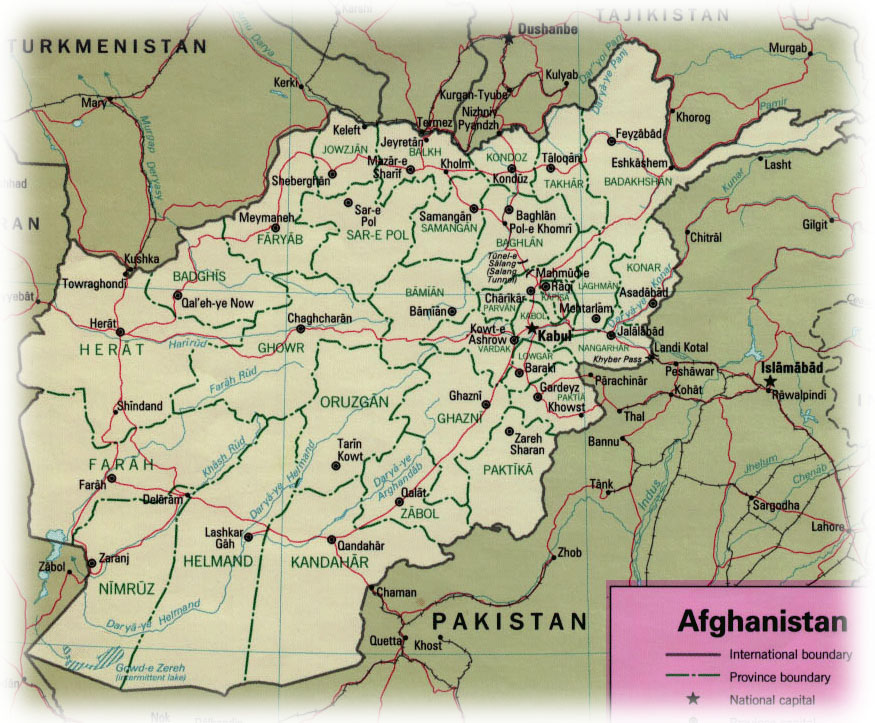
Afghanistan could be split in nine ethnic pieces: Aimaq, Baluch, Hazara, Kirghiz, Nuristani, Pashtun, Tajik, Turkmen and Uzbek. There's no oil there, so you think there'd be less to squabble about. But there may be a pipeline from the Caucasus running through Afhganistan to the Arabian Sea or the Indian Ocean off Pakistan someday. That's why we're there, according to some people. The pipeline can't be built until it's safe enough to carry out a massive construction project, though. So we're going to be there for quite a while. We might even end up catching Osama, if he doesn't die of old age first. But that's kind of a side effect.

(continued)
.

.

Things have not been going all that well in Afghanistan. You've gotta wonder how they managed to conduct an opinion survey in a place like Afghanistan in the middle of a war. Did they round up the usual suspects and have them fill out questionnaires? Go from bread line to bomb shelter to refugee camp asking questions in five different languages while under heavy guard? Did they ask women, or only men? Wait till they hear that we may be working with the Russians now. Poll that. Ah, Afghanistan!


INTERNATIONAL HERALD TRIBUNE
"Election results spur threats and infighting in Iraq"
So, the surge is working, hunh? Define "working."

' RAMADI, Iraq: The post-election curfew has been lifted and the threats of violence have been muted after the intervention of envoys from the Iraqi Army, the central government and the U.S. Marines. A cacophonous bustle has returned to the filthy, shattered streets of this provincial capital, once a base of the Sunni insurgency. And still Faris Taha, one of the election's victors, according to preliminary results, is too fearful to return to the region he will soon represent. "I cannot go back," he said, having retreated from his hometown east of Ramadi, the capital of Anbar Province, to a hotel in Baghdad's Green Zone. "I am afraid." '

MOTHER JONES
"Partition in Iraq: A Serious Problem With Biden as VP?"
A "secret plan for peace" in a divided Iraq?
' When Biden, who initially supported the war, was running for president, he repeatedly insisted he was the only candidate with a workable plan for ending it. His campaign created a video, featured in the YouTube debate, that said, "Joe Biden is the only one with the experience and the plan to end this war responsibly so our children don't have to go back." That plan was widely seen as calling for the partition of Iraq. It read, in part, "The United States should actively support a political settlement in Iraq based on the final provisions of the Constitution that create a federal system of government and allow for the creation of federal regions, consistent with the wishes of the Iraqi people and their leaders." Despite Biden's occasional objections, that wording was read by other politicians and the media as calling for the division of Iraq into three regions, one for Sunnis, one for Shiites, and one for Kurds. For that perception, Biden has himself to blame. An op-ed Biden wrote in 2006 described his plan this way: "The idea, as in Bosnia, is to maintain a united Iraq by decentralizing it, giving each ethno-religious group -- Kurd, Sunni Arab and Shiite Arab -- room to run its own affairs, while leaving the central government in charge of common interests.... The first [point of the plan] is to establish three largely autonomous regions with a viable central government in Baghdad. The Kurdish, Sunni and Shiite regions would each be responsible for their own domestic laws, administration and internal security. The central government would control border defense, foreign affairs and oil revenues." The Biden Plan, as it was called, proved remarkably popular in the Senate — in September 2007 it faced a Senate vote and passed with the support of 75 senators, including 26 Republicans. The non-binding measure did not compel the President to act, only expressed the will of the Senate. Hillary Clinton and Chris Dodd voted with Biden; Obama and McCain did not vote at all. '

INTERNATIONAL HERALD TRIBUNE
"Survey: US, allies losing ground in Afghanistan"
Change they can believe in? Not so much.
' A survey among Afghans indicates support is plummeting for the Kabul government and the United States and European troops trying to bolster it against insurgents, according to a report Monday. The decline is striking particularly in the last year, the poll shows, even as the Obama administration and NATO allies weigh moves to strengthen forces in the struggle with Taliban and other radical groups. President Barack Obama has assigned high priority to the conflict, and the administration is weighing whether to send another 30,000 U.S. troops, almost doubling the 32,000 present. Few Afghans felt encouraged by Obama's election, however: Two in 10 said they thought he would make things better for the Afghan people, and nearly as many said they thought he would make things worse. The rest either expected no change or were waiting to see. The poll — commissioned by ABC News, the BBC and ARD German TV — found that the number of Afghans who say their country is headed in the right direction has dropped to 40 percent, from 77 percent in 1995 when the survey was first conducted. '

TREND NEWS AGENCY
"Angry civilians protest civilian deaths in Afghanistan"
Maybe this has something to do with those poll numbers.
' Angry civilians in Laghman are protesting military operations that resulted in civilian deaths. The protestors are demonstrating against the deaths of 21 civilans killed in a U.S. air strike on Jan. 23. The U.S. military refused responsibility for the bombing and claimed that it did not target civilians. However, 15 insurgents may have been killed during the attack. Many Afghan civilians and the government condemn what they consider the indiscriminate use of arms by the allied forces. '

AFP
"Afghan official beheaded by 'guests' "
Another way of taking a head count.
' The Taliban, who control several districts of Helmand, have previously beheaded other people, including hostages, in a campaign of intimidation and fear that targets Afghans working for the government or international groups. Ethnic and tribal rivalries and crime, including that associated with Helmand's booming opium trade, also play a part in the wave of violence that has engulfed the country. '

THE STATE
"US supply routes in Afghanistan squeezed 2 ways"
Bit of a cock-up in the Khyber, I'm afraid...
' U.S. troops in Afghanistan saw their supply lines squeezed from the north and east Tuesday after militants blew up a bridge in Pakistan and Kyrgyzstan's government said it would end American use of a key air base following Russia's announcement of new aid. Securing efficient and safe supply routes into Afghanistan has become a top priority for U.S. officials as the Pentagon prepares to send in up to 30,000 more American soldiers this year. Some 75 percent of U.S. supplies travel through Pakistan, where militants have stepped up attacks on truck convoys destined for U.S. bases. Attackers on Tuesday blew up a bridge in northwestern Pakistan in a fresh salvo in an escalating campaign seeking to cripple Washington's war effort in Afghanistan. Islamist militants blew up a bridge in northwestern Pakistan on Tuesday, cutting a major supply line for Western troops in Afghanistan in the latest in a series of attacks on the Khyber Pass by insurgents seeking to hamper the U.S.-led mission against the Taliban. A NATO spokesman in Afghanistan confirmed that supplies along the route had been halted "for the time being," but stressed the alliance was in no danger of running out of food, equipment or fuel. The U.S. and NATO fly ammunition, weapons and other sensitive supplies into Afghanistan, but it would be too costly to ship everything that way. '

CNN
"Kyrgyzstan cites slaying, finances in closing of U.S. base"
Gee, wonder how this happened?
' U.S. Secretary of State Hillary Clinton has called the decision to close Manas Air Base "regrettable." Just a few weeks ago, during a visit to the region, Gen. David Petraeus -- who oversees U.S. operations in the Middle East and Central Asia -- talked about how important the base is. Closing Manas base would not affect only the United States. Petraeus said the site "plays an important role" in the deployment of Spanish and French soldiers into Afghanistan, in addition to U.S. troops. Sultangaziev rejected any suggestions that Russia may have pushed for the closure of the U.S. base. He said the announcement of Russia's aid package was a coincidence. The mountainous former Soviet republic is Central Asia's second poorest country. The U.S. base has been in operation since December 2001 under a U.N. mandate. Kyrgyzstan also is home to a Russian military base, at Kant, that officially opened in 2003. The Russian newspaper Kommersant reported Tuesday that Russia would offer Kyrgyzstan a $300 million, 40-year loan at an annual interest rate of 0.75 percent and write off $180 million of Kyrgyzstan's debt. Clinton said Thursday, "It's regrettable that this is under consideration by the government of Kyrgyzstan, and we hope to have further discussions with them. But we will proceed in a very effective manner no matter what the outcome of the Kyrgyzstan government's deliberations might be." '

YAHOO NEWS
"Russia denies influencing Kyrgyzstan on US base"
So, the Russians had nothing to do with it... ?
' A senior Russian envoy says Moscow did not influence Kyrgyzstan's decision to end American access to a base used to resupply U.S. troops in Afghanistan. The decision was announced several days ago as Kyrgyzstan's president was visiting Moscow after securing more than $2 billion in loans and aid from Russia. Deputy Prime Minister Sergei Ivanov says "there is no correlation" between the Russian aid offer and the Kyrgyz decision. '

REUTERS
"U.S. diplomat holds Afghan supply talks in Moscow"
Suddenly, Russia to the rescue. Well played, Vladi!
' A senior U.S. diplomat will hold talks with Russian officials on Tuesday about opening up new supply routes across Russian territory to NATO forces in Afghanistan, the U.S. embassy said. The talks come less than a week after Kyrgyzstan announced it will close a U.S. airbase on its territory that provides logistical support by air to U.S. troops fighting the Taliban in nearby Afghanistan. Russia has signalled readiness to expand cooperation in supplying non-military equipment to U.S. forces and other NATO contingents in Afghanistan. Such shipments would also have to pass through Kazakhstan and Uzbekistan to reach the conflict zone. Supply routes through Pakistan have become increasingly vulnerable to militant attacks over the last year. '

THE WALL STREET JOURNAL
"Beware of energy’s robber barons"
Russia, India, the U.S. This is getting complicated.
' In early January, Russia’s giant energy company Gazprom suddenly cut off natural gas supplies to Ukraine. As a result, much of Europe shivered without heat because pipelines through Ukraine supply most of their gas. Moscow exercised its gas clout in 2008 as well, ostensibly over pricing and transit fees, but more likely as an assertion of its readiness to wield energy as a weapon. The Russian act has implications for two gas pipelines that concern India: TAPI (Turkmenistan-Afghanistan-Pakistan-India) and IPI (Iran-Pakistan-India).
At issue is the stranglehold both monopoly suppliers and transiting countries may have over energy security. Given that TAPI and IPI would transit through rough terrain with restive populations such as Afghanistan and Baluchistan, the chances of disruption are high, whether via blackmail by the Pakistani government or due to physical damage by insurgents. '


AFGHANA.COM
"Provinces of Afghanistan"
On the road to Kabul.
' Interactive Map: Badakhsan - Badghis - Baghlan - Balkh - Bamian - Farah - Faryab - Ghazni - Ghowr - Herat - Helmand - Jowzjan - Kabul - Kapisa - Konar - Kondoz - Laghman - Logar - Nangarhar - Nemroz - Oruzgan - Paktia - Paktika - Parwan - Qandahar - Samangan - Sar-e-pul - Takhar - Wardak - Zabol '


PBS
"Interactive Map: Afghanistan's Ethnic Groups"
The many tribes of Afghanistan.
' Map: Afghanistan's Ethnic Groups - In-depth Coverage of Afghanistan and the War on Terror by the Online NewsHour. '


(Cross-posted at blog me no blogs.)
.
.


There's more: "POLLING THE VICTIMS OF GAZ WARFARE" >>

Tuesday, July 29, 2008


Real News: Is Iraq Ready To Explode?


July 29, 2008 - 3 min 10 sec - Scores killed by blasts in Baghdad and Kirkuk could be a forewarning as rival elites fight for power

Three female suicide bombers and a roadside bomb struck Shiite pilgrims taking part in a massive religious procession in Baghdad on Monday. Police said at least 32 people were killed and 102 wounded. The attacks occurred in quick succession in the early morning in the mainly Shiite Karradah district, as tens of thousands of Shiite worshippers streamed toward the pilgrimage site in Kazimiyah, northern Baghdad. Meanwhile at a Kurdish rally in the northern city of Kirkuk, A bomb blast killed at least 15 people and wounded 170 others. The attack occurred while demonstrators gathered to protest a provincial elections law being debated in Parliament. The law would limit the Kurds ability to control oil-rich Kirkuk which they consider to be part of their historical land. Last week Kurdish parties walked out of the Iraqi parliament in protest over the proposed law. Though the law was passed 127 to 13 it was later vetoed by President Jalal Talibani, who is also a Kurd. Though many reports claim violence in Iraq to be at its lowest point in three years, the political situation is still very volatile.
The Nation article by Robert Dreyfuss referred to in the video is Iraq on the Edge:
While everyone's looking at Iraq's effect on American politics -- and whether or not John McCain and Barack Obama are converging on a policy that combines a flexible timetable with a vague, and long-lasting, residual force -- let's take a look instead at Iraqi politics. The picture isn't pretty.

Despite the Optimism of the Neocons, which has pushed mainstream media coverage to be increasingly flowery about Iraq's political progress, in fact the country is poised to explode. Even before the November election. And for McCain and Obama, the problem is that Iran has many of the cards in its hands. Depending on its choosing, between now and November Iran can help stabilize the war in Iraq -- mostly by urging the Iraqi Shiites to behave themselves -- or it can make things a lot more violent.

There are at least three flashpoints for an explosion, any or all of which could blow up over the next couple of months. (Way to go, Surgin' Generals!) The first is the brewing crisis over Kirkuk, where the pushy Kurds are demanding control and Iraq's Arabs are resisting. The second is in the west, and Anbar, where the US-backed Sons of Iraq sahwa ("Awakening") movement is moving to take power against the Iraqi Islamic Party, a fundamentalist Sunni bloc. And third is the restive Mahdi Army of Muqtada al-Sadr, which is chafing at gains made by its Iranian-backed rival, the Islamic Supreme Council of Iraq (ISCI).
...
So Iraq is still poised to explode, and Iran may be in control. McCain's solution: provoke a showdown with Iran. Obama's solution: try to make a deal with Iran to stabilize Iraq. I'm not sure either "plan" will work.
So the "solution" favored by both U.S. presidential candidates remains: long term occupation of a country that has been trying for five years to free itself from American "liberation"...


There's more: "Real News: Is Iraq Ready To Explode?" >>

Saturday, July 19, 2008


The Real News: "Obama and the Cold War Mentality"


Gareth Porter: Will Obama be truly post-Cold War? [Transcript here.]

Historian and author Gareth Porter discusses with Pepe Escobar the positioning of Senator Barack Obama relative to the power of the national security establishment in the US; the legacy of JFK; the feasibility of the US refusing to occupy Muslim lands; and what it takes to be elected president of the United States.


There's more: "The Real News: "Obama and the Cold War Mentality"" >>

Tuesday, July 15, 2008


Use Iraq Moratorium to stop war with Iran

Friday, July 18, is Iraq Moratorium day #11.

It is a day, as is the Third Friday of every month, on which individuals and groups across the country take some action to call for the end to the war and occupation of Iraq.

The number of listed events on the Iraq Moratorium national website, IraqMoratorium.org, is approaching 100, with more still being added.

Since it began in September, more than 1,000 events in 41 states and 235 communities have taken place under the Iraq Moratorium banner.

This month, many peace groups are asking people to contact Congress members on Iraq Moratorium day and ask them to stop a new proposal, House Concurrent Resolution 362, which essentially calls for a blockade of Iran and is steamrolling its way through the House.

HCR 362 is a dangerous bill calling for severe sanctions--far beyond those proposed by the Bush administration--and could be interpreted as an act of war under international law. It would further alienate Iran and could trigger retaliation against our troops in Iraq and Afghanistan, blockage of oil shipments through the straits of Hormuz, and potential involvement of other nations in the region. If we want catastrophe in the Middle East, deeper recession and gas at $6 per gallon, this would do it.

United for Peace and Justice, the nation's largest antiwar coalition (and an endorser of the Iraq Moratorium) has designed July 19-21 as days of action to stop a war with Iran. Details here.

The whole concept of the Moratorium is to do something to interrupt business as usual -- to stop what you're doing on Friday, interrupt your normal routine, and do one thing, whatever it may be, to end this senseless, bloody war.

Participants either take part in a group action or do something individually -- wear an armband or button; write, call or email their Congressional representatives; put up a yard sign, or donate to a group working to stop the war. Group actions include rallies, marches, vigils, speakers, films and other activities.

There are lots of ideas and organizing tools on the website, as well as reports, photos and videos from around the country.

Will you do something?


There's more: "Use Iraq Moratorium to stop war with Iran" >>

Monday, May 12, 2008


Admiral Fallon Out at CENTCOM, Pushed Diplomacy

Cross-posted from The Paragraph

CENTCOM Area of Interest

“I come from the school of ‘walk softly and carry a big stick’,” said Admiral William Fallon, former head of the U.S. military’s Central Command (CENTCOM), which covers the Middle East and southwestern Asia.x80 He saw the mission of his command as “to work with other nations in the region to set the conditions for peace and stability.”x81 In March, shortly after an article in Esquire portrayed him as the last man standing between President Bush and war with Iran, Fallon retired early, and now Bush has nominated General David Petraeus, current commander of U.S. occupation forces in Iraq, to replace him.x82x83 Petraeus goes before Congress from time to time to promote Bush’s policies of keeping troop levels up in Iraq and trying to justify an attack on Iran—policies contrary to the advice of the Iraq Study Group and the Joint Chiefs, policies that Fallon stood against.x84x85 Last month Petraeus told Congress: “Recently … some militia elements became active again. ... [T]he flare-up [in Basra] ... highlighted the destructive role Iran has played in funding, training, arming and directing the so-called special groups …”x86 But the reason the “militia … became active again” was to fight back against Iraqi government troops that were attacking it.x92 After a thousand Iraqi government troops deserted, Iraqi government officials got Iran to pull strings for a ceasefire.x87 So Petraeus’s statement blaming Iran for a “flare up”—started by Iraqi Prime Minister Nouri al-Maliki and quelled by Iran—seems wrong. But it does fit the current theme for wider war being pushed by President Bush, Senator John McCain, and other Bushies.x88x89x90x91 Fallon has also spoken about Iran—not to push war, but to push constructive engagement:


Tehran’s feeling pretty cocky right now because they’ve been able to inflict pain on us in Iraq and Afghanistan. [The trick is] to try to figure out what it is they really want and then, maybe—not that we’re going to play Santa Claus here or the Good Humor Man—but the fact is that everyone needs something in this world, and so most countries that are functional and are contributing to the world have found a way to trade off their strengths for other strengths to help them out. These guys are trying to go it alone in this respect, and it’s a bad gene pool right now. It’s not one with much longevity. So they play that card pretty regularly, and at some point you just kind of run out of games, it seems to me. You’ve got to play a real card.x80


~~~


It is my belief that today, there is far too much talk of war and not enough talk about moving things forward in this region and taking care of the many needs of the people …x81


This constant drumbeat of conflict is one that strikes me as not helpful, not useful for the people, and I wish we could get moving to things that are more constructive for the region.


...


[I]t is certainly my hope and expectation that there is no war and that is what we ought to be working for. We ought to find ways in which we can get countries to sit together for the benefit of everyone involved. So whether now or in the future, war is not a good idea.


Adm. Fallon – pushes diplomacy (U.S. Navy)


Bush & McCain – push wider war


Sources


80 ‘The Man Between War and Peace’ – By Thomas P.M. Barnett, Esquire, March 2008


81 ‘Far too much talk of war’ – Al Jazeera


82 ‘Dissenting Views Made Fallon’s Fall Inevitable’ By Gareth Porter, Inter Press Service, WASHINGTON, Mar 11, 2008


... Fallon almost certainly knew that he would be fired when he agreed to cooperate with the Esquire magazine profile in late 2006.


...


The resignation brings to an end a year, during which time Fallon clashed with the White House over policy toward Iran and with Gen. David Petraeus and the White House over whether Iraq should continue to be given priority over Afghanistan and Pakistan in U.S. policy.


Fallon’s greatest concern appears to have been preventing war with Iran. He was one a group of senior military officers, apparently including most of the Joint Chiefs of Staff, who were alarmed in late 2006 and early 2007 by indications that Bush and Vice-President Dick Cheney were contemplating a possible attack on Iran.


...


Col. W. Patrick Lang, a former intelligence officer on the Middle East for the Defence Intelligence Agency, told the Washington Post last week that Fallon had said privately at the time of his confirmation that an attack on Iran “isn’t going to happen on my watch”, When asked how he could avoid such a conflict, Fallon reportedly responded, “I have options, you know.” Lang said he interpreted that comment as implying Fallon would step down rather than follow orders to carry out such an attack.


As IPS reported last May, Fallon was also quoted as saying privately at that time, “There are several of us trying to put the crazies back in the box”. That was an apparent reference to the opposition by the Joint Chiefs of Staff to an aggressive war against Iran.


Even before assuming his new post at CENTCOM, Fallon expressed strong opposition in mid-February to a proposal for sending a third U.S. aircraft carrier to the Persian Gulf, to overlap with two other carriers, according to knowledgeable sources. The addition of a third carrier was to part of a broader strategy then being discussed at the Pentagon to intimidate Iran by making a series of military moves suggesting preparations for a military strike.


The plan for a third carrier task force in the Gulf was dropped after Fallon made his views known.


Fallon reportedly made his opposition to a strike against Iran known to the White House early on in his tenure, and his role as CENTCOM commander would have made it very difficult for the Bush administration to carry out a strike against Iran, because he controlled all ground, air and naval military access to the region.


But Fallon’s role in regional diplomacy proved to be an even greater source of friction with the White House than his position on military policy toward Iran. Personal relations with military and political leaders in the Middle East had already become nearly as important as military planning under Fallon’s predecessors at CENTCOM.


Fallon clearly relished his diplomatic role and did not hesitate to express views on diplomacy that were at odds with those of the administration. Last summer, as Dick Cheney was maneuvering within the administration to shift U.S. policy toward an attack on bases in Iran allegedly connected to anti-U.S. Shiite forces in Iraq, Fallon declared in an interview, “We have to figure out a way to come to an arrangement” with Iran.


83 ‘Petraeus Promotion Frees Cheney to Threaten Iran’ by Gareth Porter, Inter Press Service, WASHINGTON, Apr 23, 2008


84 ‘Iraq Study Group Report: Executive Summary’ 6 December 2006


Our most important recommendations call for new and enhanced diplomatic and political efforts in Iraq and the region, and a change in the primary mission of U.S. forces in Iraq that will enable the United States to begin to move its combat forces out of Iraq responsibly. We believe that these two recommendations are equally important and reinforce one another.


The United States should immediately launch a new diplomatic offensive to build an international consensus for stability in Iraq and the region. This diplomatic effort should include every country that has an interest in avoiding a chaotic Iraq, including all of Iraq’s neighbors. Iraq’s neighbors and key states in and outside the region should form a support group to reinforce security and national reconciliation within Iraq, neither of which Iraq can achieve on its own.


Given the ability of Iran and Syria to influence events within Iraq and their interest in avoiding chaos in Iraq, the United States should try to engage them constructively. ...


85 ‘Cheney’s Iran Fantasy’ by Joe Klein, Time, May 25, 2007


Last December, as Rumsfeld was leaving, President Bush met with the Joint Chiefs of Staff in “The Tank,” the secure room in the Pentagon where the Joint Chiefs discuss classified matters of national security. Bush asked the Chiefs about the wisdom of a troop “surge” in Iraq. They were unanimously opposed. Then Bush asked about the possibility of a successful attack on Iran’s nuclear capability. He was told that the U.S. could launch a devastating air attack on Iran’s government and military, wiping out the Iranian air force, the command and control structure and some of the more obvious nuclear facilities. But the Chiefs were—once again—unanimously opposed to taking that course of action.


86 Gen. Petraeus’ Testimony to the Senate Armed Services Comm. – 2008-04-08


87 ‘Iranian general played key role in Iraq cease-fire’ By Leila Fadel, McClatchy Newspapers, Sunday, March 30, 2008


Iraqi lawmakers traveled to the Iranian holy city of Qom over the weekend to win the support of the commander of Iran’s Qods brigades in persuading Shiite cleric Muqtada al Sadr to order his followers to stop military operations, members of the Iraqi parliament said.


Sadr ordered the halt on Sunday, and his Mahdi Army militia heeded the order in Baghdad, where the Iraqi government announced it would lift a 24-hour curfew starting early Monday in most parts of the capital.


But fighting continued in the oil hub of Basra, where a six-day-old government offensive against Shiite militias has had only limited gains.


So far, 488 people have been killed and more than 900 wounded in the offensive, Iraqi Interior Ministry officials said.


88 ‘President Bush Discusses Iraq’ 2008-04-10


The regime in Tehran also has a choice to make. It can live in peace with its neighbor, enjoy strong economic and cultural and religious ties. Or it can continue to arm and train and fund illegal militant groups, which are terrorizing the Iraqi people and turning them against Iran. If Iran makes the right choice, America will encourage a peaceful relationship between Iran and Iraq. If Iran makes the wrong choice, America will act to protect our interests, and our troops, and our Iraqi partners.


89 ’ Remarks By John McCain To The Members Of The Veterans Of Foreign Wars (VFW)’ April 7, 2008 “We must press ahead against … the Iranian-backed Special Groups …”


90 ‘When Did Iran Start Beating Its Wife Again?’ by Jeff Huber, ePluribus Media, 04/28/2008


“Shipments of arms” continue to flow from Iran to Iraq, according to the article. Iran seems to be focusing now on “training Iraqi Shiite fighters inside Iran.” The Iranians provide “weapons to militias fighting the Shiite-led government in Baghdad as well as to militias supporting that government.” “American commanders” now have “a clearer picture of how Iranian weapons have entered Iraq.” “Iran’s Quds Force” has developed “a formal and sophisticated training program.”


By what burden of proof did these condemning allegations earn their way into America’s newspaper of record? Why, by the brave new world order’s highest standard of bedrock evidence: the testimony of anonymous “officials.”


91 ‘Will Bushies Sell Iran War ‘Product’?’ – The Paragraph, 2007-09-08


92 ‘British soldiers back in Basra as hundreds of Iraqi troops desert’ By Kim Sengupta, The Independent, 07 April 2008


The British return to Basra comes days after the Government announced that Gordon Brown’s pledge to reduce troop levels by 1,500 this spring could not be fulfilled because of security concerns. The development comes alongside the disclosure that up to 1,500 Iraqi soldiers refused to fight, or deserted in the operation against the radical cleric Moqtada al-Sadr’s Shia militia. The numbers, according to Iraqi and American sources, included dozens of officers and at least two senior field commanders. ...


In addition to those who refused to follow orders, about 100 members of the Iraqi security forces simply changed sides, to the Mehdi Army. The Iraqi Prime Minister, Nouri al-Maliki, has faced strong criticism over the operation, which he had led after flying from Baghdad to Basra and which ended, critics say, in a stalemate with an Iranian-brokered peace deal.


...


... The offensive which took place concentrated … on Mr al-Sadr’s forces while the Badr Brigade, which has links to Mr Maliki’s government, and the Fadilla group of Basra governor Mohammed Waeli were not targeted.


* * *


By Quinn Hungeski – Posted at G.N.N. & TheParagraph.com


There's more: "Admiral Fallon Out at CENTCOM, Pushed Diplomacy" >>

Sunday, April 27, 2008


I've seen this movie before, and it sucks

It was 2002, and the advances were all pointing to a smash hit - and box office success.

Five years on, it's fucking Ishtar.

Now the saber rattling at Iran is picking up and the threats being offered are more ominous and dire, and yet, it seems to be met with a collective yawn. "Well, yeah. He's nuts. Of course they'll bomb Iran. What're ya gonna do?" (Shrugs shoulders, reaches for Cheetos and turns on American Idol.)

This time there is no Judith Iscariot selling it. Instead, the press just quotes the administration and accepts that they have "evidence" that they haven't produced; as if they can trust the lying bastards to shoot straight.

Fortunately, there is the foreign press and the internet.


Some intelligence and administration officials said Iran seemed to have carefully calibrated its involvement in Iraq over the past year, in contrast to what President George W. Bush and other U.S. officials have publicly portrayed as an intensified Iranian role.

None of the officials interviewed disputed the notion that Iran sought to undermine U.S. interests in Iraq, but in recent weeks the Bush administration has sought to emphasize the threat by citing new evidence. The interrogations of four Iraqi Shiite militia commanders, for example, have provided new details about the extent of training conducted by the Quds Force of Iran's Revolutionary Guard, officials said.

Still, the officials offered an assessment of Iranian involvement that was more complicated and nuanced than public statements by Bush and other officials, including Secretary of Defense Robert Gates, who said at a news conference this week that "what Iranians are doing is killing American servicemen inside Iraq" by providing training and weapons to Shiite fighters.

It remains difficult to draw firm conclusions about the ebb and flow of Iranian arms into Iraq, and the Bush administration has not produced its most recent evidence...

They said last year that they don't trust another administration to "deal with" Iran - and as the rhetoric ramps up and the clock runs down on the Bush maladministration - that comment comes back and echoes in my head.

If they do something rash and stupid - like declare war on Iran - we will have to hold the congress responsible. That means that Nancy and the leadership that refuses to do their duty by impeaching these nutcases will have to be held to account for their complicity in war crimes.


[Crossposted from Blue Girl, Red State]


There's more: "I've seen this movie before, and it sucks" >>

Wednesday, April 16, 2008


Iraq: Teh Success Is Killing Us


The WahPoo reports that yesterday provided further evidence of success in Iraq. In fact, that particular day in Iraq was so successful that we may not have an army left at all, if each day to come is exactly like that one.


Shoot, we may not have any Iraqis, either. Then we can just mosey on in there and suck up all the oil for our Hummers. According to the article,

Two bombings killed nearly 60 people Tuesday in parts of Iraq where U.S. and Iraqi forces have claimed significant success in combating Sunni insurgent groups.
Just imagine what the death toll might have been like if we weren't that successful.

Bombings took place in Baquba (Diyala province), Mosul, Ramadi (Anbar province), and Baghdad. Some 82 people were wounded, and the carnage inspired one Iraqi spokesman to add to our treasury of unforgettable quotes this particular remark:
"Half of the dead people are still at the Baqubah morgue because it is so hard to identify their bodies," Jassem said.
Being cursed with an overactive imagination, we're currently searching for our psychoactive meds while speculating on just why identification appears to be so elusive. Possibly, the difficulty of identifying a knee or a wrist is greater if it is no longer attached to the person one might know and love.

What a terrible thing this war is. Day after day, our purported "leaders" lie to us, until even the tinpot soldier in charge of the current efforts (since all the better men were forced out for daring to tell the truth about this misadventure) is forced to admit that no corners have been turned, there is no light at the end of the tunnel, and the "last throes" of the insurgents have persisted for three too many long, weary years even as the U.S. Army is in its last throes thanks to the throe-er's friends and cronies accumulating wealth by winning no-bid contracts to give our military insufficient arms and equipment and poisoning them with bad food and dirty water.

Some people are doing something about it. Some very courageous people. Grateful thanks to those of you speaking out against the war.

Crossposted over at ThePoliticalCat


There's more: "Iraq: Teh Success Is Killing Us" >>

Saturday, April 12, 2008


This makes me want to shout, "What a lying, cheap, ridiculous cop-out!"


In a change of heart the bush maladministration now claims that al-Qaeda is no longer the primary threat in Iraq, that it has been defeated and routed from Iraq, and that Iran now poses the greatest threat to peace in the Middle East. If this is true then it is time to bring our troops home after being victorious against al-Qaeda; the rest of the Middle East can take care of itself.

Excerpt from the washingtonpost.com:

Last week's violence in Basra and Baghdad has convinced the Bush administration that actions by Iran, and not al-Qaeda, are the primary threat inside Iraq, and has sparked a broad reassessment of policy in the region, according to senior U.S. officials.

Evidence of an increase in Iranian weapons, training and direction for the Shiite militias that battled U.S. and Iraqi security forces in those two cities has fixed new U.S. attention on what Defense Secretary Robert M. Gates yesterday called Tehran's "malign" influence, the officials said.


The intensified focus on Iran coincides with diminished emphasis on al-Qaeda in Iraq as the leading justification for an ongoing U.S. military presence in Iraq.[…]

During their Washington visit, Petraeus, the top U.S. military commander in Iraq, and Ambassador Ryan C. Crocker barely mentioned al-Qaeda in Iraq but spoke extensively of Iran.

With "al-Qaeda in retreat and disarray" in Iraq, said one official who spoke on the condition of anonymity because he was not authorized to speak on the record, "we see other obstacles that were under the waterline more clearly. . . . The Iranian-armed militias are now the biggest threat to internal order."

Partly in response to advice from Petraeus and Crocker, the administration has initiated an interagency assessment of what is known about Iranian activities and intentions, how to combat them and how to capitalize on them. The review stems from an internal conclusion, following last week's fighting, that the administration lacked a comprehensive understanding and a sophisticated approach.

President Bush reiterated yesterday that if Iran continues to help militias in Iraq, "then we'll deal with them," saying in an interview with ABC News that "we're learning more about their habits and learning more about their routes" for infiltrating or sending equipment.
If the administration and army leaders are correct and we have defeated al-Qaeda in Iraq, our mission there is complete, we are victorious, and we have no right to consider attacking Iran, which poses no threat to America or Iraq.

Iraq and Iran have previously, much to bush's dismay, formed a "mutual defense pact" that would require Maliki to turn his armies against Americans in the event that we unlawfully attack Iran. And wouldn't that be a hoot, battling Iran, which is no weakling country as Iraq was and remains, but having Iraqi forces turn on American forces because bush feels like he, still in his "god complex", must bomb Iran at any costs.

bush has already bankrupted us with this ridiculously expensive Iraqi Oil War, to the tune of over 3 TRILLION dollars, and I would wager that bush would spend another three trillion if he attacks Iran.Our military is being rapidly and dangerously depleted, and I don't believe our forces in Iraq could sustain themselves against a dual attack from Iranian and Iraqi forces.

Our country would suffer a multitude of terrorist attacks by from Hamas, the Quds Force, and loyal Iranian sleeper cells already, undoubtedly, in place here in America and around the world should we attack Iran.

Congress needs to yank in bush's chain, forbid an attack on Iran, reduce defense spending that is destroying the "Age of America," and get back down to the business of taking care of the American people and their needs here at home.

I have said it before and I will always maintain that we could have BOUGHT all the oil under Iraq for less than this senseless war will cost in lives and treasure, and attacking yet another Muslim country that poses no threat to America will just reinforce the Muslim worlds belief that America is truly on a new crusade to wipe out Muslims, compounding all our problems exponentially by several orders of magnitude.

bush needs to be hamstrung. Congress should stop action on any bill even resembling authorization or payment of more money for war.

If it were explained to the country by congress that their intent was to hamstring bush, leaving him impotent to pursue war, I believe they would be supported by the vast, vast majority of Americans who are also sick unto the point of death with bush's reckless and dangerous foreign policies and lust for eternal war and American hegemony.


Cross-posted from VidiotSpeak and Edgeing


There's more: "This makes me want to shout, "What a lying, cheap, ridiculous cop-out!"" >>

Thursday, April 3, 2008


How Many Times


Does Nouri al-Maliki need his ass kicked really hard before he learns his lesson?

This is a question that will undoubtedly be resolved sometime before he either absconds with all the billions we've been pouring into Iraq (no doubt largely funnelled directly into his, and his cronies', unnumbered Swiss bank accounts) or meets a hideous end when he proves to be too much of a liability to either the Dawa Party (his party) or the fragile coalition of Dawa/SCIRI (or Islamic Supreme Council of Iraq, ISCI, as it's calling itself these days) and whatever else is coalitioning with these thugs.

We didn't post about al-Maliki's recent primate-like posturing and associated blunders because it was all so deeply depressing and predictable. Why bother? It was obvious from the conflation of Cheney's "visit" to the ME and the revelation that he did not really discuss oil prices with the House of Saud followed by the chest-beating and rump displaying of teh Maliki that Sadr was going to have to kick his baboonlike ass but good just to keep the dumb motherfucker from overreaching.

To recap, a chronology of events:

  • March 17, three days before the anniversary of the invasion of Iraq: Cheney flies into Iraq unannounced, meets with al-Maliki

  • March 21, Cheney meets with King Abdullah of Saudi Arabia

  • March 22, Cheney announces through a myrmidon that the only relief in terms of oil prices will come from drilling in America's remaining pristine wildernesses, in other words, thanks America for funding my junket on which I took my wife and daughter and we went fishing in Oman on March 19th, and fuck you very much on oil prices.

  • March 26, Nouri al-Maliki issues his famous "ultimatum" to Iraqi "militias."

    Who are these Iraqi militias? Right now, Iraq is controlled by various hardline Islamic Shi'a factions, including al-Maliki's Dawa party, which has the Iraqi Army functioning as its own militia; SCIRI/Islamic Supreme Council of Iraq (ISCI) which has its own militia; and Hojatoleslam Moqtada al-Sadr's Jaish al-Mahdi.

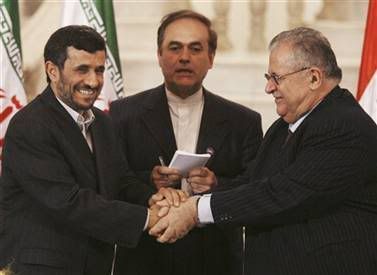
    For the benefit of the apparently senile or terminally stupid John McCain, elderly and doddering presidential candidate, we would like to point out here that al-Qaeda in Iraq (aQI) is a Sunni Muslim organization, with no friendly ties at all with the warring Shi'a militias. Also that al-Maliki's Dawa party is very friendly with the rulers of Iran - so friendly that they greeted that nation's president, Ahmedi Najad, with flowers and parades and marching bands when he recently visited &mdash unlike our leaders, who, despite paying nearly one trillion fucking dollars of our money for the privilege, must sneak into Iraq under cover of darkness and cannot even travel to the fucking market without fully armed squads of bodyguards, full body armour, and air cover.

    Nouri al-Maliki was apparently targeting al-Sadr's Jaish al-Mahdi with this crackdown. He called them "worse than al-Qaeda," the Sunni terrorist organization. Apparently, to al-Maliki, al-Sadr's challenge to his Prime Ministership is worse than the terrorist strikes around the world that have killed thousands of American, British, Spanish, Iraqi, Pakistani, and other peoples. Nice to know one's allies' priorities, Mr. Cheney. al-Maliki gave the JAM three days to lay down their arms and personally flew to Basra to supervise the extermination of JAM.

  • March 28, three days later, when it was pretty obvious that JAM was beating the living shit out of the Iraqi army, with Iraqi police turning over arms and equipment to JAM in Baghdad and Basra, al-Maliki "extended" the deadline to ten days.

    Despite all the guns and uniforms and training we have given the Iraqi Army, you can't buy loyalty and you can't buy a will to fight. JAM fights because they want control of Iraq and they believe they will be rewarded with political power or houris in paradise regardless of whether they live or die. The Iraqi Army fights because it's a job in a country with staggering unemployment rates and few other ways of making money, and at least they can feed their families. Whose motivation do you think is greater?

    Despite the full strength of the U.S. Army as backup & despite 160,000 or so American and British fighters with top-flight military equipment, including air strike capability, al-Maliki was forced to put lipstick on the pig of his claim that he would fight the Shi'a militias to the end. He had to beg for the help of his Iranian masters to end the conflict.

  • March 31, al-Sadr graciously extends the olive branch of peace &mdash along with a nine-point statement demanding the release of various of his supporters who have been arrested but not accused of any crime, and an end to attacks on his forces.

  • April 1, Nouri al-Maliki announces that the military operation in Basra has been a success. Obviously, he's smoking the same thing as Bush.

    Five hundred Iraqis were killed in the fighting. al-Maliki is asking al-Sadr to "please return" the 50 armored vehicles and government cars that JAM took. Two Americans were also killed, and rocket and mortar attacks carried out on the "fortresslike, secure" Green Zone, where the American Embassy is located.

  • April 03, we learn that Nouri al-Maliki is a masochist with a fetish for ass-kicking &mdash as long as he is the kickee. Nouri, my man, we had no idea you were such a BOTTOM!

    Even as Hojatoleslam Moqtada al-Sadr is calling for nationwide protests to mark the anniversary of the U.S. toppling Saddam (April 9), al-Maliki is planning to enter Sadr City and other JAM strongholds. Is he trying to get the nascent Iraqi Army wiped out? Or is this an attempt to force continuing American and British involvement in the war?
Already the drawdown of "surge" troops has been halted and the British have announced that they will not pull out the 4,000 remaining troops in Basra. Not that the British troops are very effective, since they're all hiding out at the airport, and who can blame them. They must be tired of being used for target practice.

As for American troops &mdash people, if you have friends and relatives over there who were supposed to come back anytime soon, you can just kiss that goodbye. They may never come back at all, except in a body bag, if George keeps letting al-Maliki play soldiers using our forces. Is that what your friends and relatives signed up for? To be the pawns of an idiot who persists in playing with other people's lives and doesn't have the first clue about military strategy?

Meanwhile, you will no doubt be thrilled to your very toenails to hear that Chimpy McAWOL, who managed to weasel out of serving in any capacity except possibly National Buffoon, is paying no attention whatsoever to the restarting of the meatgrinder. Nope, he's busy trying to create a "legacy" or something, at the taxpayers' expense, somewhere in the former Soviet Union.

REUTERS/Francois Lenoir

Clue: They're not laughing with you, George.

Crossposted over at ThePoliticalCat


There's more: "How Many Times" >>

Sunday, March 2, 2008


Is This What We're Fighting For?

The topic below was originally posted in my blog, the Intrepid Liberal Journal, as well as the Wild Wild Left, Independent Bloggers Alliance, The Peace Tree and Worldwide Sawdust.

A picture is worth a thousand words. This is Iranian President Mahmoud Ahmadinejad and his Iraqi counterpart Jalal Talabani together in Baghdad, today. Americans are fighting, suffering post traumatic stress disorder, permanent injuries, dying and killing innocent civilians to help establish an Islamic Shiite fundamentalist axis in the Gulf. Likely Republican nominee John McCain promises more of the same. Hillary Clinton enabled President Bush and John McCain to pursue this strategic calamity out of sheer political expediency. Yet Clinton has the temerity to suggest she has superior credentials to be commander and chief? Both Clinton and McCain represent more of the same. It's time for a change. Enough said.


There's more: "Is This What We're Fighting For?" >>

Bush Announces No Drawdown After July

The evil Bushman is not going to promise a draw down of troops from Iraq as expected. Besides the troops sent in the surge no other soldiers will be coming home on his watch. In fact the number of post surge soldiers on the ground will increase by 6000. 140,000 compared to 134,000 before the surge.From his vacation home in Crawford he announced uncertainty of the October elections in Iraq as the reason.
He is leaving it all up to the Generals recommendations whether more troops will come home after July. Saying that stability is needed in October to ensure the voting process is kept on the up and up he is willing to commit the lives of our citizens to ensure his puppet regime is safely put in place.

He said decisions about any further withdrawals of troops will be postponed until August or September, with no promise there will be a reduction until after the elections.
"I think our generals ought to be concerned about making sure there's enough of a presence so that the provincial elections can be carried off in such a way that democracy advances," Bush said. "But I'll wait and hear what they have to say. But, yes, I mean, that ought to be a factor in their recommendation to me."
With Iranian President Mahmoud Ahmadinejad visiting Baghdad today I wonder what political rhetoric the US Government will start slinging. Bush has already reminded the Iranians about the U.N.Security Council's proposed sanctions against Iran and urged Iraq's leaders to tell him "Quit sending in sophisticated equipment that's killing our citizens.". Iran has already denied arming Shi'ite militants.
With the decision to postpone troop withdrawals stated so firmly this writer wonders if the hollow cry of "Support Our Troops" will ever come from Bush again. I believe the only way to support our fighting men and women is to bring them home.
As we have seen there has been little support in reality.
Just empty words.


There's more: "Bush Announces No Drawdown After July" >>

Wednesday, January 16, 2008


Did Robert Gates Order Iran Speedboat Provocation?

The story of the Iranian speedboats in the Strait of Hormuz that supposedly threatened U.S. warships has been pretty thoroughly debunked by now. Now Asia Times has an article that details how the disinformation was created and spread by the Pentagon, as the Pentagon planted stories with the press, starting with CBS and CNN. Even though the encounter at sea was "not that different from many others in the Gulf over more than a decade," the Pentagon timed the news about the supposed provocation to a trip by Bush to the region.

The key line in the Asia Times piece is right at the beginning (my bold emphasis):

Senior Pentagon officials, evidently reflecting a broader administration policy decision, used an off-the-record Pentagon briefing to turn the January 6 US-Iranian incident in the Strait of Hormuz into a sensational story demonstrating Iran's military aggressiveness, a reconstruction of the events following the incident shows.


Forget the small fry, like Bryan Whitman, the deputy assistant secretary of defense for public affairs in charge of media operations, who initially spread the story at an "off the record" briefing for reporters. From whence did this "broader administration policy decision" derive? Who ordered it?

A little into the AT story, we get our answer (or the first inklings of it):

Lieutenant Colonel Mark Ballesteros of the Pentagon's Public Affairs Office told IPS the decision on what to include in the video was "a collaborative effort of leadership here, the Central Command and navy leadership in the field".

"Leadership here", of course, refers to the secretary of defense and other top policymakers at the department. An official in the US Navy Office of Information in Washington, who asked not to be identified because of the sensitivity of the issue, said that decision was made in the office of the secretary of defense.

So it was Gates. It's Secretary of Defense, and former CIA chief Gates's resignation we should be calling for. But, I find it hard Gates would have initiated this all on his own. He must have consulted with, if not received orders from either Cheney or Bush. -- Funny though how those three letters keep popping up whereever you look: C-I-A.

Where's a free and enquiring press when you need one? The whistleblowers on this one probably emanate from the Navy itself, as commanders in Iraq were not apparently too happy at this dangerous exercise in spin and provocation from Washington:

The commanding officer of the guided missile cruiser Port Royal, Captain David Adler, dismissed the Pentagon's story that he had felt threatened by the dropping of white boxes in the water.... "I saw them float by. They didn't look threatening to me."

The naval commanders seemed most determined, however, to scotch the idea that they had been close to firing on the Iranians....

Asked whether the navy's reporting of the episode was distorted by Pentagon officials, Lydia Robertson of Fifth Fleet Public Affairs would not comment directly. But she said, "There is a different perspective over there."

Coming after the startling revelations in the British press by FBI whistleblower Sibel Edmonds that U.S. officials have been involved in a bribery scheme involving the export of nuclear secrets to countries like Pakistan (which has been suppressed in the U.S. press), the emerging truth about this latest provocation and misinformation in the Gulf, presaging war against Iran, demonstrates that the rulers of the U.S. are the most dangerous threats to the world on the planet. We can only hope, given the current political dynamic in the U.S., that Robert Wexler and Dennis Kucinich in the U.S. House of Representatives are successful in bringing impeachment charges against Bush and Cheney. Because short of that, I can't imagine what will stop them in their insane quest for war.

Also posted at Invcitus, with H/T to FishOutOfWater for his excellent diary on this at Daily Kos.


There's more: "Did Robert Gates Order Iran Speedboat Provocation?" >>

Sunday, January 13, 2008


Bush's Last Defiant Act As President: Fomenting Another War

Crossposted from BFD Blog!

In an article headlined "Bush Urges Arab Allies to Confront Iran" in the New York Times Steven Lee Myers reports:


In an address to government and business leaders here, Mr. Bush focused not only on what the United States suspects are Iran’s nuclear ambitions but also its suspected support for Islamic groups and militants in Afghanistan, Iraq, Lebanon and the Palestinian territories. He called Iran’s government “the world’s leading sponsor of terrorism” and accused it of imposing repression and economic hardship at home.


“Iran’s actions threaten the security of nations everywhere,” Mr. Bush said. “So the United States is strengthening our longstanding security commitments with our friends in the gulf and rallying friends around the world to confront this danger before it is too late.”


"Confront this danger before it is too late" sounds like code for "provide me the cover to invade another sovereign nation to further the agenda of my true masters, the disaster capitalism corporate complex."


Don't let this "train leave the station", folks, contact your representatives in Congress and tell them to exercise some character and stop writing Bushiliburton blank checks. Tell them to stand up to everything that is evil, greedy, rapacious and mercenary about Bushliburton and the disaster capitalism corporate complex and to stop dragging our country in to Fascism.


Illustration: The Worried Shrimp


There's more: "Bush's Last Defiant Act As President: Fomenting Another War" >>

Saturday, December 29, 2007


Dick Cheney Confession: The Continuing Story of "The Fall Of The House Of Bush"

Cross posted at Edgeing

During an interview with Craig Unger about his new book "The Fall Of The House Of Bush" Amy Goodman of Democracy Now (transcript here) refers to comments made by Dick Cheney in September 1992 after the first Gulf War, in a speech at the Economic Club of Detroit explaining why the George H. W. Bush administration did not go on to Baghdad after Saddam then.

Cheney's comments in the speech show clearly that they knew irrefutably in 2003 before the invasion, not only that Saddam Hussein was no threat militarily to any country, much less to the United States, but that they also knew exactly what the conditions in Iraq likely to be produced by an invasion would be, and that they did it with eyes wide open, with conscious and full intention of producing the humanitarian crisis and chaos and death that has followed.

And knew that the responsibility for it would be theirs.

Cheney's speech begins at about 3 min 50 sec into this Democracy Now Craig Unger interview video:


Parts two and three of the Democracy Now Craig Unger interview follow here:


There's more: "Dick Cheney Confession: The Continuing Story of "The Fall Of The House Of Bush"" >>

When You Know The Truth, The Facts Don't Seem So Important

Cross posted at DocuDharma and Edgeing

Jason Leopold of Truthout interviews Craig Unger, a contributing editor for Vanity Fair, on the Rise of the Christian Right and Neoconservatism.

Unger garnered national attention with his previous book, House of Bush, House of Saud. Michael Moore cited it as a key source for Fahrenheit 9/11, and the film popularized the author's reports on Saudi investments in Bush family enterprises.

In his new book, The Fall of the House of Bush: The Untold Story of How a Band of True Believers Seized the Executive Branch, Started the Iraq War, and Still Imperils America's Future, Unger turns his attention to neoconservative officials and theorists. At times he focuses so closely on neocon tactics that he misses other forces driving Bush-Cheney policies. Even so, the book offers a vivid account of the use of disinformation to promote extremism.
Leopold: Craig, thank you for being with truthout today. What are some of the issues in your new book that we don't know about - that the public does not know about?

Unger: Well, I think we've been told again and again that we got into the war in Iraq beacause of intelligence failures - that various things just turned out not to be true - that we made one mistake after another.

I actually think we got into the war for exactly the opposite reason - because of intelligence successes - and by that I mean black propaganda operations - disinformation.


Chris Pepus of Chicago Reader takes the book review further for us with...

Bush and the Neocons
By Chris Pepus, Chicago Reader, Thursday 20 December 2007

When you know the Truth, the facts don't seem so important.

Craig Unger, a contributing editor for Vanity Fair, garnered national attention with his previous book, House of Bush, House of Saud. Michael Moore cited it as a key source for Fahrenheit 9/11, and the film popularized the author's reports on Saudi investments in Bush family enterprises. In The Fall of the House of Bush: The Untold Story of How a Band of True Believers Seized the Executive Branch, Started the Iraq War, and Still Imperils America's Future, Unger turns his attention to neoconservative officials and theorists. At times he focuses so closely on neocon tactics that he misses other forces driving Bush-Cheney policies. Even so, the book offers a vivid account of the use of disinformation to promote extremism.

Unger traces the origins of Bush's foreign policy to the 1970s, when prominent bureaucrats and writers gathered around such converts to conservatism as Irving Kristol and Albert Wohlstetter. The neocons scored their first big success in 1976, when two of their allies in President Ford's administration, Donald Rumsfeld and Dick Cheney, created a group outside the CIA to assess the Soviet threat. That panel, dubbed Team B, was staffed by neocon worthies and led by Richard Pipes of Harvard University. One of the group's advisers was a Wohlstetter protege named Paul Wolfowitz.

Team B concluded that the CIA had vastly underestimated Soviet power and that supporters of detente were merely assisting the Kremlin's drive for world domination. It was an imaginative assessment, given that the economy of the USSR was crippled and its military infrastructure was suffering as CIA officers pointed out. Pipes's group held, for instance, that the USSR had probably deployed a top-secret antisubmarine system, even though U.S. intelligence had found no credible evidence of such a program. As Unger writes, "The absence of evidence, [Team B] reasoned, merely proved how secretive the Soviets were!" It was a bold preemptive attack on fact and logic.

Team B's creativity went unrewarded in the short term, as Jimmy Carter won the presidency that year. But Ronald Reagan would use the panel's report to justify his enormous military buildup (and consequent budget deficits) in the 1980s, and in the '90s Team B alumni and followers took aim at the Clinton administration's Middle East policy. In 1996 a group of neocons led by Richard Perle produced a policy statement, "A Clean Break," that prescribed military action to remove anti-Israel governments like Saddam Hussein's. When George W. Bush entered office, flanked by Cheney, Rumsfeld, and Wolfowitz, it became a blueprint for war.

Unger is at his best in these early chapters, where he convincingly links neocon biases to the Republicans' most disastrous policies. He gleans a thicket of reports and think-tank papers to reveal that the Bush administration's claims about Iraqi weapons programs followed the same pattern as Team B's exaggeration of Soviet power in the 1970s. Likewise, many of the administration's rosy projections for post-Saddam Iraq originated with the authors of "A Clean Break." In 1999 one of them, David Wurmser, stated that Iraq's Shiite majority "can be expected to present a challenge to Iran's influence" instead of aligning with Iran. Wurmser offered no factual support for his claim, but wrote that his thinking had been "guided" by his ideological allies, such as Ahmed Chalabi. By that point, Unger writes, "the neocon echo chamber had begun to rely on itself to reinforce its own myths."

Four and a half years into the Iraq war, the price of upholding those myths is rising. The president and vice president appear smitten by the idea of air strikes against Iran. Unger cites Philip Giraldi, a former CIA specialist in counterterrorism, who argued that in the case of Iran, Bush officials were "using the same dance stepsódemonize the bad guys, the pretext of diplomacy, keep out of negotiations, use proxies. It is Iraq redux."

Describing three decades of right-wing gambits, Unger paints a stunning portrait of arrogance and duplicity. The Fall of the House of Bush may be the definitive group biography of the neocons. But he makes a few missteps when the story moves beyond that group. For instance, he calls President Bush a "genuine born-again Christian," despite finding evidence that the president's professions of faith are as cynical as anything Team B ever presented. Bush maintains that Billy Graham converted him to evangelical Christianity in 1985, but Graham has disagreed with that and so has Mickey Herskowitz, a ghostwriter of Bush's 1999 autobiography.

Herskowitz told Unger that Bush couldn't recall the details of his 1985 meeting with Graham and replied negatively when Herskowitz asked him whether Graham had said something like, "Have you gotten right with God?" (Herskowitz was "stunned" by the book's account of Bush's conversation with the minister.) "Witnessing" about your relationship with Christ is a key element of evangelicalism. Lying about your conversion experience for electoral gain is just about the last thing a sincere evangelical would do.

Unger also underplays the importance of oil-industry leaders, including his previous subjects, the Saudis. In his 2006 book Armed Madhouse, journalist Greg Palast writes about a 2000 report by the Joint Task Force on Petroleum, cosponsored by the James A. Baker III Institute (named for and headed by Bush I's secretary of state). The panel, which included oil execs as well as foreign-policy specialists, complained that Iraq was a "swing producer" of oil, with a propensity to "manipulate oil markets."

Saddam Hussein had a history of abruptly suspending and restarting oil production. In fact, he interrupted petroleum exports for 12 days the month the task force began its work. His tactics undermined efforts by the oil companies and Saudi-dominated OPEC to control the price of crude. An earlier assessment by the Baker Institute put it this way: "In a market with so little cushion to cover unexpected events, oil prices become extremely sensitive to perceived supply risks. Such a market increases the potential leverage of an otherwise lesser producer such as Iraq." For its part the task force recommended "an immediate policy review toward Iraq," including military options. Palast says Cheney got its report early in 2001, and its economic considerations may have provided the strongest impetus for war.

Likewise, the Saudis have played a large role in developing Bush's aggressive approach toward Iran and Shiite Muslims throughout the Middle East. (Saudi rulers are Sunnis.) Bush and his aides choose to blame Iran for the disaster in Iraq, even though it's the Sunnis who've inflicted the majority of casualties on U.S. troops. The New Yorker's Seymour Hersh has reported that the administration has joined the Saudis in providing clandestine support to Sunni extremists in Lebanon and Syria. The president hopes these Sunni militias will attack Iran's allies and not America's, even though some of those receiving aid have ideological affinities with Al Qaeda. It's an astonishing policy, completely at odds with the lessons of 9/11 and battlefield realities in Iraq. That contradiction is the best indicator of the House of Saud's continuing grip on Bush-Cheney foreign policy. The administration's close ties with the Saudi royals demonstrate that there are limits to the influence of the neocons, many of whom advocate regime change in Saudi Arabia.

Bush and his aides cite Iran's nuclear capability as justification for air strikes. But Hersh has reported that American intelligence thinks Iran won't have the ability to produce a warhead until sometime between 2010 and 2015. And according to an intelligence estimate released December 3, the country shut down its nuclear weapons program in 2003. These assessments appear to have done little to deter the administration's drive toward confrontation. "Iran will be dangerous if they have the knowledge necessary to make a nuclear weapon," said President Bush in response to the new intelligence estimate. "What's to say they couldn't start another covert nuclear weapons program?"


There's more: "When You Know The Truth, The Facts Don't Seem So Important" >>