THE SURGE, PART DEUX
.
OBAMA DOES BUSH
FROM THE GENERALS WHO BROUGHT YOU 50 YEARS IN IRAQ,
HERE'S 50 MORE IN AFGHANISTAN
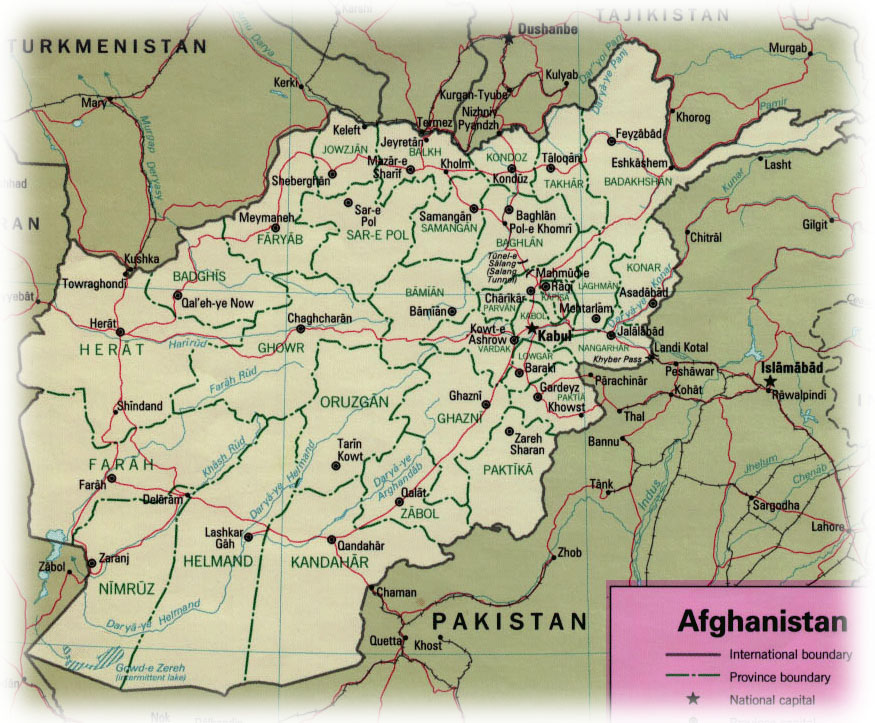
(click to enlarge maps)
Former Soviet Republics Bordering Afghanistan
Waziristan
Swat Valley
Meanwhile, Back In Babylon, Things Fall Apart; And In Pakistan, A Fundamental Deal
The first Marines went over the wall, parlez-vous. Hm. Where have we heard that before? Oh, yeah, in the "War To End All Wars," almost a hundred years ago. Think how many died believing their sacrifice might end war forever. Makes you wonder if we're not always delusional, going into a war.
You'd think, after seven years in Iraq, the scales would have fallen from our eyes. Anyone who believes that we can ever leave there without sizable portions of whatever is left of it falling into chaos, civil war and terrorism is plainly delusional. And now we're going to do the same thing in Afghanistan. Why? Because the very same generals who managed the mess in Mesopotamia are insisting upon it. And if they don't get their way, again, they're going to try to overthrow Obama in the corporate media. So, what choice does Obama have but to do their bidding? Grow a pair?
(continued)
.
.
He's pretty much doing what the new Pakistani PM is doing: Giving in to the other side. Yousuf Raza Gilani just did a deal with the Pakistan version of the Taliban to give them official control of their breakaway region on the border of Afghanistan, Shariah Law and all. (Not exactly Ladies Night in Pakistan tonight.) This region is next door to the home base of Al Qaida and much of the Afghan Taliban. So, here we are reliving the Cold War, where the worst people on both "sides" of an imaginary conflict pretty much ran the show. That put us all under "nuclear umbrellas" for almost fifty years, until the financial weight of it brought down both sides. Hmmmm.
Of course, both sides are already down, financially, in this new "drole de guerre." So, what, exactly, is going to bring about glasnost and perestroika this time? You could try asking Vladimir Putin, the ex(?)-KGB agent & FSB chief in Soviet Russia. He recently outmaneuvered the U.S. in Kyrgyzstan, bribed them to kick us out, then offered to let us use Russian territory as our sole northern access to the territory of his old buddies, the Afghans. They're probably thrilled. But why would the Rooskies want to help us build a natural gas pipeline to compete with their European lines? Are they trying to sabotage the pipe, or are we going to end up finishing the Russians' drive for a warm-water port in the Indian Ocean or the Arabian Sea for them? Cuz, you know, I think our troops deserve to know which country they're going to die for. I'm just sayin'.
EMAIL THE PRESIDENT
EMAIL THE SENATE MAJORITY LEADER
EMAIL THE SPEAKER OF THE HOUSE
EMAIL THE DEMOCRATIC PARTY CHAIRMAN
MCCLATCHY NEWSPAPERS
"Dozens of Shiite pilgrims die in resurgent violence in Iraq"
"The Surge is working! The Surge is working! The Surge is BOOOM!!!' More than three dozen Shiite Muslim pilgrims were killed Friday when a suicide bomber blew herself up at a crowded roadside tent in central Iraq , marking the first time in more than a month that a suicide bomber carried out such a deadly attack. The blast — the third straight day of intense violence — threatens to set back the security gains Iraq has made in recent months as Washington prepares to draw down U.S. troop levels. In the past three days, car bombings, political assassinations and suicide attacks — including Friday's — have claimed the lives of at least 72 people. The climb in violence comes after a stretch of relative calm following five years of sectarian warfare. Much to the relief of many Iraqis, the Jan. 31 election passed without major violence. However, the vote's pending outcome — results should be released next week — could be exacerbating tensions among rival sects and politicians. Despite a heightened security presence in Karbala and beyond, attacks on Shiite Muslim pilgrims have persisted. The attacks targeting Shiite Muslim pilgrims coincide with a spate of attacks directed at Sunni politicians and others in the north. In Mosul , a volatile city to the north where Iraqi security forces have yet to secure control, sectarian tensions between Sunni Arabs and Sunni Kurds have intensified. In the past few days, Mosul has seen a mounting death toll. Among the dead: Four policemen, one Sunni politician, one civilian, and an Iraqi soldier. And on Monday, four American soldiers and their interpreter were killed at a checkpoint when a vehicle with a makeshift explosive blew up nearby. '
AUSTRALIA.TO
"Troop Increase in Afghanistan Differs from Iraq Surge "
Permanent "surge"?' When discussing an increased troop commitment in Afghanistan, the chairman of the Joint Chiefs of Staff cautions that it won't be a carbon copy of the troop surge that proved so successful in Iraq. "I actually don't use the term 'surge,' and I don't think it's right, because the 'surge' term has an implication that it is going to go up, then come down," Navy Adm. Mike Mullen told reporters returning with him today after a two-day trip to Fort Drum, N.Y., and Ottawa. That's what happened during the troop surge in Iraq, when 33,000 additional troops began deploying in early 2007 to boost security in Baghdad and Anbar province. Violence quickly decreased, and the last of the five original surge brigades redeployed in July 2008 after a 13-month deployment. But Mullen has made no secret of the fact that he considers Afghanistan a tougher mission than the one in Iraq, and the challenges more daunting. As a result, he said there's no set timetable anticipated for the additional 20,000 to 30,000 troops Army Gen. David D. McKiernan, commander of NATO and U.S. forces in Afghanistan, has requested to improve security there, Mullen said. "I don't know how long it is the troops will be there," Mullen said. "I think we will keep troops there long enough to provide the security and sustain it at a time when we will continue to build the Afghan security forces." '
YAHOO NEWS
"First wave of U.S. troops in Afghan surge engages in combat"
Giving in to the bad guys I.' LOGAR PROVINCE, Afghanistan – Close to 3,000 American soldiers who recently arrived in Afghanistan to secure two violent provinces near Kabul have begun operations in the field and already are seeing combat, the unit's spokesman said Monday. The new troops are the first wave of an expected surge of reinforcements this year. The process began to take shape under President George Bush but has been given impetus by President Barack Obama's call for an increased focus on Afghanistan. U.S. commanders have been contemplating sending up to 30,000 more soldiers to bolster the 33,000 already here, but the new administration is expected to initially approve only a portion of that amount. White House press secretary Robert Gibbs said Monday the president would decide soon. Militant activity has spiked in Logar and Wardak over the last year as the resurgent Taliban has spread north toward Kabul from its traditional southern power base. Residents say insurgents roam wide swaths of Wardak, a mountainous province whose capital is about 35 miles from Kabul. Haight said he believes the increase of militant activity in the two provinces is not ideologically based but stems from poor Afghans being enticed into fighting by their need for money. Quoting the governor of Logar, the colonel called it an "economic war." Logar Gov. Atiqullah Ludin said at a news conference alongside Haight that U.S. troops will need to improve both security and the economic situation. "There is a gap between the people and the government," Ludin said. "Assistance in Logar is very weak, and the life of the common man has not improved." Ludin also urged that U.S. forces be careful and not act on bad intelligence to launch night raids on Afghans who turn out to be innocent. It is a common complaint from Afghan leaders. President Hamid Karzai has long pleaded with U.S. forces not to kill innocent Afghans during military operations and says he hopes to see night raids curtailed. Pointing to the value of such operations, the U.S. military said Monday that a raid in northwest Badghis province killed a feared militant leader named Ghulam Dastagir and eight other fighters. Other raids, though, have killed innocent Afghans who were only defending their village against a nighttime incursion by forces they didn't know, officials say. Haight cautioned last week that civilian casualties could increase with the presence of his 2,700 soldiers. "We understand the probability of increased civilian casualties is there because of increased U.S. forces," said the colonel, who has also commanded Special Operations task forces in Afghanistan and Iraq. '
TIME MAGAZINE
"Will Pakistan's Shari'a Pact Calm or Inflame the Tribal Regions?"
Giving in to the bad guys II.' In a desperate move to deal with an intractable radical insurgency, the Pakistan government says it will impose a form of Islamic law in the area of Swat Valley in the northwestern corner of the country. As a result, Islamabad's faltering military campaign there has been put on hold, and the militants have agreed to a tentative ceasefire. But many observers fear that, far from calming the conflict, the government has capitulated to the Islamist guerrillas and has set a worrying precedent — one that will surely displease some U.S. officials who want the government to take a harder line against militants. It is, however, a highly controversial and risky course. A previous peace deal failed within months, after giving the militants the space to regroup and sweep away earlier military gains. "It is an attempt on the part of the government to win over a section of religious extremists," says Hasan Askari-Rizvi, a military analyst. "The idea is that if they are pulled out of the struggle, they will cooperate with the government and help isolate the militants. It may have been a good idea if the Taliban were on the run, but they're well entrenched." It is unclear what Sufi Mohammed's precise role will be, or how much leverage he has in Swat. The militant leader emerged as a force in the mid-1990s, when his loyalists, sporting black turbans, seized control of buildings and courthouses before the government of then Prime Minister Benazir Bhutto was able to tame the revolt and sign a truce. In late 2001, Sufi Mohammed led thousands of young men — including Fazlullah — to Afghanistan to fight western forces who had invaded in the wake of the 9/11 attacks on the United States. Upon their return, he was arrested and imprisoned. His release last year was contingent on his disavowal of militancy and an agreement to cooperate with the government. '
MCCLATCHY NEWSPAPERS
"Is the U.S. repeating Soviet mistakes in Afghanistan?"
Those who do not remember the past...' Some Afghan experts are worried that the United States and its NATO allies are making some of the same mistakes that helped the Taliban's forerunners defeat the Soviet Union after a decade-long occupation that bled the Kremlin treasury, demoralized Moscow's military and contributed to the Soviet Union's collapse. Among the mistakes, these experts said, are relying too heavily on military force, inflicting too many civilian casualties, concentrating too much power in Kabul and tolerating pervasive government corruption. Violence and ethnic tensions will worsen, they warned, absent a rapid correction in U.S.-led strategy that improves coordination between military operations and stepped up reconstruction, job-training and local good governance programs. "We have not justified democracy. We have not justified human rights. We have not justified liberalism," said Azziz Royesh, a political activist, educator and former anti- Soviet guerrilla. "Afghans don't like the Taliban . But we haven't shown them a better option." "I see a time when again there could be thousands of unorganized insurgencies around the country," he cautioned. "The foreigners are the ones who will be targeted. If we don't bring change here, these kinds of incidents will add to the Taliban insurgency." Previously secret Soviet documents made public in English for the first time on Saturday reveal that Obama is facing some of the same problems that compelled former Soviet leader Mikhail Gorbachev to order a withdrawal from Afghanistan. The documents, posted on the George Washington University's National Security Archive Web site, show that Gorbachev decided in 1985 to end the Soviet occupation after realizing that Moscow couldn't win a military victory, a point that Obama and senior U.S. commanders repeatedly stress. '
THE CHRISTIAN SCIENCE MONITOR
"Moscow again eyes Afghanistan 20 years after retreat"
They're B-A-A-A-A-A-C-K ! ! !' "The consensus of Russian experts is that there is no winning strategy for the US and NATO in Afghanistan," says Fyodor Lukyanov, editor of Russia in Global Affairs, a top Moscow-based foreign policy journal. "Most believe that, sooner or later, Afghanistan's neighboring countries will face serious challenges from a possible revived Taliban. It means we need to work with the Americans, and find common approaches, but we need to make our own preparations, too." Last week, after receiving a $2.3 billion package of loans and aid from Moscow, Kyrgyz president Kurmanbek Bakiyev ordered the US to vacate Manas, the last of the military bases on former Soviet territory that Russia had acquiesced to following the Sept. 11, 2001, attacks. Also last week, Russia pushed its regional alliance, the six-member Collective Security Treaty Organization, to beef up its joint rapid reaction force to 10,000 men aimed at combating terrorism and drug trafficking. And next month, the Shanghai Cooperation Organization, a regional alliance led by Russia and China, will convene a special conference on Afghanistan to explore ways to strengthen the group's relations with Kabul, which could include Russian arms sales and military advice for the first time since the Soviet withdrawal, experts say. Cooperating with the US may, in the future, take a back seat to Moscow's own regional offensive, some say. "Russia urgently needs to create friendly regimes in central Asia and a strong, unified border defense," says Alexei Mukhin, director of the independent Center for Political Information in Moscow. "We're very willing to work together with NATO against our common enemy, the Taliban, but we've seen from past experience that this does not produce positive or lasting results for us. The Kremlin is certain that Russia needs to act decisively on its own" to ensure Russia's security if Afghanistan collapses again, he says. '
.
.


There's more: "THE SURGE, PART DEUX" >>